The price of any item (including residential real estate) is determined by the theory of ‘supply and demand.’ If many people are looking to buy an item and the supply of that item is limited, the price of that item increases.
The supply of homes for sale dramatically increases every spring, according to the National Association of Realtors (NAR). As an example, here is what happened to housing inventory at the beginning of 2018:
Putting your home on the market now, rather than waiting for increased competition in the spring, might make a lot of sense.
Bottom Line
Buyers in the market during the winter are truly motivated purchasers and they want to buy now. With limited inventory currently available in most markets, sellers are in a great position to negotiate.

How Does the Supply of Homes for Sale Impact Buyer Demand?
The price of any item is determined by the supply of that item, as well as the market’s demand for it. The National Association of REALTORS (NAR) surveys “over 50,000 real estate practitioners about their expectations for home sales, prices and market conditions” for their monthly REALTORS Confidence Index.
Their latest edition sheds some light on the relationship between seller traffic (supply) and buyer traffic (demand).
Buyer Demand
The map below was created after asking the question: “How would you rate buyer traffic in your area?”
The darker the blue, the stronger the demand for homes is in that area. The survey showed that in 38 out of 50 states buyer demand was slightly lower than this time last year but remains strong. Only six states had a ‘stable’ demand level.
Seller Supply
The index also asked: “How would you rate seller traffic in your area?”
As you can see from the map below, 23 states reported ‘weak’ seller traffic, 22 states and Washington D.C. reported ‘stable’ seller traffic, and 5 states reported ‘strong’ seller traffic. This means there are far fewer homes on the market than what is needed to satisfy the buyers who are out looking for homes.
Bottom Line
Looking at the maps above, it is not hard to see why prices are appreciating in many areas of the country. Until the supply of homes for sale starts to meet buyer demand, prices will continue to increase. If you are debating listing your home for sale, let’s get together so I can help you capitalize on the demand in the market now!
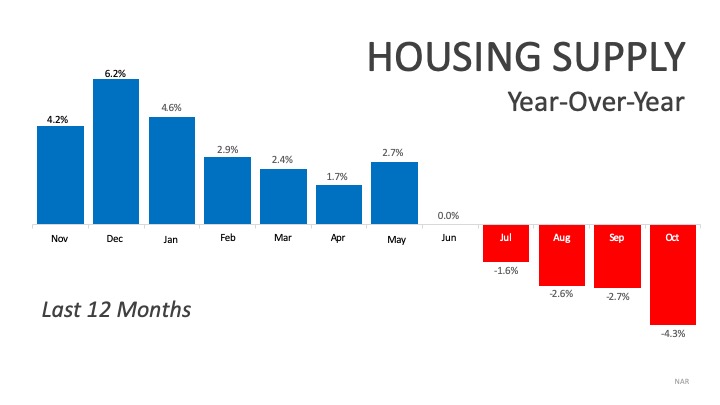
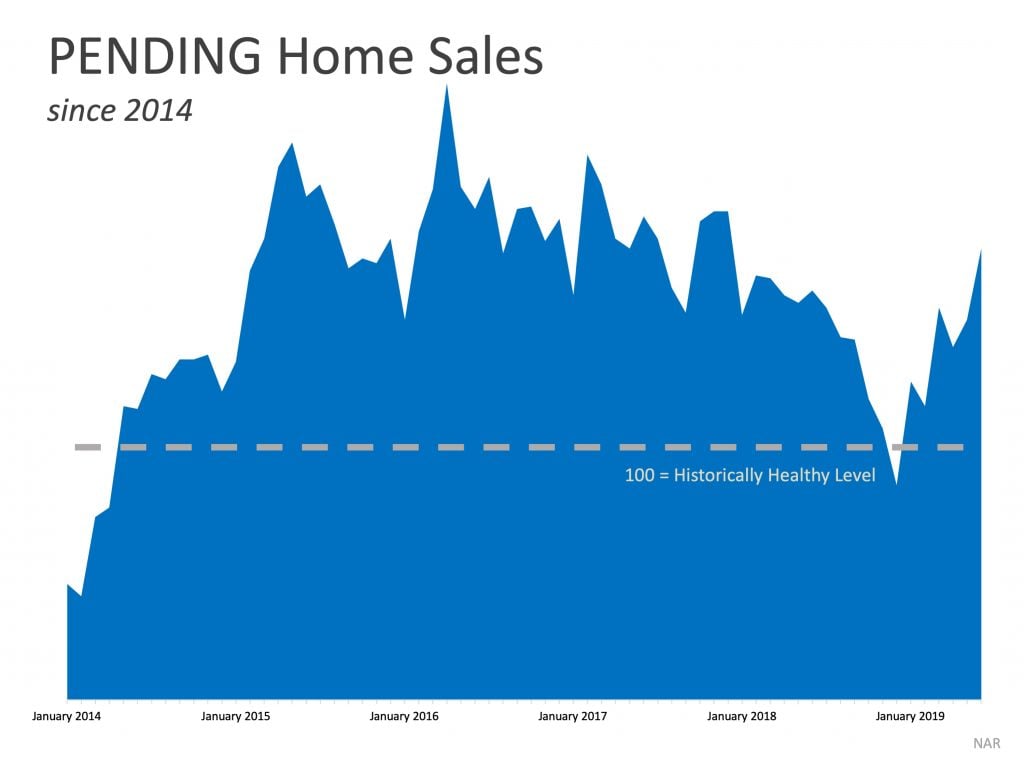
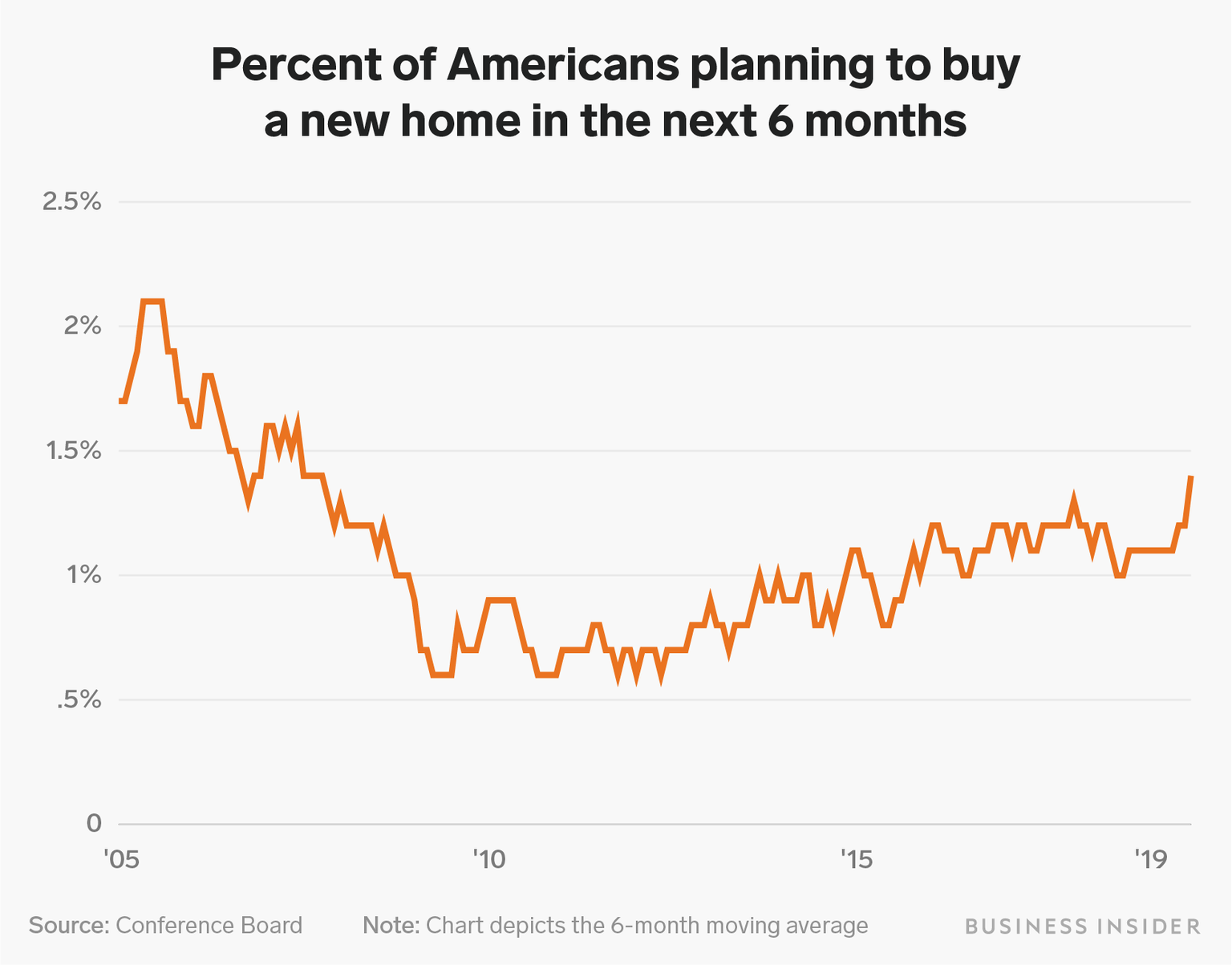
You may have heard that the housing market is softening. There is no doubt that buyer traffic has decreased. There are fewer purchasers in the market than there were last month and at this time last year. What you may not have heard, however, is that there is still a severe shortage of listing inventory in many regions of the country.
In a recent interview discussing the housing market, First American’s Chief Economist Mark Fleming put it simply:
“The biggest challenge is really the availability of supply.”
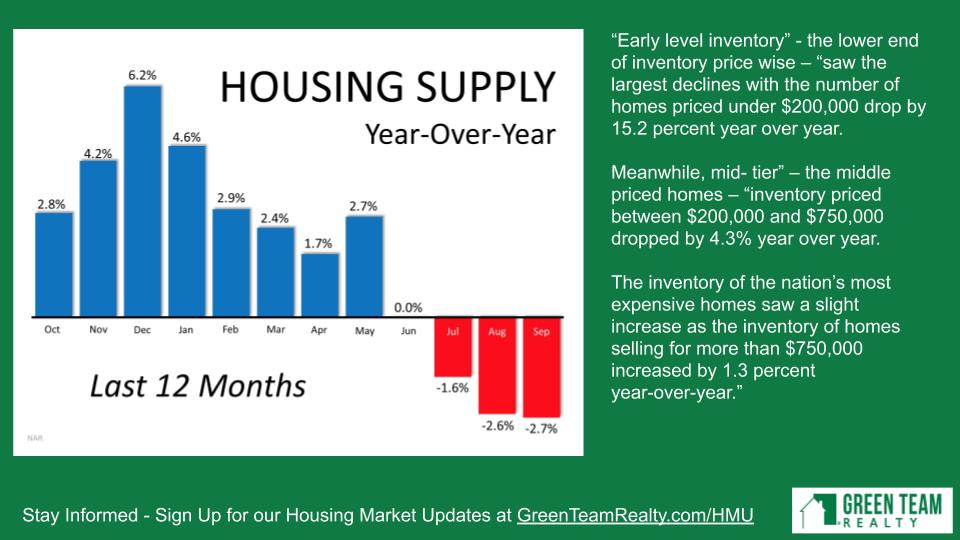
When we look at available inventory numbers released by the National Association of Realtors (NAR), we see that the actual number of homes for sale has decreased in each of the last five months.
What does this mean to you as a seller?
The best time to sell is when there is less competition. That guarantees you a better price and fewer hassles in the transaction.
Bottom Line
If you are thinking of selling your house this year, the best time to put it on the market might be right now. Let’s get together to evaluate the demand for your house in our market!
Start by finding out what your home is worth, use our quick and free Home Evaluation tool.
The Green Team’s December 2018 Housing Market Update was held on Facebook Live Tuesday, December 11 at 2 p.m. If you were unable to view the webinar live, you can watch it at your convenience here. You can also sign up for future updates at GreenTeamHQ.com/hmu.
This month’s panelists…
Geoffrey Green is the President/Broker of Green Team Home Selling System. In addition to moderating the monthly webinars, Geoff also presents national statistics as well as local updates for Orange County, NY and Sussex County, NJ. This month he is joined by regular panelist Keren Goren, and by Joyce Rogers, both from Green Team New Jersey Realty.
The National Outlook
Will home prices continue to appreciate through 2019?
Overall sentiment is that the housing market seems to be cooling off, so now we’re at the prediction stage, trying to foresee what will happen next. Per the graphic, 99% of the 105 economists, market analysts and real estate experts consulted felt that home prices will continue to appreciate through 2019. However, that does not mean that the market won’t continue to slow; it means that the rate of appreciation will continue on a positive note. Most agree that it will continue to appreciate at a lesser value in the coming year.
Will there be a sharp turn in the housing market?
Geoff Green finds this quote to be of great importance. Nobel Price Winner Robert Shiller is one of the thought leaders of real estate analytics. Compared to where we were in 2008, where almost 50% of transactions just went away within a two year period of time, and where we are now, Shiller doesn’t expect a sharp turn. This point of view coincides with Geoff’s observation’s over the last several months.
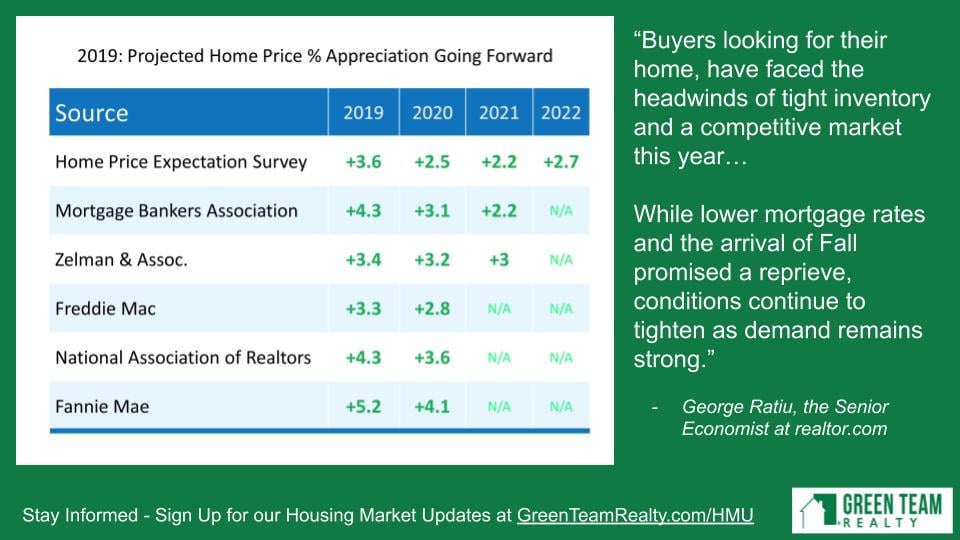
Looking forward – Predictions of the experts on home appreciation growth over the next 3-5 years
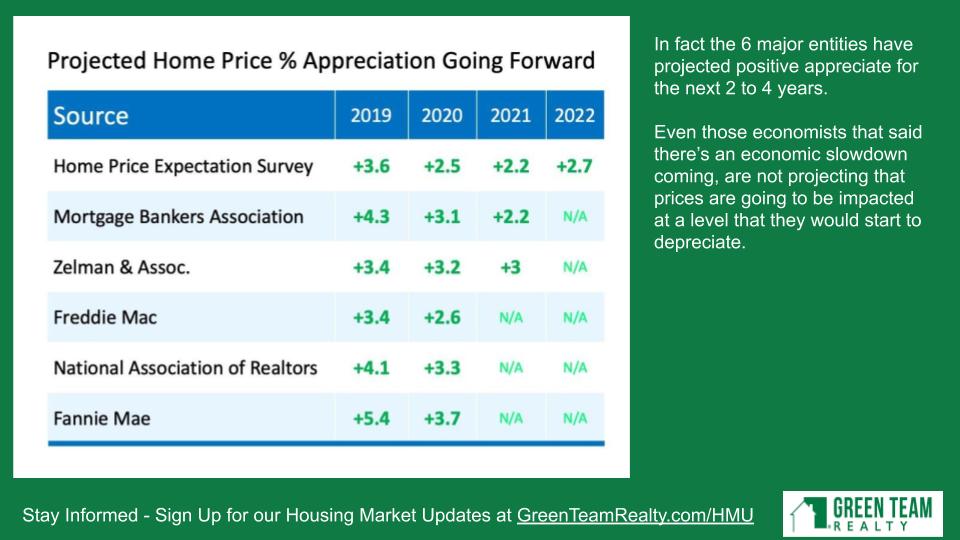
This chart has been updated from November to include predictions of where things are headed in the future. Some of the larger organizations that provide information to the industry are showing a slow turn to the downside. And, important to note, there are no numbers indicating a reduction in price.
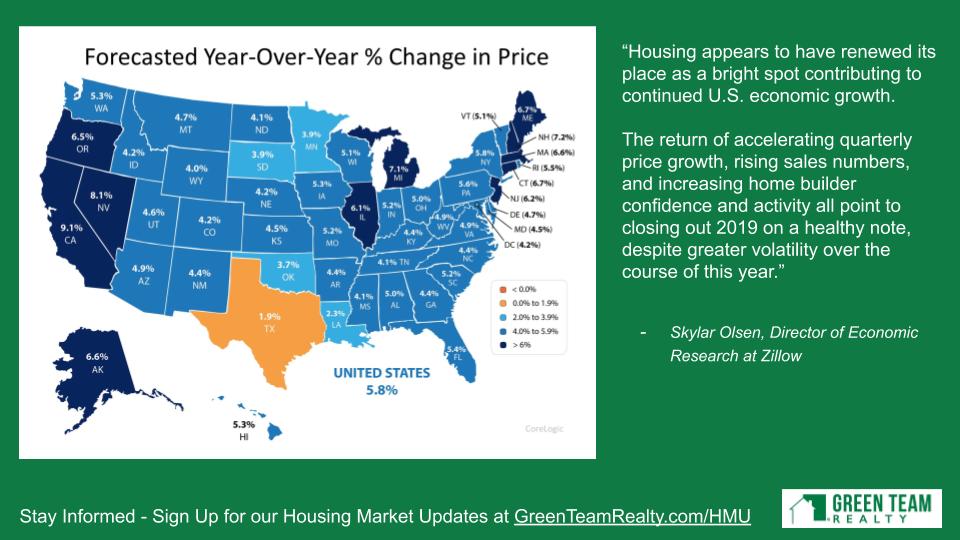
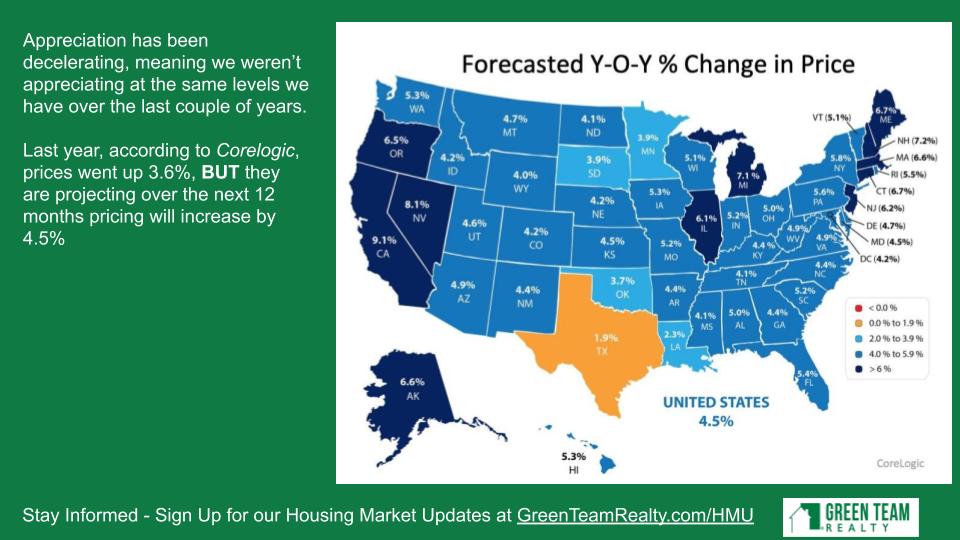
Corelogic’s State by State forecasted changes in price
Price appreciation most often happens in the south and on the coast, where many people tend to move as they get older. No projections are in the red for any state. Historically speaking, most of the country is looking at a very substantial increase in terms of price. The numbers are solid, and if this trend continues through 2019, it will be a very good year.
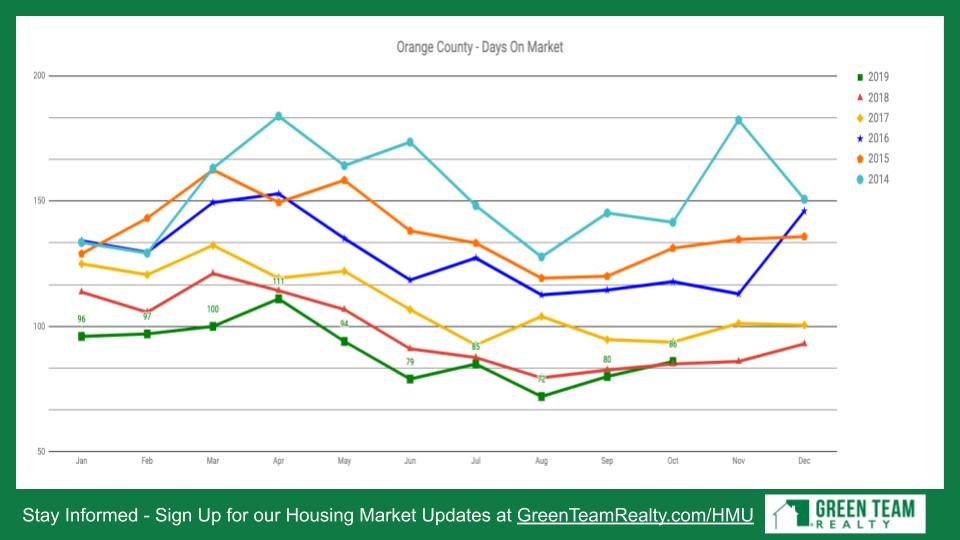
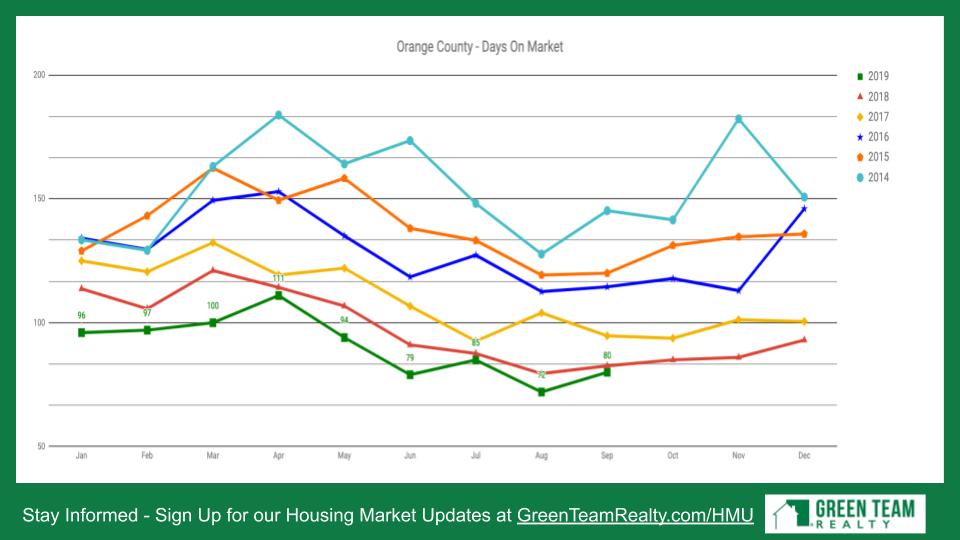
December 2018 Housing Market Update – Orange County
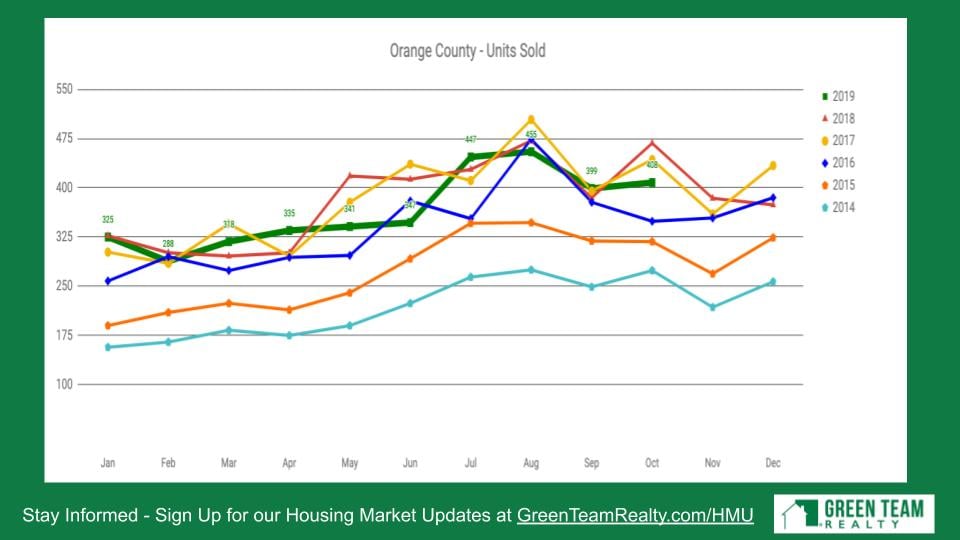
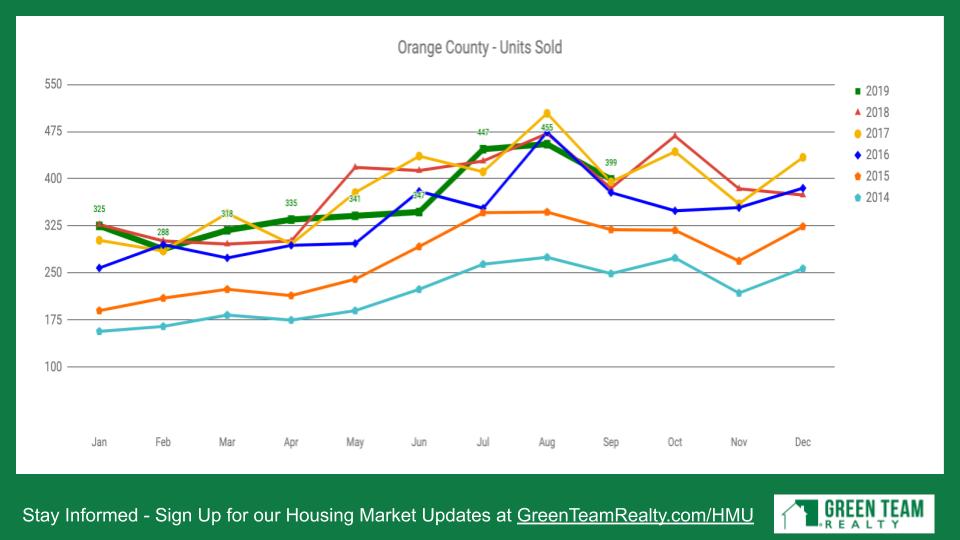
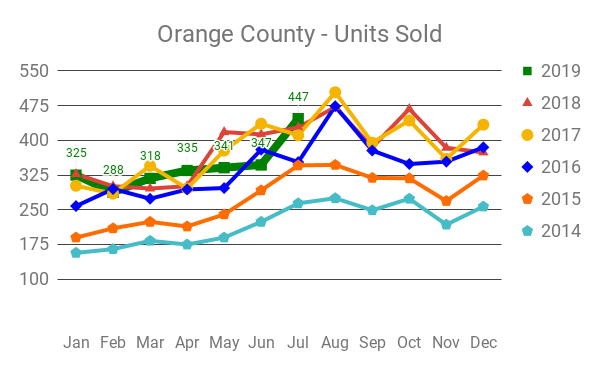
Units Sold
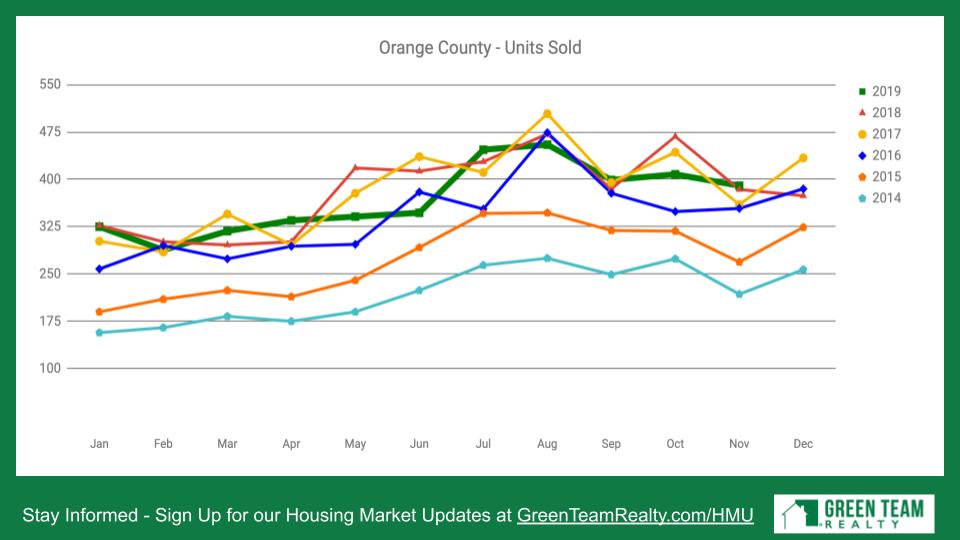
The red line representing 2018 shows there is not too much of a variance between this year and last year.
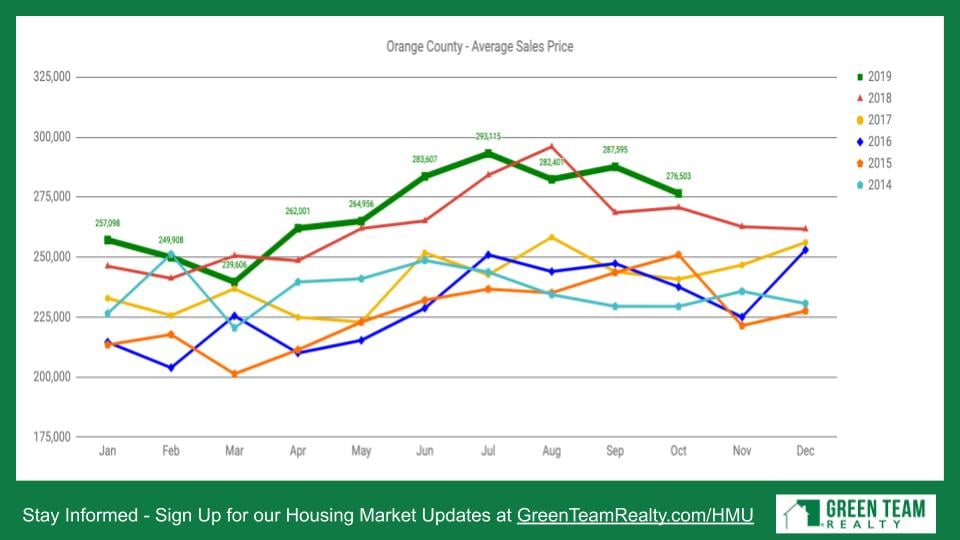
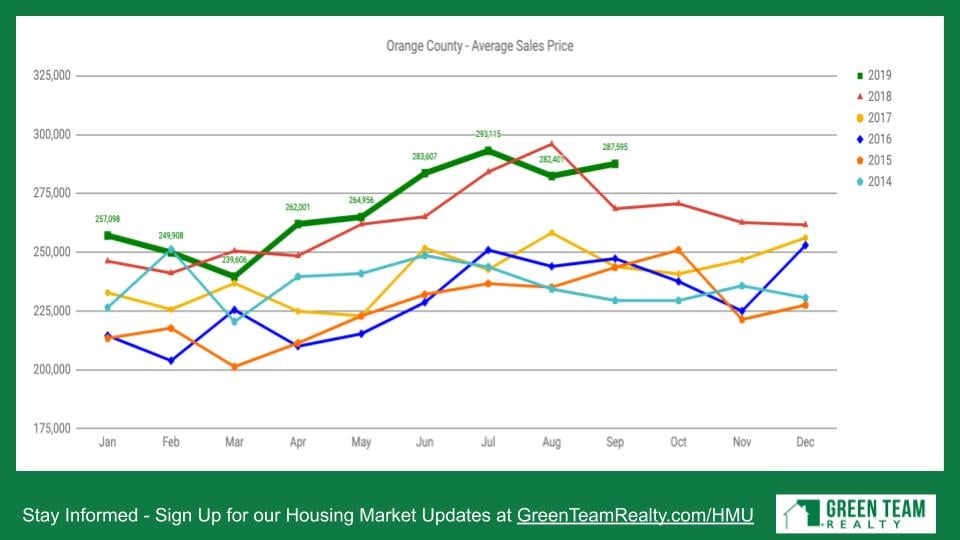
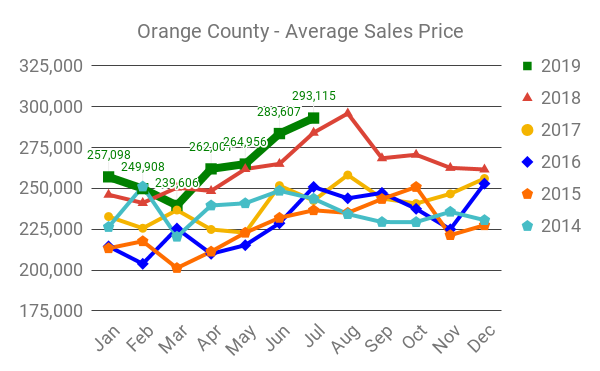
Average Price
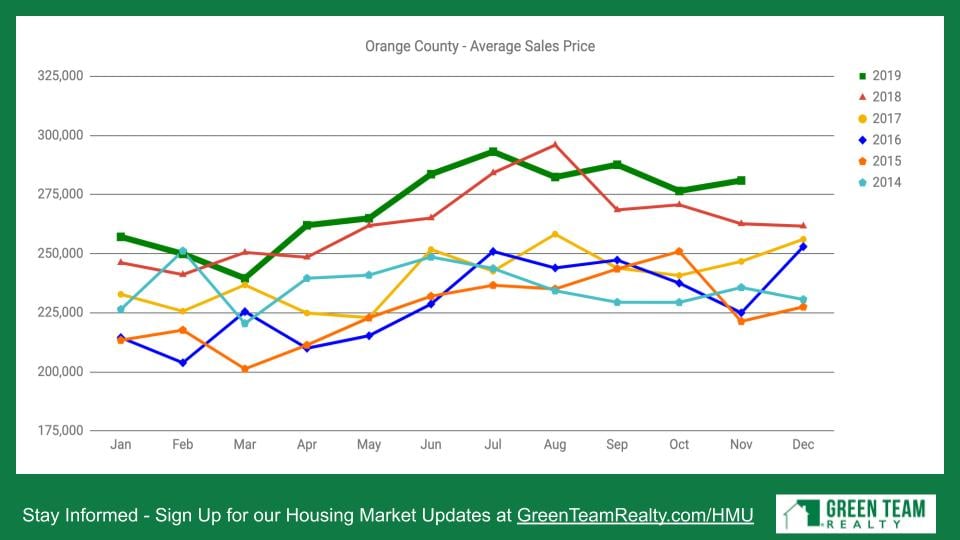
Prices spiked during the summer and have been simmering down, coming a little closer to 2017’s numbers.
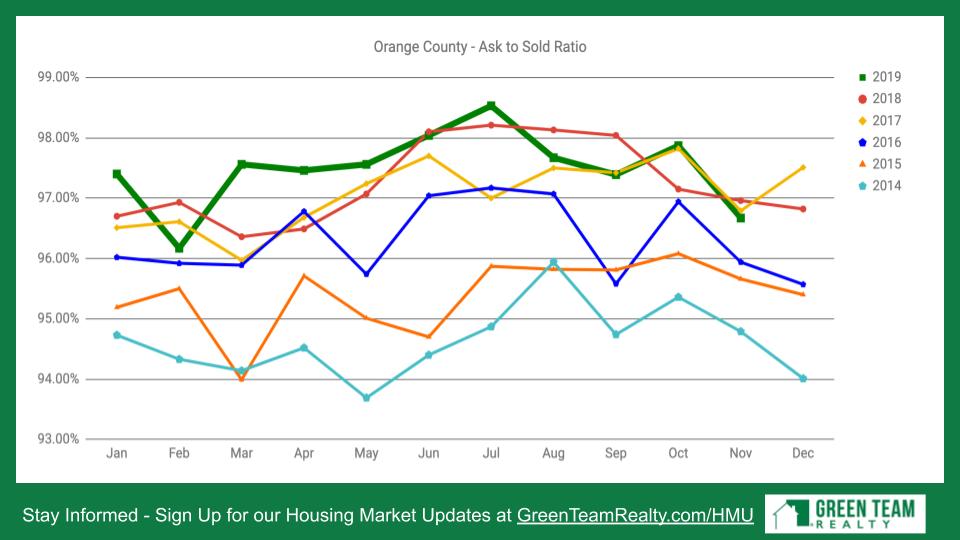
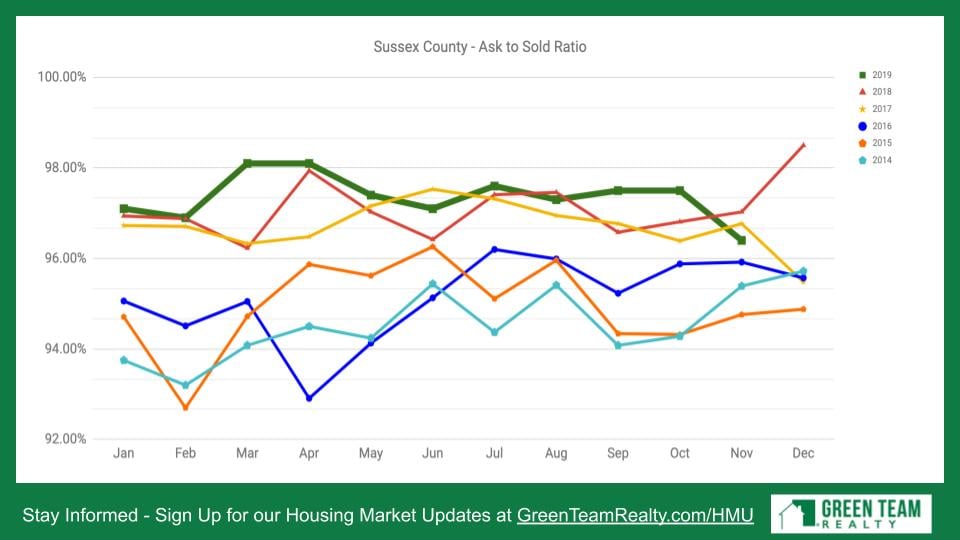
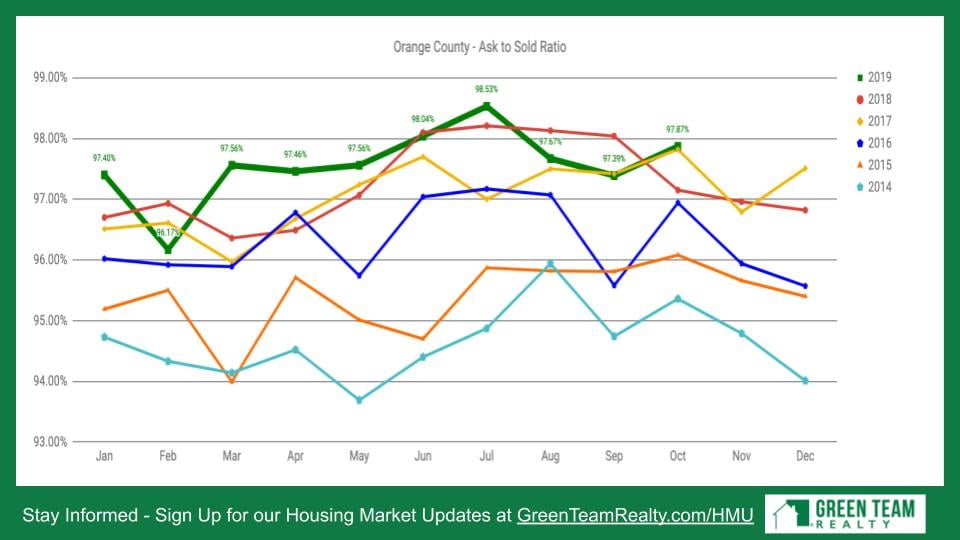
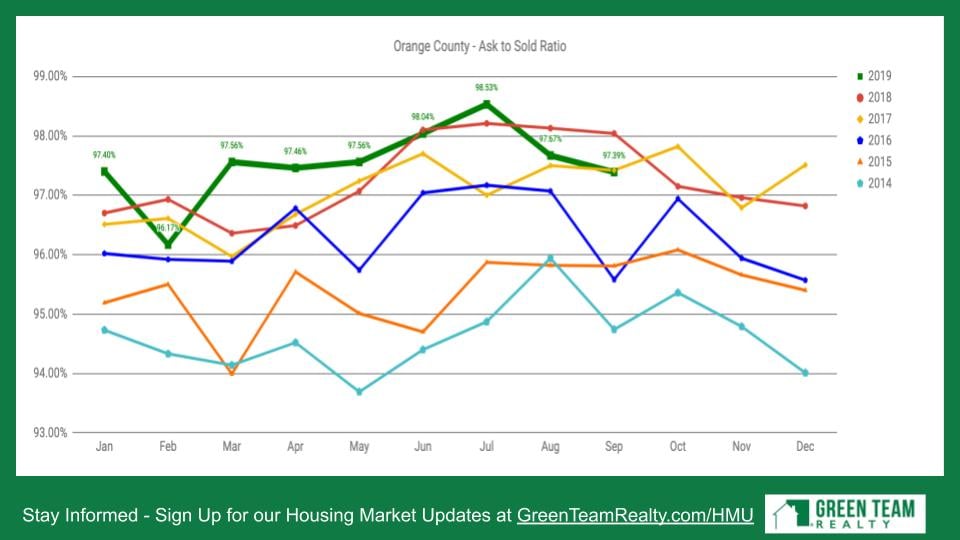
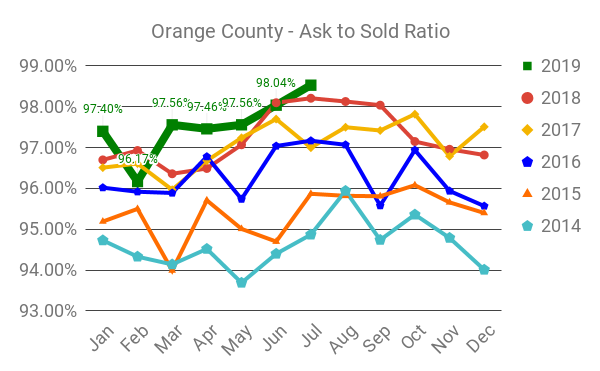
Average Sold to Asked Ratio
This number shows the price the home sold for versus the last asking price. The higher the number, the hotter the market. This is a mixed bag result from 2018 over 2017.
The Green Team’s November 2018 Housing Market Update was held live on Facebook Tuesday, November 13 at 2 p.m. If you missed the live webinar, you can view it at your convenience by clicking here.
Geoffrey Green , President/Broker of Green Team Home Selling System, moderates the monthly webinar and presents the national stats, as well as the market updates for Orange and Sussex Counties. This month he is joined by Pam Zachowski and Keren Goren of Green Team New Jersey Realty and Vikki Garby, Green Team Home Selling System, Warwick.
Joe Moschella, Branch Manager and Vice President of Lending, and Amy Green, Vice President of Lending, of Guaranteed Rate discuss market updates from a mortgage industry perspective.
The National Outlook
According to Geoff Green, it’s a very exciting time in the housing market right now as we’re starting to see some shifts. We’re experiencing all-time highs reminiscent of 2008 over the last 18 months. It does seem like things are cooling off. According to Michael Fratantoni, Chief Economist of the Mortgage Bankers Association, he expects that home sales growth will pick up again over the next year, even with somewhat higher mortgage rates, though the pace of price growth will likely slow.
Despite the fact that national and local numbers indicate that the velocity of homes selling is actually slowing, Fratantoni and some others are predicting that it is going to increase in 2018. So, it’s not that appreciation is going down, it’s just slowing down.
The Mortgage Bankers Association, National Association of Realtors, and Freddie Mac, with the exception of Fannie Mae, all are predicting increases over the past two years. All are predicting increases over the past year. For the most part each of these organizations wants the housing market to continue to grow. Geoff reminds us that it’s in their best interest. It’s important to be aware of the source of information. During the downturn In 2006, 2007 and 2008, during the downturn, some organizations were putting out information that did not accurately portray what was happening. However, you can rely on the Green Team to put out information that is accurate and honest.
In projections for 2018 through 2022, everyone seems to have a positive outlook that the market will continue to appreciate. Just at a slower pace.
November 2018 Housing Market Update – Orange County
Units Sold
While this is hyper local, it is reflective of the 2018 national numbers. While prices may increase and decrease, depending on inventory, units sold have been a mixed bag this year versus last year. It’s been up, it’s been down.
Average Price
Geoff has found that price always lags activity, according to his observations over the past 14 years. If you start to see a slowdown in activity, 6 to 8 months later you’ll start to see a slowdown in the rate of price increases.
Sold to Asked Ratio
This is telling you at what percent of the asking price your home is selling for. The closer you are to 100%, the hotter the market. While this took a little dip recently, it is still at very high levels.
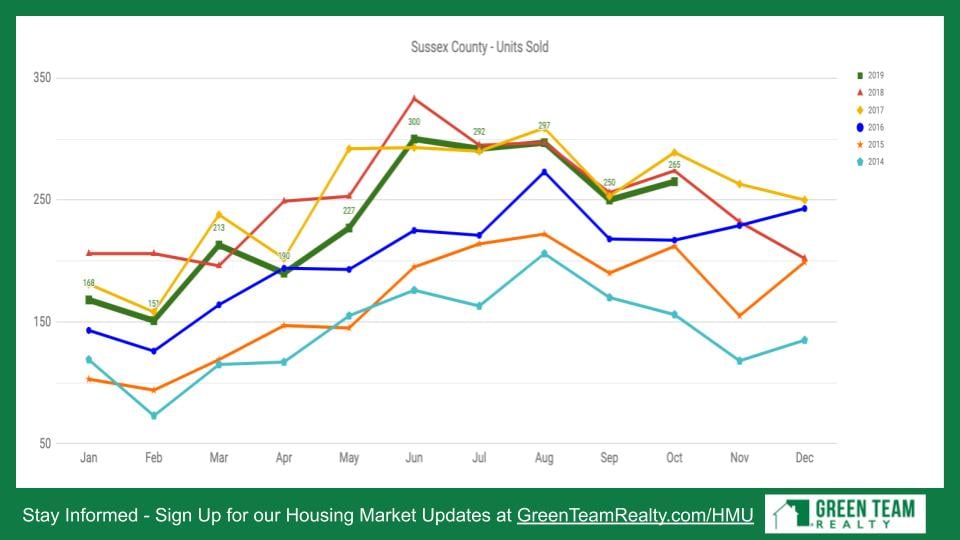
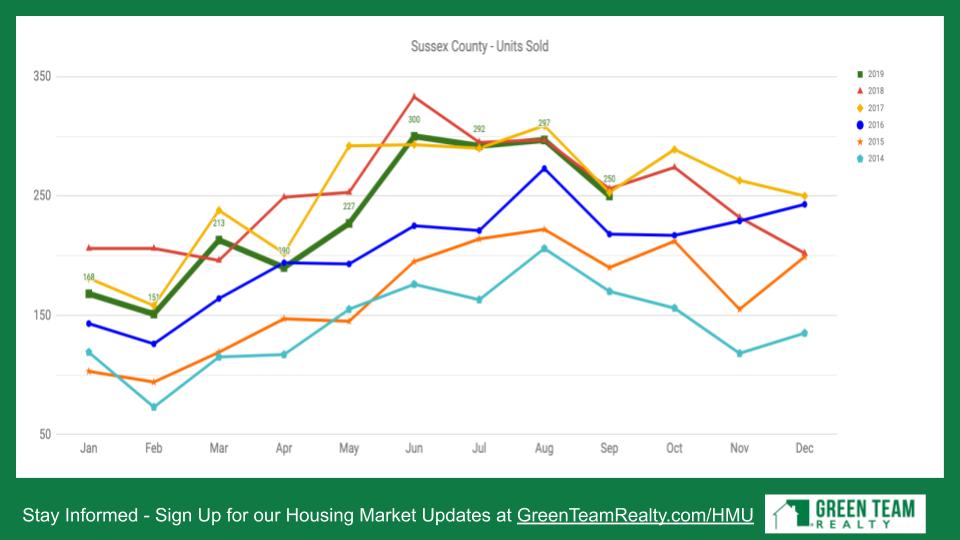
November 2018 Housing Market Update – Sussex County
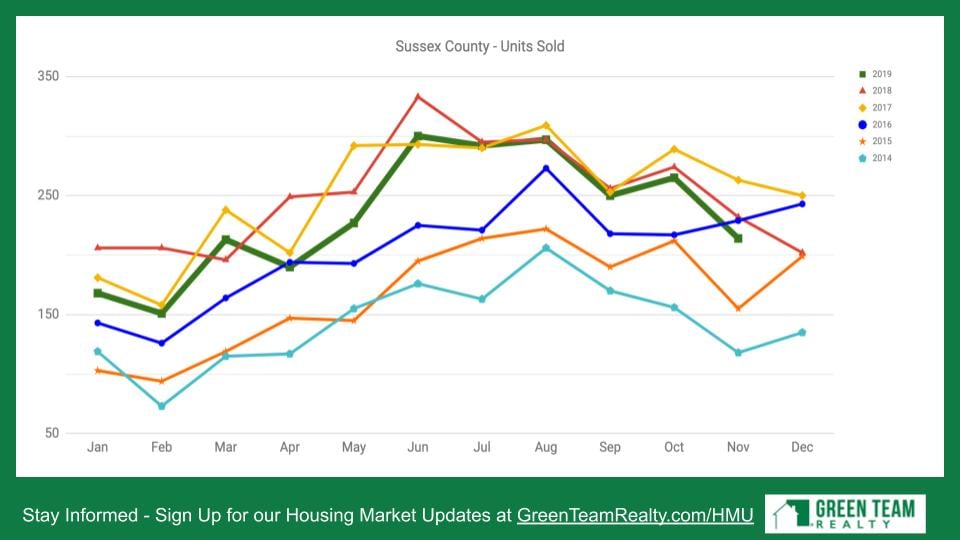
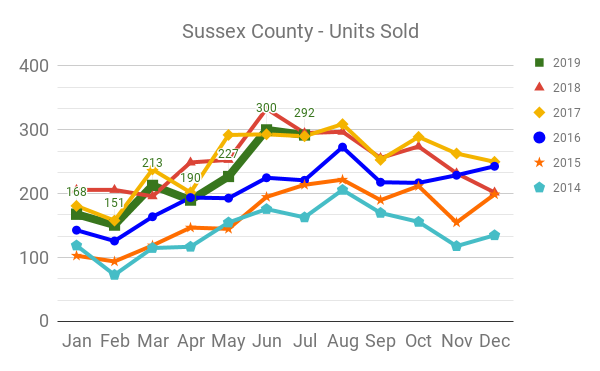
Units Sold
This is a small data sample that is still reflective of what is happening nationally. Again, it’s a mixed bag, up, down, then often flat.
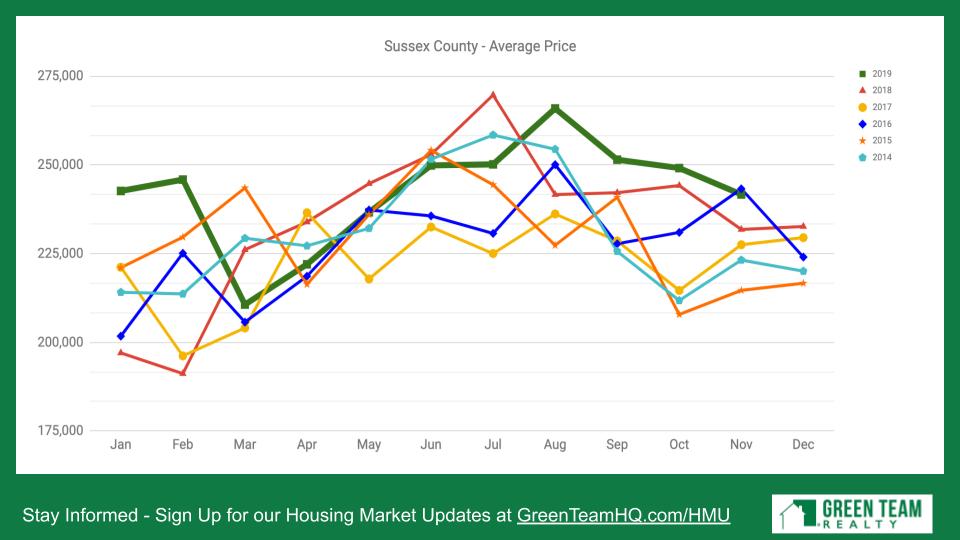
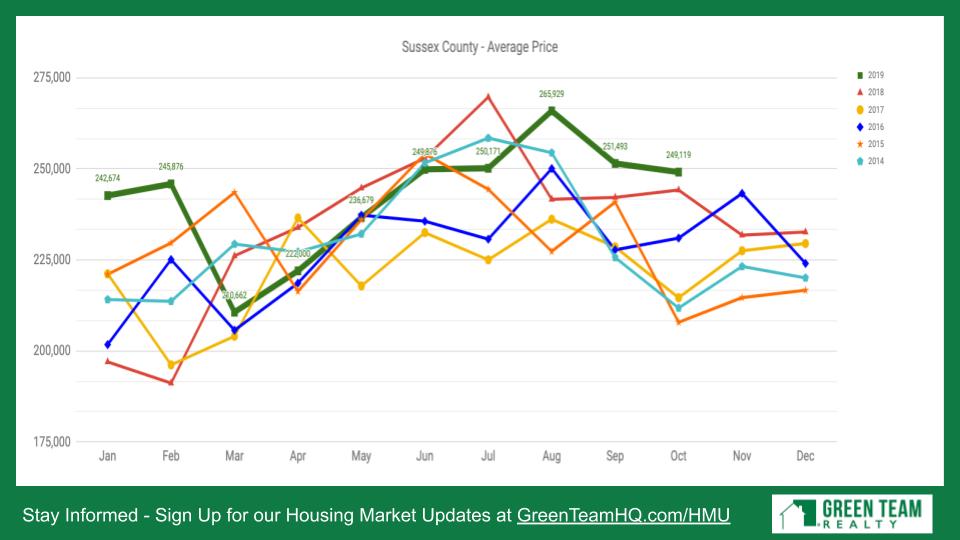
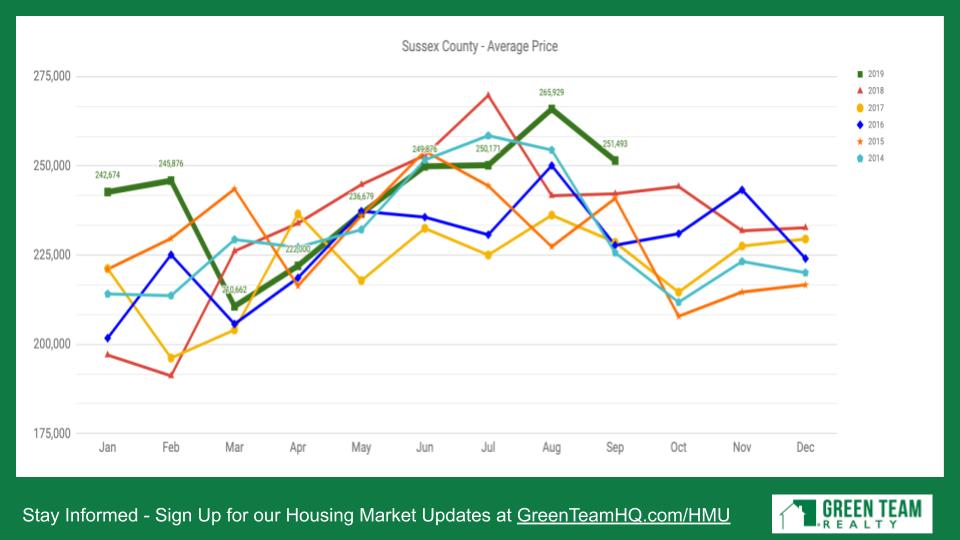
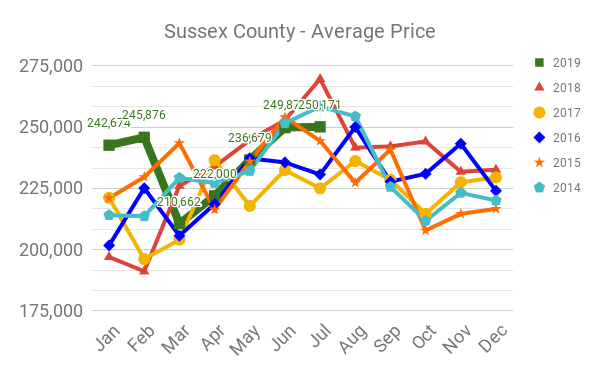
Average Price
Average price never really gained a tremendous amount of traction, as compared to Orange County, where there had been increases in price.
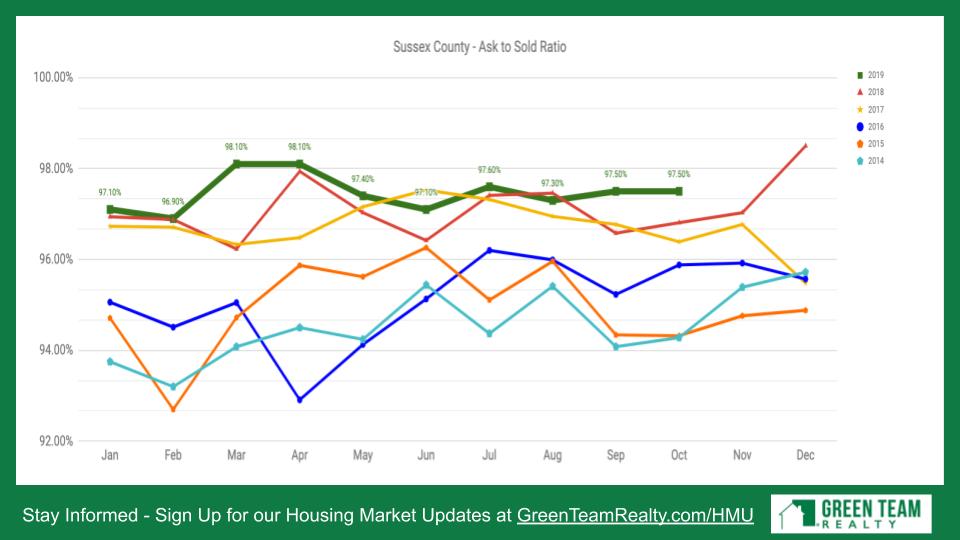
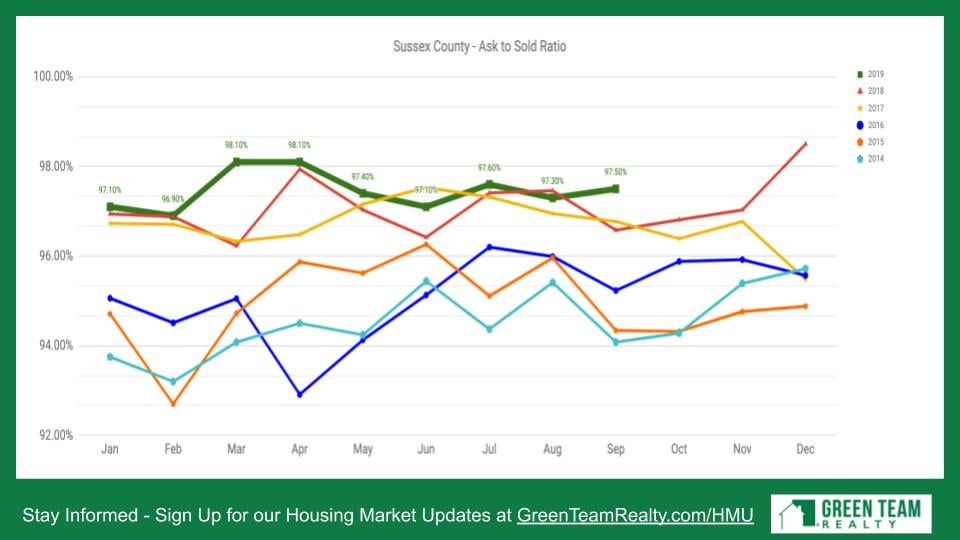
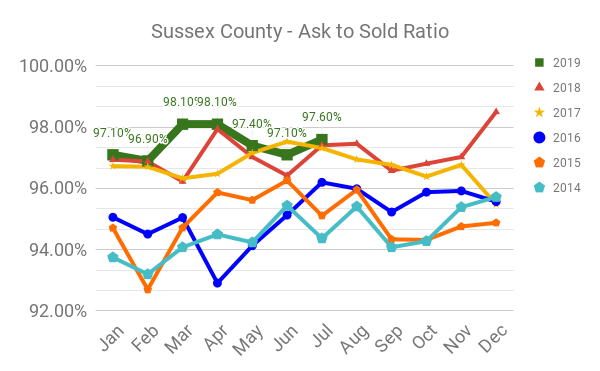
Sold to Asked Ratio
This looks similar to what is happening in Orange County.
Panel Discussion
The Sales Associates Points of View
Geoff asked Vikki what changes she’s seen since she was last on the panel about 4 months ago… Vikki agreed that she has been seeing a little bit of a slowdown, part of which she believes is due to timing. Many families time their house hunting to coincide with the start of school. However, what she’s finding is a lot of people are looking for land. Historically, we’ve had low inventory compared to the number of buyers, And, as existing house prices go up, more people are starting to consider new construction. Housing starts will be up 9% beginning of the coming year. So there is still a lack of inventory.
Pam also sees a slowdown. More people are looking for homes, but between the low inventory, the start of the school year, people are taking their time. She still sees investors trying to buy and flip homes but finding it harder and harder to find that good deal that makes it worthwhile.
Geoff then asked about appraisals. Are there issues with properties appraising, or are there now enough comps in the marketplace? Keren has not seen any problems recently. They’re all coming in at asking and a little bit above. One thing she has noticed is Sellers asking for CMA’s or listing presentations, more than she had over the summer. Keren always advises clients that we only know what the market is right now and can’t tell where it’s going. She lets them know that low inventory makes it a good time to put their home on the market, as opposed to waiting for Spring, Geoff replied that sellers that were holding off putting their home on the market may now decide to take a chance, seeing that the market is cooling off a little. This may ultimately bring more inventory and more transactions to the marketplace as a whole. There are still many buyers out there, anxious to find a home.
A Mortgage Industry Point of View
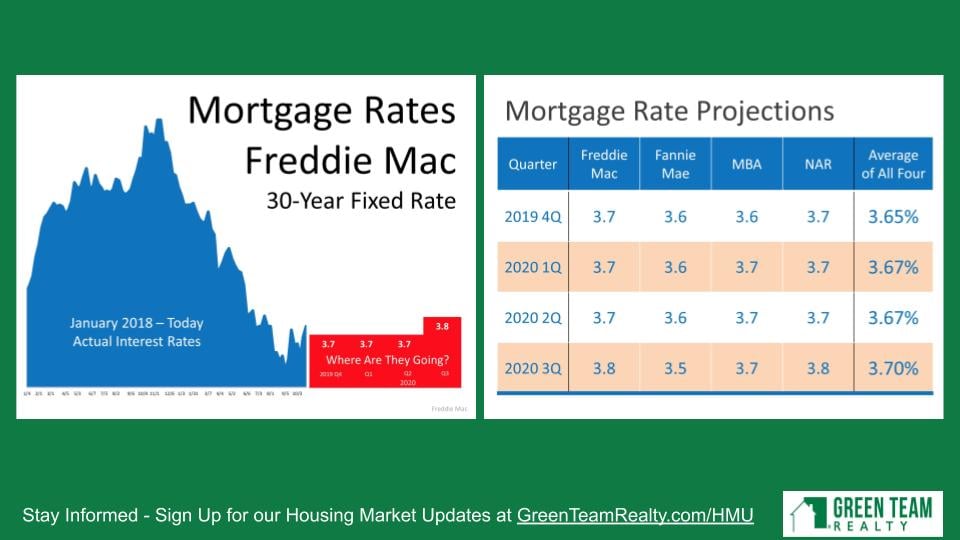
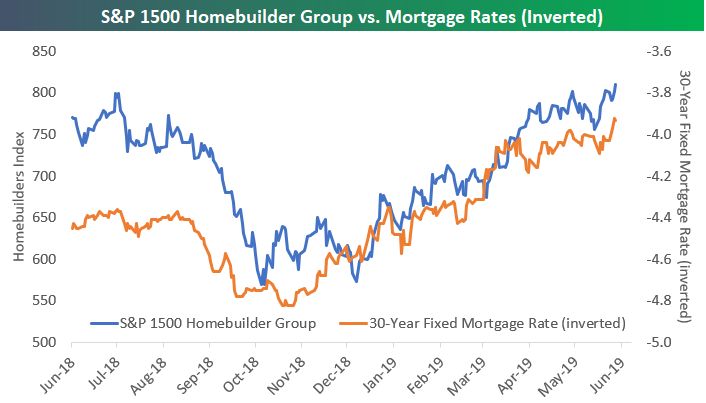
According to Joe Moschella, over the last 5 months they’ve seen a steady rise in interest rates. The year started with a 10-year treasury note at 2.21% and this week it was 3.21%, one full percent. That, along with the Fed stopping its purchasing of mortgage-backed securities, caused a liquidity crunch in the market. This contributed to pushing rates up. They started the year with 4% on a 30-year fixed rate and are now closing in on 5%.
Geoff asked Joe what the bond market was like 4 years ago on a percentage basis, just to give some perspective. Joe brings it back to 9/11, when the Fed didn’t want to see the economy spiral down. They jumped in and started dramatically dropping rates, bringing them down to almost zero. Now we’re seeing the unwinding of these artificially low rates. Thankfully the Fed eased into this, providing a “soft landing.” 2.21 to 3.2% represented about ¾ of a percent, interest rate wise. About 2, 2-1/2 years ago we were at 1.2% on the US Treasury. Before that, we were at the 0.7, 0.8% range. We’ve seen a steady rise, which hopefully the economy is strong enough to handle.
Some of the other changes in the market on the mortgage front are in the role technology is playing. Lenders are able to verify client’s income and assets automatically, do the application online and do the process without sending any paperwork back and forth. The whole process is done digitally.This is revolutionizing the industry and leading to higher consumer satisfaction. The industry is also easing credit standards. Geoff asked if easing credit standards was necessarily a good thing. Joe responded that rising rates have opened the door for new loan products to come out. Those new products are not coming from the banks, but rather from private equity firms flowing back into the market. No verification loans do not exist, but they have a bank statement loan that has come back into play. No seasoning waiting period for someone who had a foreclosure or bankruptcy or short sale, whereas before you had to wait three, four or seven years. Geoff stated that if you’re talking about private equity, they basically can do whatever they want with their money, as long as those products don’t make it into mortgage-backed securities. He asked if there were any controls in place to make sure that didn’t happen again. The trade-off with non-conforming products is that the buyer has to have some “skin in the game.” They need a sizeable down payment, and investors want higher return for higher risk, so rates may be at the 6-1/2% range.
Geoff said it’s important to keep things in perspective. The sky won’t be falling if rates hit 6-1/2%! Historically, it’s a pretty average rate.
Joe and Amy had a graph showing 10-year treasury yield minus 2-year treasury yield. Historically when those yields come together, it signals a slowdown in the market or a recession. From Joe’s perspective, we might have a slow down in the stock market and see a pull back, but he’d rather see a market that goes up and goes down. In a stale market buyers and sellers are sitting on the fence; there is no call to action. As far as housing goes, everyone can do well and make some money.
Geoff thinks there is enough pent up demand from 2008 to 2016; there are a lot of people who need to buy a home and rates are still low enough. The American housing market is the place to be in the Global real estate market. There may be a continued cooling off and slow down a little. We’ve been at such high levels right now, it had to. Like the stock market, it can’t keep going up indefinitely; at some point it has to come down.
Thanksgiving. It’s a time of gratitude, friends and family; of turkey and all the trimmings. And at the Green Team, it’s a time to let clients know how much they are valued. The Client Appreciation Program, or CAP, is the cornerstone of the Green Team’s foundation. The Green Team doesn’t take its clients for granted. Through the CAP program sales associates find ways to say “I appreciate you” throughout the year. However, one of the highlights of the program is Thanksgiving Pie. A Green Team CAP tradition, clients are invited to come to the office for a casual party. And to pick up their Thanksgiving pie. Because this gift from their sales associate is a way of saying “Thank You.” Thank you for your business, your referrals, and your friendship.
Thanksgiving Pie… A “family” event for both the Warwick and Vernon Offices
Walking into either office you can feel the warmth and joy and know that you are welcome. Pies are stacked high, waiting to be distributed. Being a local brokerage, it’s important to the Green Team to support other local businesses. Thus Noble Pies has become part of the tradition. Their pies are baked from locally sourced ingredients when available. Cider, wine, donuts and more await the clients as they drop in to pick up their pies. And, of course, there is laughter; lots of laughter!
Green Team Sales Associates agree that the Client Appreciation Program is something they themselves appreciate. It keeps the focus on the people who are most important to their businesses: their clients. And events like this one bring everyone together, strengthening bonds between associates and between clients and associates. Probably one of the best things is that two days later pies from the Green Team’s sales associates will be sweetening Thanksgiving Dinners at many homes. Again letting clients know how much they are appreciated.
The Green Team’s October 2018 Housing Market Update was held live on Facebook Tuesday, October 16 at 2 p.m. If you missed the live webinar, you can view it at your convenience by clicking here.
Meet this month’s Panelists from Green Team New Jersey Realty and Green Team Home Selling System
Geoffrey Green, President/Broker of Green Team Home Selling System, is the moderator of the monthly webinar and presents stats and market updates for Orange and Sussex County. He is joined this month by Keren Gonen, Pamela Zachowski and Alison Miller of Green Team New Jersey Realty in Vernon and Jacqueline Kraszewski of Green Team Home Selling System in Warwick.
Market Update – The National Perspective
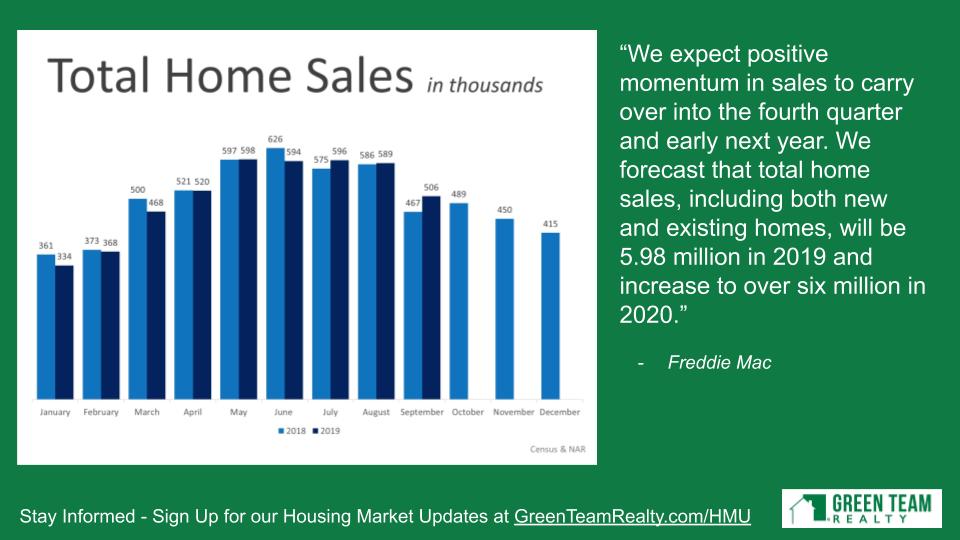
A look at Total Home Sales Nationally
Things seem to be shifting in the housing market. For Geoff, the stats of homes sold are the “mother’s milk” of the industry. Nationally it’s been a mixed bag through 2018. September’s numbers are not yet in, but August numbers for total home sales were just about even for 2017 and 2018. It appears that things are shifting in the market, with the number of sales not increasing like last year, year over year. However, foot traffic in August was much higher in 2018 than in the same period in 2017.
Buying versus Renting…Which is the best way to go?
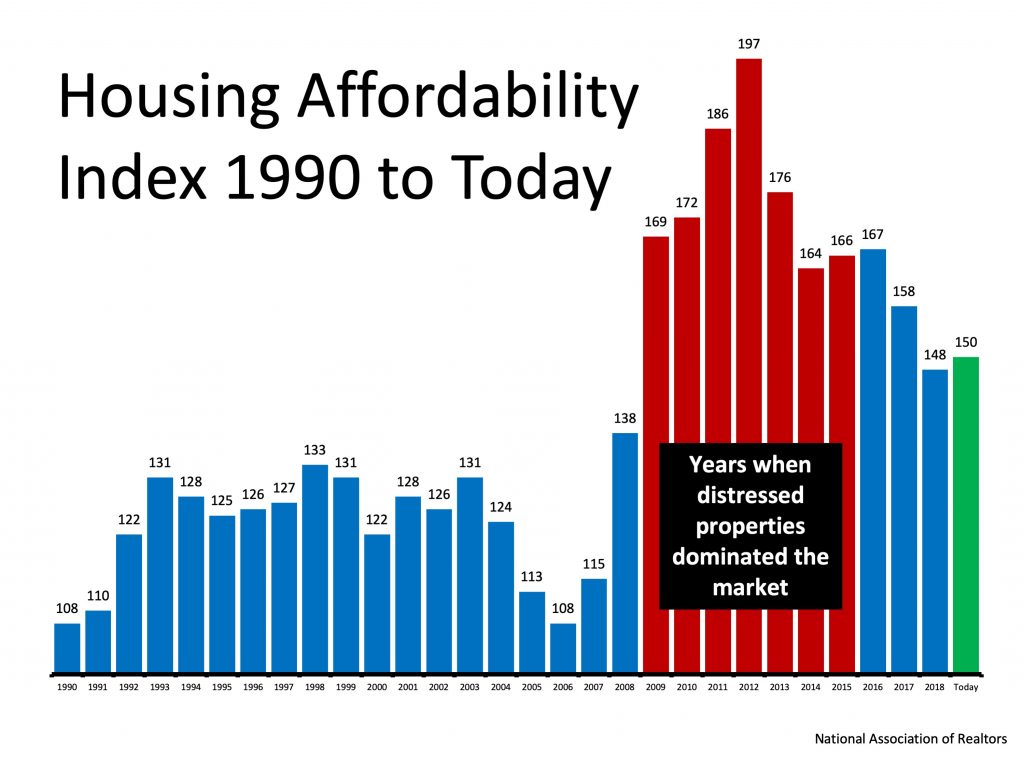
Lawrence Yun, the economist of NAR, has said that we’ll probably see growth in terms of the housing market on the lower end because the job market is strong. People are working, making money and want to invest their money in real estate. However, there may be a slowdown in the higher end because interest rates are rising. How does affordability of renting compare with buying? There is a steep curve, not a good outlook for renters. Since 2013 it has been cheaper to buy instead of rent on an overall national basis. If you have the ability, it costs less to buy than to rent on an overall monthly basis.
October 2018 Housing Market Update – Orange County
Units Sold
As stated before, Geoff sees this number as the mother’s milk of the housing market. This all-important number gives us a snapshot of how many homes are selling. The number of units sold in Orange County appears to be cooling off. He believes we’ve seen the peak of the last runoff and that it’s behind us. Geoff’s view seems to be backed up by an article that appeared last week in the Wall Street Journal, which referred to a soft downturn in the market.
Average Price
There is a big variance in price from where we were last year. The downward trend is a seasonal fluctuation and not a cause for concern. Price always lags units sold at least 6 months or more. Price increases may occur over the next 6 to 12 months, even though the number of units sold is dropping.
Average Sold to Asked Ratio
We are still pretty high, still over 98%, which means sellers are only having to negotiate 2% from their asking price.
October 2018 Housing Market Update – Sussex County
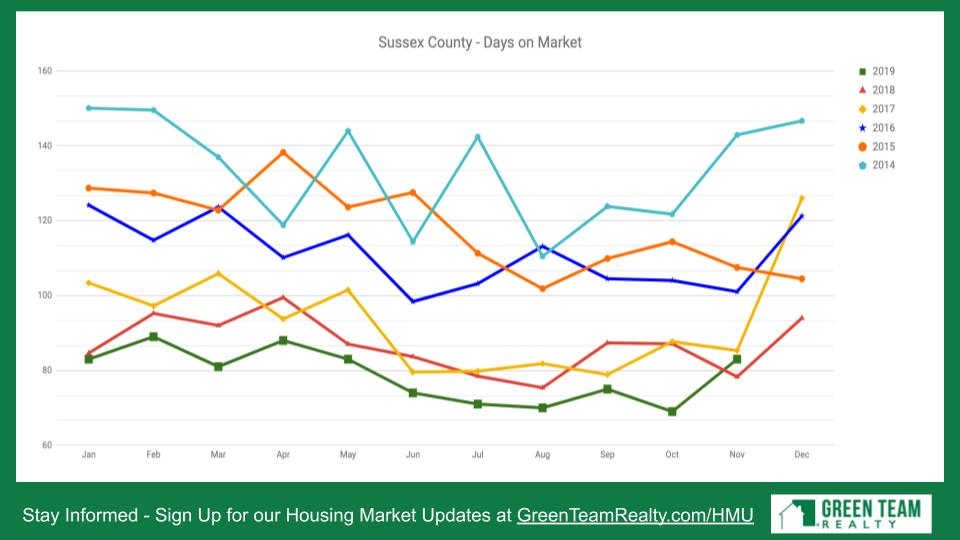
Units Sold
A similar trend to Orange County, where some months are up, some down, on a year over year basis. It’s a mixed bag, and the numbers seem to indicate a cooling off.
Average Price
Average prices never rocketed in Sussex as they did in Orange County. In previous updates, we’ve spoken about how there is simply more foreclosure inventory and activity which has dragged down the average. However, that doesn’t mean that homes that are well maintained and well located haven’t done well.
Average Sold to Asked Ratio
Average price never rocketed here like it did in Orange County. There has been much more foreclosure inventory and activity in Sussex and that has dragged down the average home price. However, that doesn’t mean that well-located, well-maintained homes haven’t done well.
Slightly below Orange County, the numbers are still hovering around 98%.
Panel Discussion
The Sales Associates Point of View
Geoff believes the market is cooling. He asked the panelists what they were sensing in the field. Keren replied that there are fewer houses that are updated and nicely done, and buyers have higher expectations. During the summer, people were rushing to find homes in order to get situated before the start of the school year. Without that added stress, many buyers are being pickier. Alison finds that people are looking for something that is just not there. Inventory is not meeting the demand. In addition, many of her closings were delayed, affecting numbers for September.
Jacque is finding that there is a lack of finished, move-in-ready homes under the $400,000 price point in Warwick. In addition, many families with school-aged children are waiting for the spring to resume their search. Also, the seasonal fluctuation impacts the market as people are beginning their holiday preparations. Pam is also seeing the issues mentioned by the other sales associates. The inventory shortage, buyers being very picky, even homes that have been flipped that aren’t good enough. It’s difficult for people to find what they’re looking for in their dollar amount.
Geoff summed up these comments by stating it is still a very good time to sell a house. However, there is nothing to stop the housing market from slowing down. Thus he advises sellers not to put off listing their home if they are planning on selling.
Guest Panelist, Matt Zagroda, discusses the bond market…
Matt Zagroda is a Sales Manager at MBS Highway, the leading provider of real-time market data for mortgage professionals. As such, Geoff welcomed his input on the bond market. Geoff asked Matt what is happening with the bond market, as rates seem to be increasing by the minute. Matt explained that at the end of last year the Fed wanted to do quantitative tightening. Previously they had been reinvesting gains from the bond market back into the bond market, which brought their balance sheet up greatly.
They wanted to wind that balance sheet down and made a plan just before Janet Yellen stepped down as Fed Chair. So, October of last year they wanted to reduce it by $10 billion. January of this year, $20 billion, April $30 billion, July $40 billion and October, $50 billion. That was the last tightening session. They weren’t going to continue to reinvest it. There is no Fed buying into the bond market, which is why we’re seeing changes in interest rates. There was a drop in the bond market and a rise in rates.
Matt expects that in the upcoming months we’ll be experiencing volatility. However, this is actually a more normal bond market. If there is any economic news that would potentially hurt bonds, we’ll notice it more. Previously the Fed was buying back into it, softening the blow, creating almost a safety net. Now there is no safety net, so if it’s going to hurt – it’s going to hurt. That doesn’t mean that if there’s good news that it will be the opposite and that it will help the bond market… Again, the Fed is not juicing the good news to buy and make that increase even more so.
More volatility is expected into the future, potentially more to the downside, but it’s not expected to be a straight downward line. Rates may continue to get worse, though the hope is that they’ll remain steady. Much depends on what happens with the Fed and their plans for rate hikes.
Geoff recalled buying his first home around 2003. His 30 year fixed rate was at 6.5%. We’re hovering now at about 5% now. Matt agreed that was about right.
Looking back, it hasn’t been higher than this since 2009. Previously, it was much higher. Rates have been pretty much below 5% since then. The largest run on the housing market was 2005, 06, 07 and rates were pretty high back then. The rates may impact the mortgage industry insofar as refinancing. However, when rates eventually come down, the refinancing market should open up again.
… the stock market, and global contagion
Geoff asked Matt his thoughts on the stock market and its unbelievable run. Matt expects that eventually we can’t go much higher and things will come back to a more normal range. Not a crash, but just a more normal range that will help bonds and interest rates even a little bit. When money comes out of stocks it is generally invested in bonds, especially when there’s talk of trade wars, etc. When there is uncertainty in the market, many people invest in safer, long-term investments like bonds.
Geoff had a final question… The idea that there could be a global contagion. By and large, there is a lot of risk around the globe. Many governments are not in a good fiscal situation. Currencies are all over the place. There’s a lot of risk around the globe. The US seems like the shining city on the hill, on our own pedestal for some time. He asked Matt his thoughts on the global market. Matt replied that there is turmoil in Europe, and especially Italy right now. The world is interconnected. However, we’re not expecting great leaps and bounds right now because of that turmoil. However, it does affect us.
In closing, Geoff recommends the article he mentioned at the beginning of the update. Written by Laura Kusisto, it was published in the Wall Street Journal on October 13. “Housing Market Positioned for a Gentler Slowdown Than in 2007″ provides a good, historical outlook on the market and its future.
The Green Team Home Selling System is pleased to announce Pip Klein as 3rd Quarter Sales Leader.
“Ever since I got my license in 2011, it was always a personal goal to win a quarterly award. In the beginning it felt unattainable. But with every transaction, every year that passed, I knew I was learning and growing as an agent.”
A Natural People Person…
Pip feels fortunate to be part of the Green Team and to have found a new career at this point in her life. “I was at a turning point,” adds Klein. “Many of my peers were starting to slow down or retire, when Geoff Green encouraged me to dive head first into this fascinating business.” At the time, Pip had her late parents’ home to sell and as a natural “people person,” she was an ideal candidate to become an agent. “I am so grateful that Geoff gave me that push and this opportunity to put my skills to work in this industry. It’s been a great journey and I love working in my hometown!”
According to Geoff Green, “It’s hard to believe, because she is such a great producer, that this is Pip’s first quarterly Sales Leader Award. That said, it has come at the busiest time of the year in the fastest moving market that Pip has experienced in her career as a Realtor. So this is a truly awesome accomplishment. And probably the first of many such awards for Pip.”
As a copywriter for the Green Team, one of my jobs is to do write-ups of the various webinars held by the company. On October 10, 2018 a special webinar was held on Facebook. Team Up for Hope: The Green Team Live with NAMI Orange County, NY. For those unfamiliar with the organization, NAMI stands for the National Alliance on Mental Illness. It is the largest grassroots organization in the nation dedicated to building better lives for the millions of Americans affected by mental illness. It operates on national, state and local levels by volunteers who are themselves impacted by mental illness. And these volunteers go through extensive training to offer education, support and advocacy to those of us who have had our lives turned upside down.
So why is a real estate company spending time talking about mental illness? Because the Green Team cares about what happens in the communities we’re part of and which we serve. Every year we raise money for a local charity. This year, our committee felt that we should do something more than hold a fundraiser. We decided to team up with NAMI for an initiative to help end the stigma surrounding mental illness and to provide much needed information to our communities. Thus, this webinar was held, featuring two members of NAMI Orange who presented the personal side of mental illness as well as information and the services NAMI offers.
About our guest panelists
Marcy Felter and Sheila Sutton are working with the Green Team’s Team Up for Hope Committee, educating us on mental illness and the services that NAMI offers. We are also working with Annie Glynn, President, and Jeri Doherty, Treasurer, of NAMI Sussex. Marcy and Sheila volunteered to do the webinar on behalf of both NAMI Affiliates.
Marcy is Chair of the Education Committee, teaches the NAMI Basics and Family to Family Courses, is a Family Support Group Facilitator and serves as a volunteer for Families Helping Families at Orange Regional Medical Center. She is also teaching a new NEABPD (National Education Alliance on Borderline Personality Disorder) class on Borderline Personality Disorder. Hosted by NAMI, this is the first class of its kind being offered in Orange County.
Sheila is a member of the Board of Directors and manages the lending library. She also teaches the NAMI Basics and Family to Family Courses, is a Family Support Group Facilitator and serves as a volunteer for Families Helping Families at Orange Regional Medical Center. In the webinar, Sheila shares her powerful story of the effects of mental illness on her son and her family and how NAMI changed her life.
To write or not to write, that is the question
As I watched the webinar, I realized that I could not do justice to what I was hearing and seeing. To do so would be to rob it of its power, its intent, and its ability to reach people. So I am going to ask everyone reading this to watch the webinar. Spend a few minutes learning about the lives many of you, your family, your friends and your neighbors are living. There are people living in the shadows, afraid of discrimination, bullying, being deserted by friends and family… being judged. Imagine living in fear for a loved one, not understanding what had happened, where that person went, what to do when things got out of control and scary… And then being thrown a lifeline by people like the two women talking to us. And that is exactly what NAMI is, a lifeline.
Mental Health First Aid Class – to learn how to identify, understand and respond to symptoms of mental illnesses and substance abuse disorders in your community
The September Housing Market Update was held live on Facebook Tuesday, September 18 at 2 p.m. If you missed the live webinar, you can view it at your convenience by clicking here.
Geoffrey Green, President/Broker of Green Team Home Selling System, is the moderator of the webinar and presents stats and monthly market updates for Orange and Sussex Counties. Keren Gonen of Green Team New Jersey Realty, and Jacque Kraszewski of Green Team Home Selling System provide perspective on the market from the sales associate’s view. Michael Gianetto of Residential Home Funding provides perspective from the vantage point of the mortgage broker. Behind the scenes is Melissa Bressette, putting it all together!
Market Update – The National Perspective
Year over year numbers – There’s been almost no increase year over year in total home sales over 2017. However, Foot Traffic has increased in 2018 over 2017.
From a pricing perspective, Geoff has found in his 14 years in this industry that price always lags units sold. However, we’re still seeing substantial price increases even though units sold is cooling off. There is typically a 6-month lag.
Existing home prices increased the most in the east. followed by the west. The market is still pretty healthy. Locally, we still haven’t seen a huge increase in price like the 2006/2007 levels.
Market Update – Orange County
We’ve been at or below units sold for the last 3 months.
The average price has really shot up.
A very strong number; prices are aggressive, and there are bidding wars.
Market Update – Sussex County
The number sold is still at historic heights, though it is a little lower than August 2017.
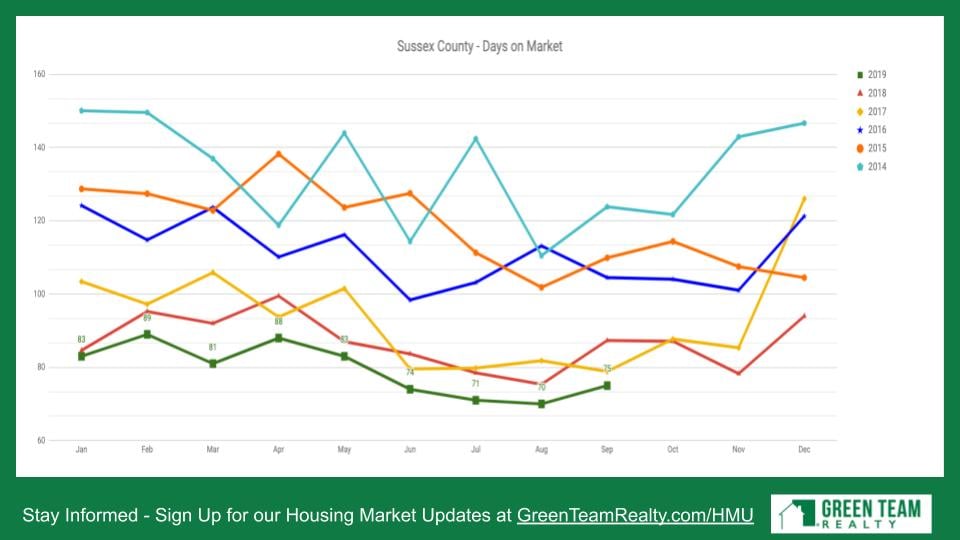
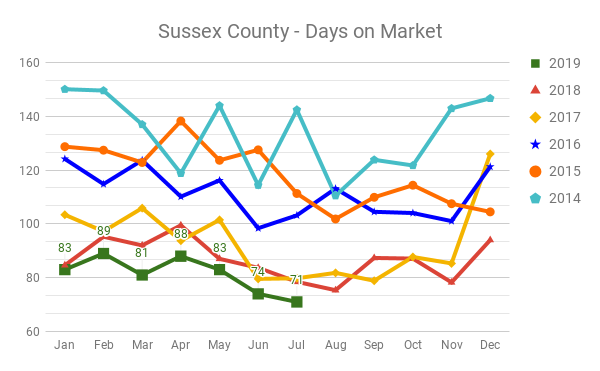
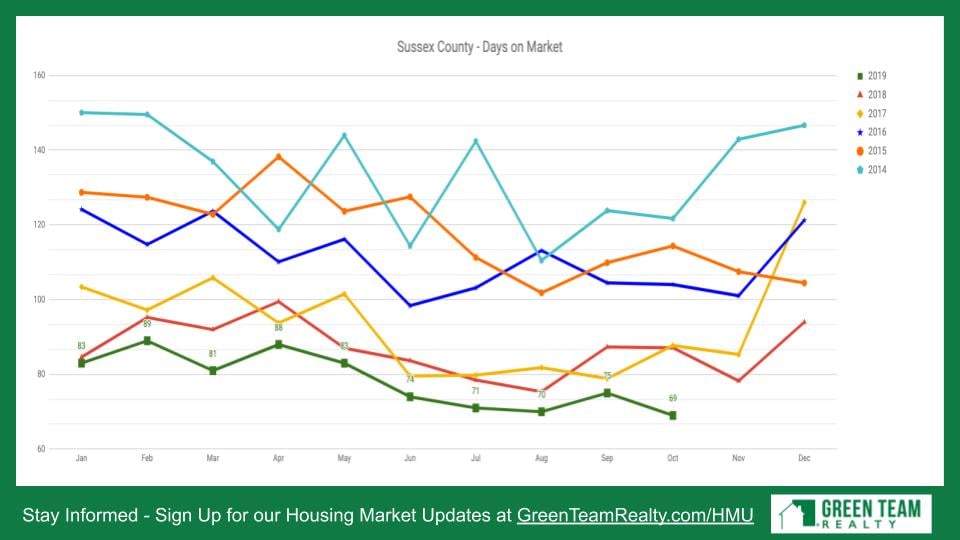
Prices went down, August was the lowest number in 3 years. Sussex is still a vibrant market with lots of transactions happening.
Similar to Orange, at or above the 97.5%-98% range.
Where are Home Prices Headed?
Nationally, the actual change in the last 12 months was 6.8%, a huge increase. Corelogic Home Price Index is forecasting a 5.1% increase for the next 12 months. This does not mean that prices will be decreasing. It just means they will increase by a lesser amount, which Geoff agrees with. Price usually lags in what is happening with units sold, and we’re seeing that happen. However, it is still a very robust market.
Panelists Discuss the Market
Sussex County Market
Because of the inverse numbers in New Jersey, Geoff asked Keren Gonen her opinion on what’s happening. Keren noted that a lot of transactions had been delayed. It was not an issue of not enough houses or buyers, but a delay in closings. There may be a rise in units sold in September. Regarding the lower price, the banks have released another batch of low priced homes. These usually are bought by flippers and investors, often for cash. That can skew the numbers. These homes were released at the end of July, closed in August. Keren invests and flips homes herself, so she is very knowledgeable on this subject. There are many more foreclosures available in Sussex than in Orange County. Therefore, that’s a major reason for the difference in home price stats for the two counties.
Orange County Market
Geoff asked Jacque Kraszewski where she thought the market was headed. She believes we’re still in a seller’s market. Inventory is still low. She has several buyers she can’t find houses for. She put a house on the market and within 2 days she had 7 offers. People may want to move, downsize, or rent. However, there are no rentals available. The inventory is a problem for renters as well as buyers. Also, some people don’t want to sell then purchase something at a higher interest rate.
Geoff recalled one listing that had 26 offers within 3 or 4 days. It’s hard to talk about a market cooling off when this is going on. You want to look ahead and see what is coming…. From the number of homes being sold on a national, regional and local level, we’ve seen the highs from this last run up and he’s hoping for a soft landing – not a precipitous decline. Jacque commented that there is usually a decline this time of year, with people who are looking to move to a certain school district now waiting for spring to find a home their children can start in, in September.
Geoff replied that there are always seasonal fluctuations, but year over year decreases, same period each year, tell the story. We’re seeing very steady increases in units sold for 4 to 5 years. And now, for the first time, not seeing big increases. The market does seem to be cooling a little.
Mortgage Rates and Availability
Geoff discussed with Mike Gianetto the major factor of the last precipitous decline. There, 50% of the marketplace was lost in a 2-year time span. This was due to the financial mess, mostly created by mortgage-backed securities. He asked Mike if we see a lot of sub-prime lending happening? Are we seeing the mistakes of the past being repeated?
Mike said there was a period of product elimination over 1-1/2 to 3 years. This took the market from somebody fogging a mirror to not giving any money at all. It was prohibitive for buyers less than perfect trying to buy a home. There are now safeguards and regulations saving the downside a little. There is a rise in products that are out there to help people buy. It allows for a lot more people in this marketplace. We have a shortage of inventory but we still have availability of credit and funding. People are lending, the money is out there, and people can get mortgages.
Geoff noted that not only did we have a financial crisis, but also a real tightening of credit making it hard to make a comeback. He asked Mike what’s going on with rates?
Mike said there has been a little uptake in rates. Further, there will probably be another. He thinks next year we may be in for lower rates. We’re at mid to high 4’s now, for a 30 year fixed mortgage. which is still a great rate. People will buy no matter what the rate, but this is still a very good rate.
Geoff replied that it would be good news if rates stabilize or come down next year. He also noted that the unemployment rate is at an 18 year low as of August. Wages are increasing. And the Construction sector added 23,000 jobs in August. Builders are ramping up. So many people were crushed during the last downturn – plumbers, general carpenters, framers, etc. Seeing them become the largest sector of jobs is good news.
Geoff’s take – if you need to buy or sell a home now, just do it. Mike said they can find mortgages for most buyers. If you’d like to contact Mike to discuss a mortgage, you can reach him at his office, 845-496-0836 or visit rhfunding.com/michaelgianetto. You can find Jacque or Keren at greenteamhq.com
Join us for the next Housing Market Update
We’ll be on Facebook live on Tuesday, October 16 at 2 pm. You can also sign up for our Housing Market Updates at GreenTeamHQ.com/HMU.
The Housing Market Update webinar is now sponsored by REALLY – Agent to Agent Referral App. You can learn more at reallyhq.com