The gap between the increase in personal income and residential real estate prices has been used to defend the concept that we are experiencing an affordability crisis in housing today.
It is true that home prices and wages are two key elements in any affordability equation. There is, however, an extremely important third component to that equation: mortgage interest rates.
Mortgage interest rates have fallen by more than a full percentage point from this time last year. Today’s rate is 3.75%; it was 4.86% at this time last year. This has dramatically increased a purchaser’s ability to afford a home.
Here are three reports validating that purchasing a home is in fact more affordable today than it was a year ago:
“Falling mortgage rates and slower home-price growth mean that many buyers this year are committing to lower mortgage payments than they would have faced for the same home last year. After rising at a double-digit annual pace in 2018, the principal-and-interest payment on the nation’s median-priced home – what we call the “typical mortgage payment”– fell year-over-year again.”
“At the national level, housing affordability is up from last month and up from a year ago…All four regions saw an increase in affordability from a year ago…Payment as a percentage of income was down from a year ago.”
“In 2019, the dynamic duo of lower mortgage rates and rising incomes overcame the negative impact of rising house price appreciation on affordability. Indeed, affordability reached its highest point since January 2018. Focusing on nominal house price changes alone as an indication of changing affordability, or even the relationship between nominal house price growth and income growth, overlooks what matters more to potential buyers – surging house-buying power driven by the dynamic duo of mortgage rates and income growth. And, we all know from experience, you buy what you can afford to pay per month.”
Bottom Line
Though the price of homes may still be rising, the cost of purchasing a home is actually falling. If you’re thinking of buying your first home or moving up to your dream home, let’s connect so you can better understand the difference between the two.
[/et_pb_text][et_pb_text _builder_version=”3.18.2″][/et_pb_text][/et_pb_column][/et_pb_row][/et_pb_section][et_pb_section fb_built=”1″ _builder_version=”3.18.2″ custom_padding=”32.875px|0px|72px|0px|false|false”][et_pb_row custom_padding=”0|0px|16.4375px|0px|false|false” _builder_version=”3.18.2″][et_pb_column type=”1_2″ _builder_version=”3.18.2″ parallax=”off” parallax_method=”on”][et_pb_button button_text=”Start Your New Home Search” button_alignment=”center” _builder_version=”3.18.2″][/et_pb_button][/et_pb_column][et_pb_column type=”1_2″ _builder_version=”3.18.2″ parallax=”off” parallax_method=”on”][et_pb_button button_text=”Download A Free Buyer’s Guide” _builder_version=”3.18.2″ button_url=”https://greenteamrealty.com/home-buyers-guide/”][/et_pb_button][/et_pb_column][/et_pb_row][/et_pb_section]
Here are four great reasons to consider buying a home today, instead of waiting.
1. Prices Will Continue to Rise
CoreLogic’s latest Home Price Insights Reportshows that home prices have appreciated by 3.6% over the last 12 months. The same report predicts prices will continue to increase at a rate of 5.8% over the next year.
The bottom in home prices has come and gone. Home values will continue to appreciate for years. Waiting no longer makes sense.
2. Mortgage Interest Rates Are Projected to Increase Next Year
The Primary Mortgage Market Survey from Freddie Macindicates that interest rates for a 30-year mortgage have recently hovered just above 3.5%. This is great news for buyers in the market right now, because low interest rates increase your purchasing power – but don’t wait! Most experts predict rates will rise over the next 12 months. The Mortgage Bankers Association, Fannie Mae, Freddie Mac, and the National Association of Realtors are in unison, projecting that rates will increase by this time next year.
An increase in rates will impact your monthly mortgage payment. A year from now, your housing expense will increase if a mortgage is needed to buy your next home.
3. Either Way, You Are Paying a Mortgage
There are some renters who haven’t purchased a home yet because they’re uncomfortable taking on the obligation of a mortgage. Everyone should realize that, unless you’re living rent-free with your parents, you are paying a mortgage – either yours or that of your landlord.
As an owner, your mortgage payment is a form of ‘forced savings’ that allows you to have equity in your home you can tap into later in life. As a renter, you guarantee your landlord is the person with that equity.
Are you ready to put your housing costs to work for you?
4. It’s Time to Move on With Your Life
The ‘cost’ of a home is determined by two major components: the price of the home and the current mortgage rate. It appears both are on the rise.
But what if they weren’t? Would you wait?
Look at the actual reason you’re buying and decide if it is worth waiting. Whether you want to have a great place for your children to grow up, you want your family to be safer, or you just want to have control over custom renovations, maybe now is the time to buy.
Bottom Line
Buying a home sooner rather than later could lead to substantial savings. Let’s get together to determine if homeownership is the right choice for you and your family this fall.
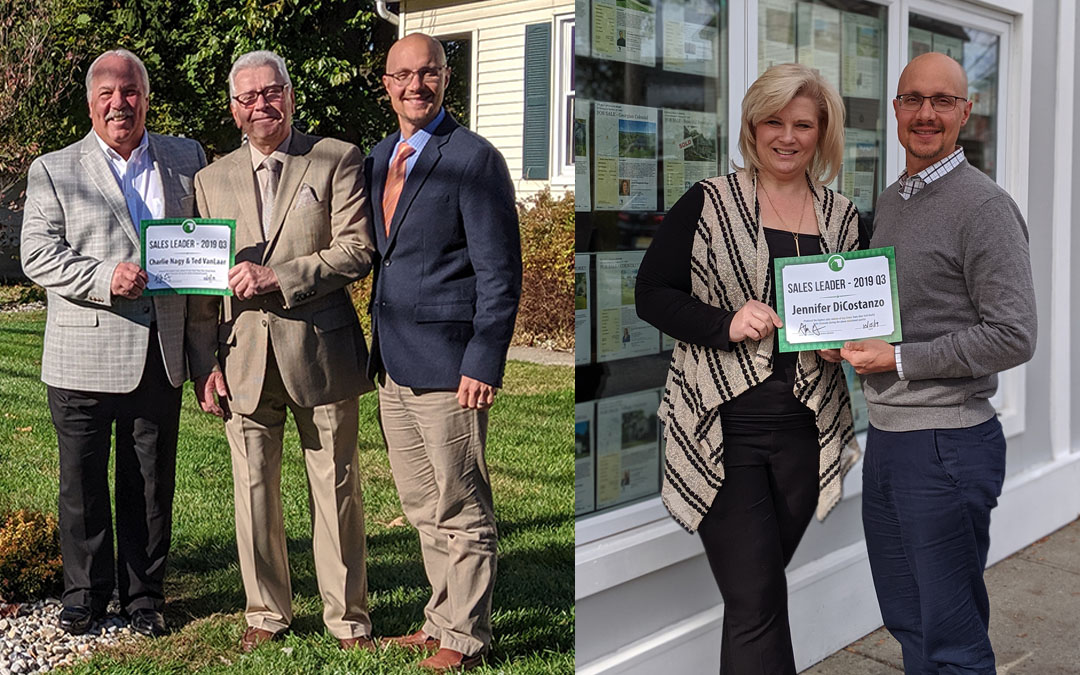
Congratulations from Geoff Green, President of Green Team Realty, to our Third Quarter 2019 Sales Leaders
Congratulations to Jennifer DiCostanzo of Green Team New York Realty and the dynamic team of Charlie Nagy and Ted Van Laar of Green Team New Jersey Realty for taking first prize as our third quarter sales leaders. It’s no secret that Q3 is the biggest quarter of the year in our industry. Therefore, it shouldn’t come as a surprise that we’re seeing these three names at the top once again. The truth is, behind the accolades there is a lot of hard work. All three of these individuals work tirelessly to yield the results they do. So, keep up the great work everyone!
Jennifer DiCostanzo, Warwick
For this hard working Associate Broker, success is not measured by sales numbers alone. Rather, Jen views true success by the clients she’s helped and the satisfaction she gets from doing her best at something she loves. She is constantly striving to enhance her knowledge and skills so that she can provide her clients with an edge in this competitive market.. Jen has earned her Seller Representative Specialist (“SRS”) and Accredited Buyer’s Representation (“ABR”) Designations. In 2016, 2017 and 2018, she received the annual Sales Leader Award as well as the Citizenship award. Further, in 2017 she became the first recipient of the Green Team MVP Award for over $10 Million in sales. Jen is a member of the NYS Association of Realtors, the Hudson Gateway Association of Realtors, the National Association of Realtors, and the Warwick Chamber of Commerce. In addition, as a Warwick resident married to a NYC firefighter, she understands the needs of commuters and has helped many buyers relocate to Orange County.
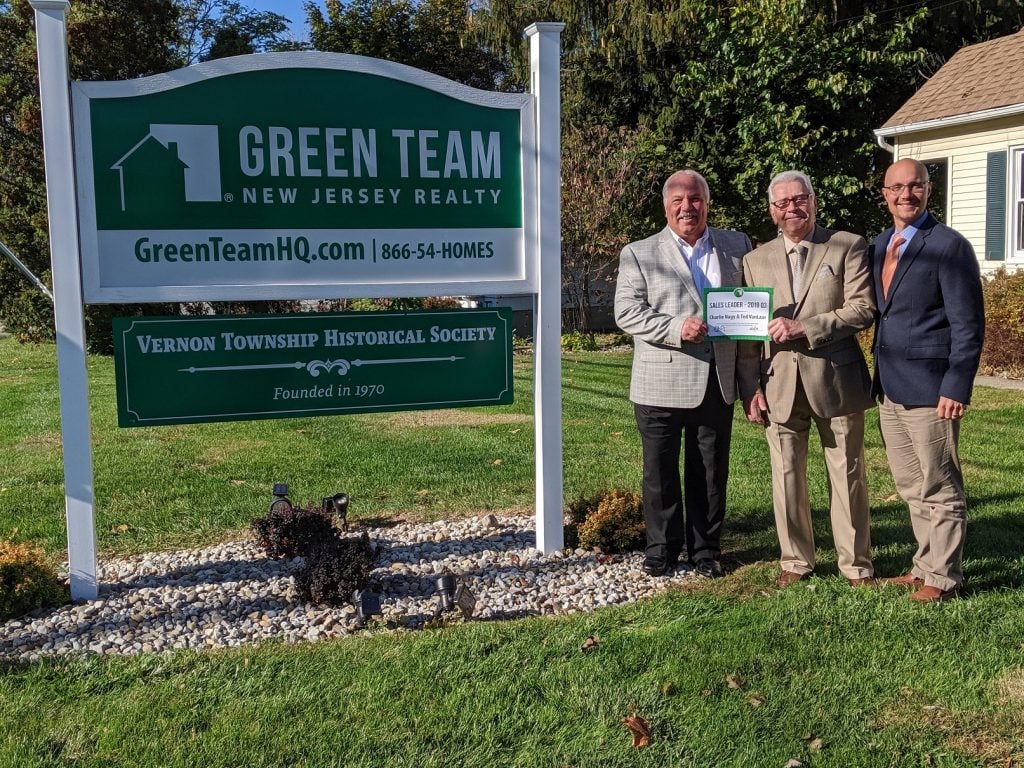
Charles Nagy and Theodore Van Laar, Vernon
Ted Van Laar, Charles Nagy & Geoff Green
In addition to this Q3 Award, the team of Charles Nagy and Theodore Van Laar earned Green Team New Jersey Realty’s 1st Quarter Sales Leader Award for 2019. That follows their 4th Quarter and Yearly Sales Leader Awards for 2018. The Dynamic Duo, as Geoff Green affectionately calls them, are equity partners in the brokerage. And they are committed to leading by example. They are strong believers in the Green Team’s unique system of training and support which gives sales associates the tools to provide the best possible customer service and experience. Charlie and Ted come from diverse backgrounds in real estate. Yet together they form a productive, successful team. One bond that unites them is their love of resort properties and living. They have been recipients of the Circle of Excellence Award multiple times between 2014 and 2018. That Award requires minimum sales of $2.5 Million and 15 transactions to qualify. In addition, they were Second Quarter Sales Leaders at Green Team New Jersey Realty for both 2017 and 2018.. And in 2018 they became part of the Green Team’s President’s Club, which honors those associates with $5 to $10 Million in sales volume.
Charlie and Ted are proud of Green Team New Jersey Realty’s growth and achievements. After only two years in business, GTNJR owns their own office building and ended 2018 as the #1 firm in sales volume and transactions in all of Vernon, NJ. They also take pride in the team they are building.
Congratulations to our 2nd and 3rd Place Winners
Green Team New York Realty: Toni Vogel is our second place Q3 Sales Leader, with Nancy Sardo in third place.
Geoffrey Green, President of Green Team Realty, invited viewers to the Sept 2019 Housing Market Update. The update took place on Sept 17, 2019, 2 p.m. on Facebook Live.
National Housing Market Statistics
Recession Worries
According to Geoff, we’re starting to hear the word recession far more than we did a year ago, far more than six months ago. The big buzz is, are we headed to a recession? If so, when? And how dramatic will it be? The bottom line is most people think we won’t be experiencing anything like we went through from 2008 to around 2016.
“The housing crash during the Great Recession left a lasting impression… But as we look ahead to the next recession, it’s important to recognize how unusual the conditions were that caused the last one, and what is different about the housing market today.” Jeff Tucker, the Zillow Economist
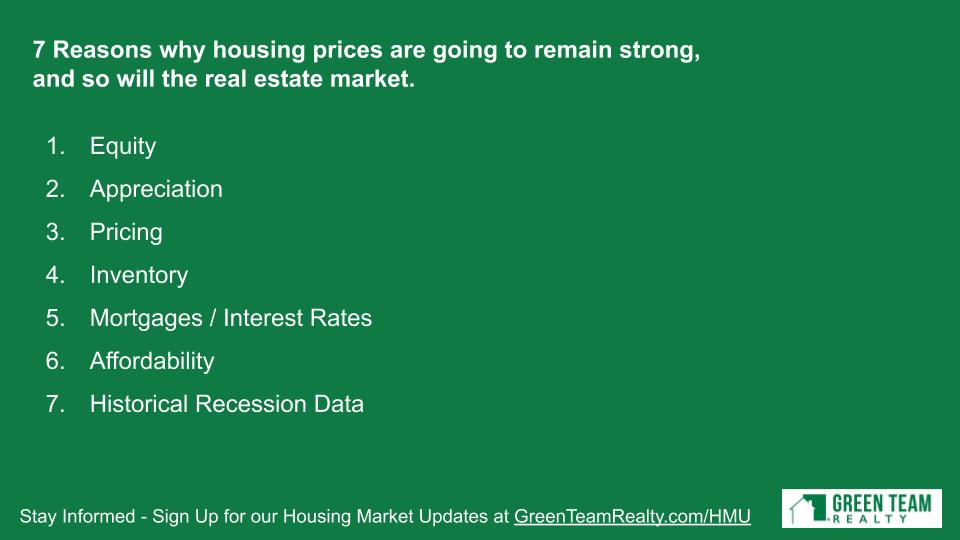
Reasons why housing prices and the real estate market should remain strong
Many people are in a very strong equity position as far as their home goes. That’s the amount of money that is in the value of the home. If you know the fair market value of your home minus the pay off amount of your mortgage, the difference is the equity. Keren Gonen and our Producer, Melissa Bressette, were discussing that over one-third of US households are free and clear of any mortgage. That is a very strong number. From a balance sheet perspective, we’re doing very well as a nation.
We’ve had good appreciation over the last few years. It continues and most experts agree that despite the market slowing, appreciation is still going to be something that will continue for the next 12 months at least. The question is really by how much.
Inventory levels are still relatively low. Days on market are low, bidding wars are still happening.
Mortgage and interest rates are fantastic. Geoff thinks that if you had asked a lot of mortgage professionals a year ago where rates would be now, they would not have predicted how low rates would be. The low rate environment is continuing to fuel the real estate market.
There is a level of affordability we haven’t seen in a long time. When you package everything together; earnings, mortgage rates, taxes, prices of homes, etc.you get affordability rates that are historically high. That is, how affordable it is for the average American to buy a home.
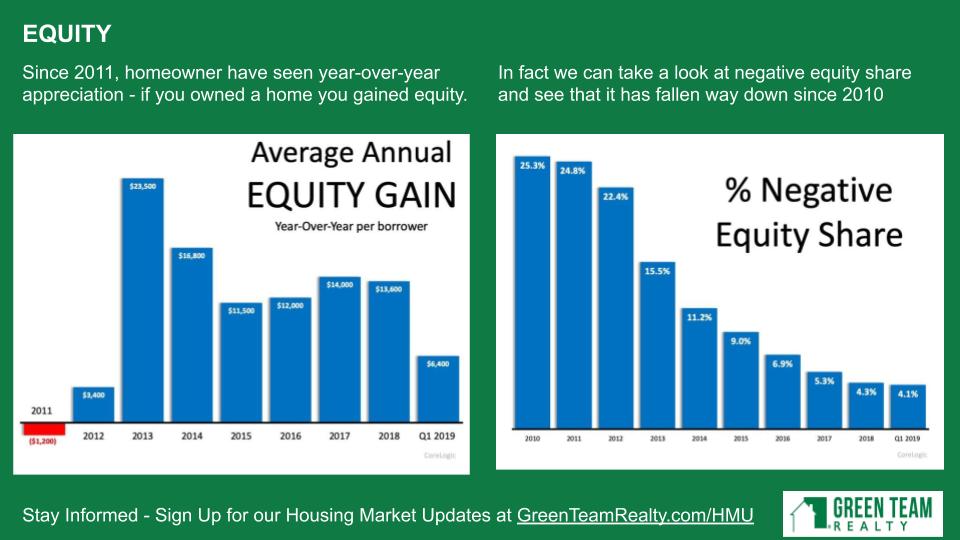
Equity
Here we’re seeing year over year appreciation growth. It is still very strong. Still where it was a couple of years ago. Percent of negative equity share refers to who is in negative equity situation. That occurs when the mortgage payoff is higher than the fair market value of the home. That has been steadily declining since 2010 and we are now at the lowest level since then. Those are very good signs.
Appreciation
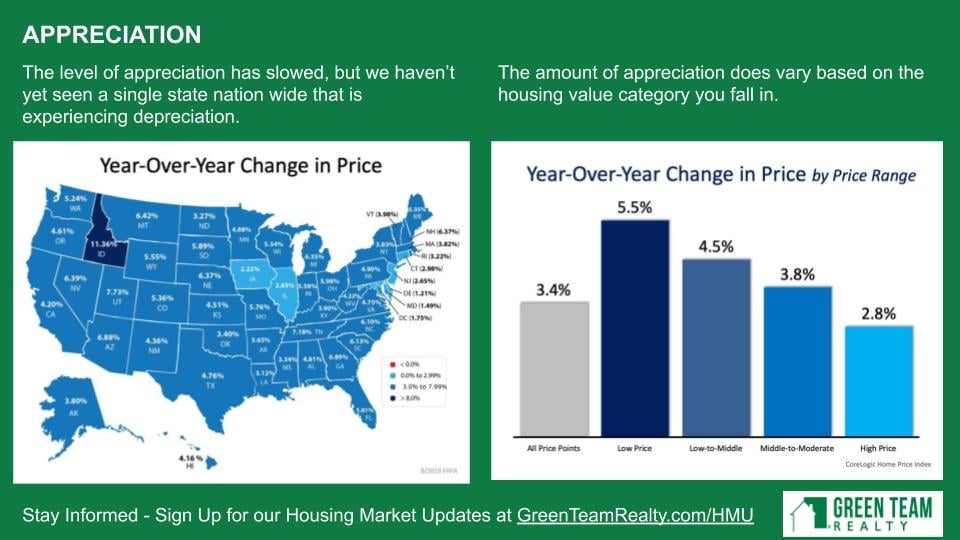
A quick glance at the map of the U.S. on the left side shows nothing is below “0” and everything is still appreciating. Then we review the right side, which examines year-over-year change in price by price range. All price points are in grey. Lower end homes have a bigger market, more demand, which drives up price. However, even the high range homes are experiencing appreciation.
Pricing
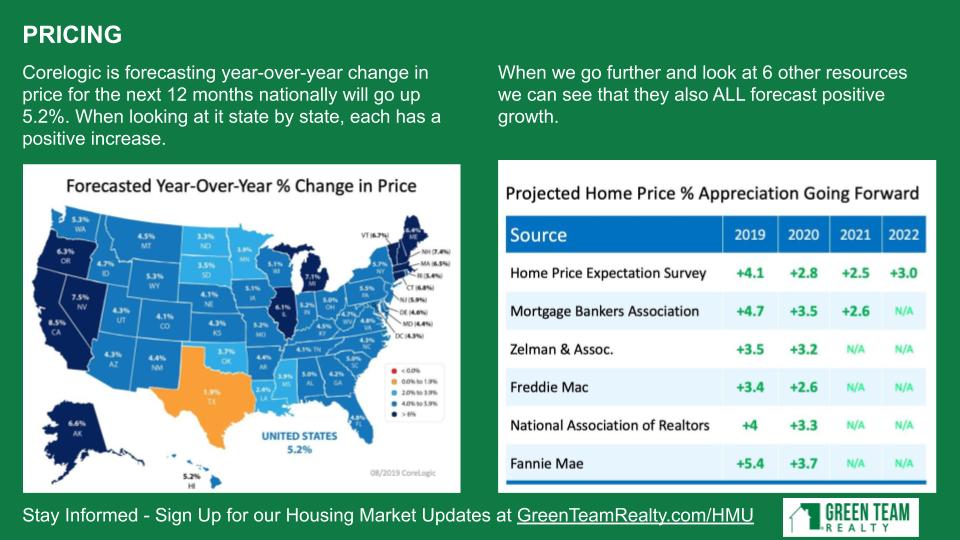
Corelogic,a leading provider of statistical data on the housing market is projecting, per the above map, that over the next 12 months the nation will go up another 5.2%. That is a very healthy rate of appreciation. In addition, some other sources, shown here on the right, are predicting a fairly substantial level of appreciation, even into 2021.
Inventory
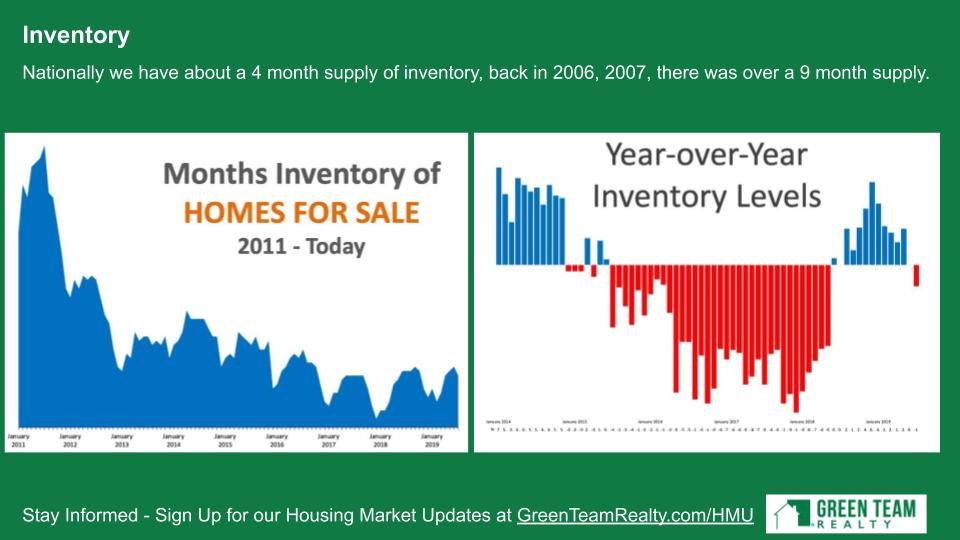
Historically, left to right, we are still at a very low level of inventory, which means that pricing should continue to increase. or stay strong year over year. Year-over-year inventory levels, we’ve had a bump at the end of 2018, beginning of 2019. Now we can see inventory starting to tighten up again a little.
Mortgages/Interest Rates
Where are they headed? Where are they now? We can see from January 2018 to today the rates that could not have been predicted a few years ago to be so low. And we recognize that this is a good spot that we’re in.
Affordability
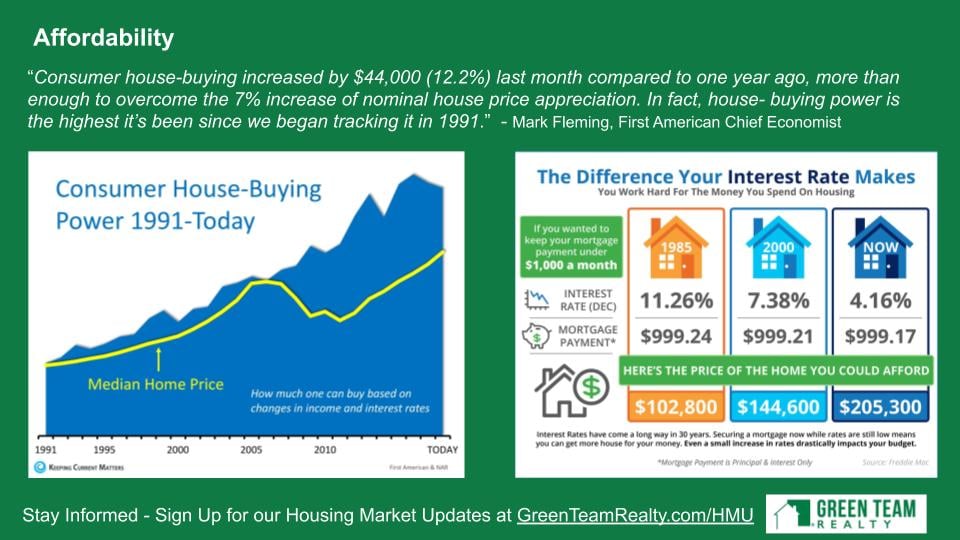
On the graph to the left, the yellow line represents median home price while the blue represents purchasing power. It’s evident that there is much less of a variance between the two up to 2005, which was the worst period of time. But we’ve stayed strong. During the crash, home prices went down while affordability went up. And it hasn’t really changed. There is still ta good opportunity for people to secure one of the most important assets they ever will own – a home.
Historical Recession Data
Geoff agrees with everyone who believes that this recession will be much shorter than the last one. The housing market is in a better position. We have better fundamentals in place than we did the last time around. There is not nearly as much sub-prime lending as there was. Of the last five recessions, home prices went down in just two. Home prices went up in the other three.
Having gone through the last recession, it can be hard to believe that prices can actually rise. But maybe this one will go that way as well.
Resource Center
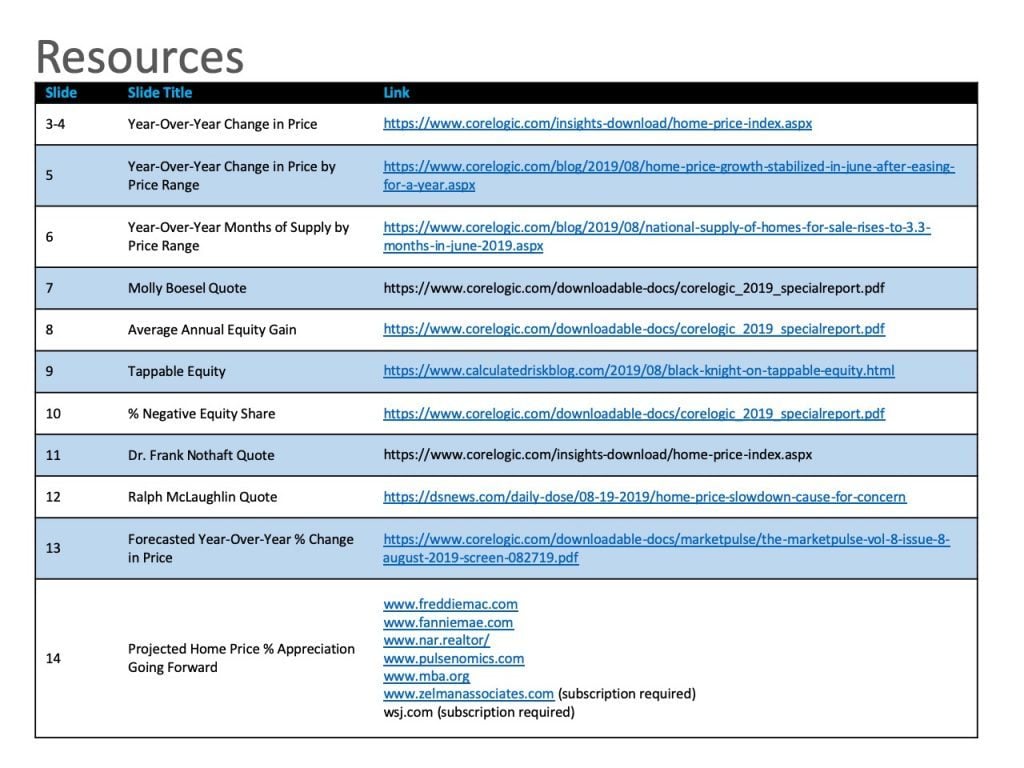
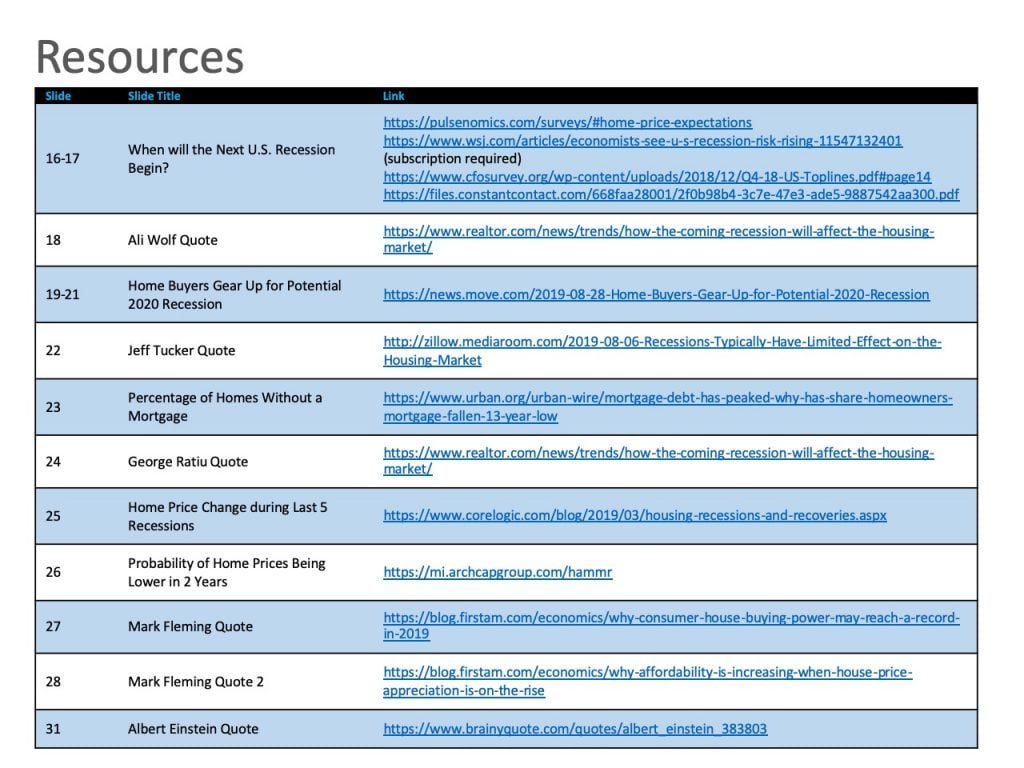
Each month we bring you stats, data and quotes from various trusted industry sources. These resources will now be available to you in our monthly Housing Market Update recap blog post, which can be accessed from GreenTeamRealty.com/hmu/ under Housing Market Recap.
Local Housing Market Updates
Orange County, New York
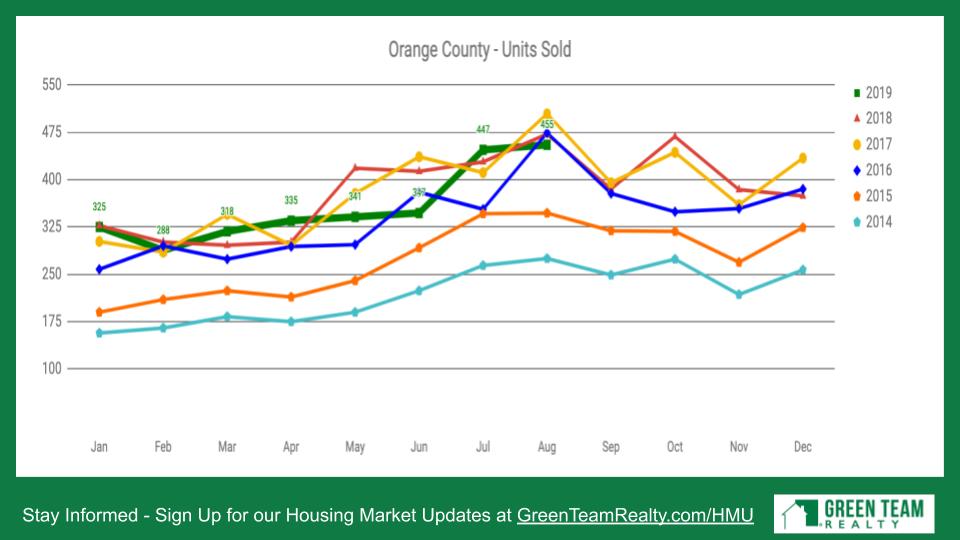
Units Sold
It’s been a mixed bag this year. The green line is 2019. It’s fair to say the number of units sold is consistent with 2018. We’re definitely seeing a slowing in the number of transactions. But, it’s still a very high historical level. And it’s still a very strong market. So, yes, it’s cooling, but it’s still a very high rate.
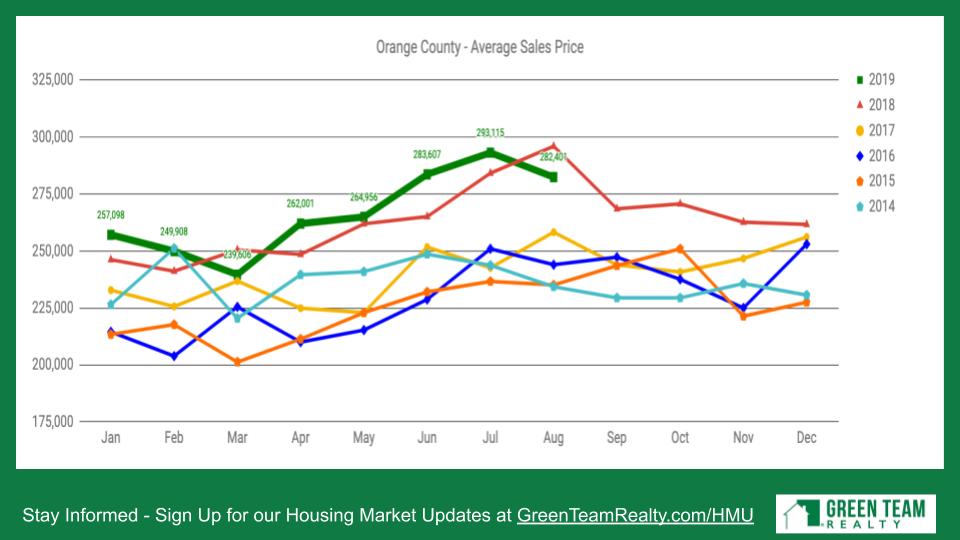
Average Sales Price
The average sales price took a little dip this month.That doesn’t mean that prices will ultimately continue to go down year-over-year over 2018. However, units sold has been slowing. Geoff believes we’ll see a softening of the market, rather than a crash.
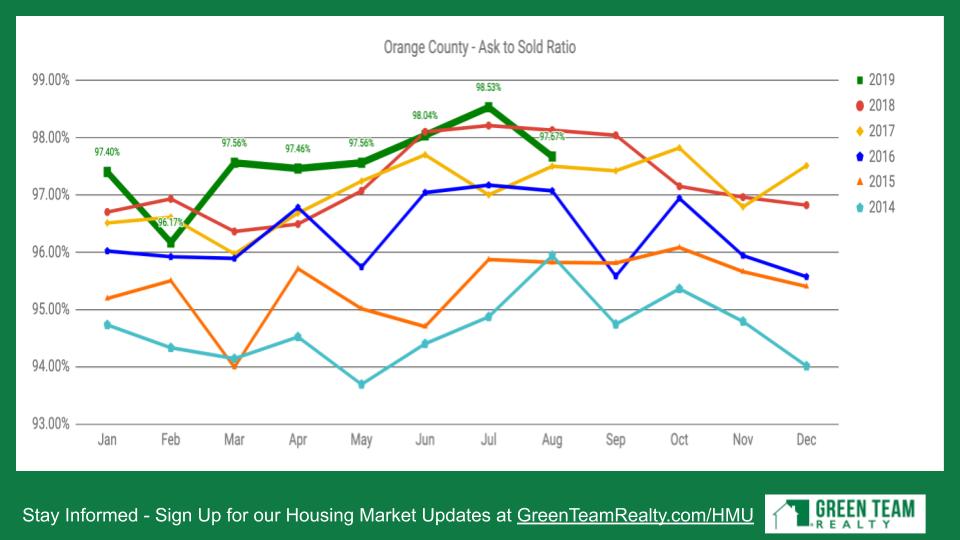
Ask to Sold Ratio
The last asking price versus what the house sold for and the ratio thereof. As you an see, this year it’s been high, meaning sellers haven’t had to negotiate much off of their asking price. However, recently we’re seeing a dip, which is worth noting.
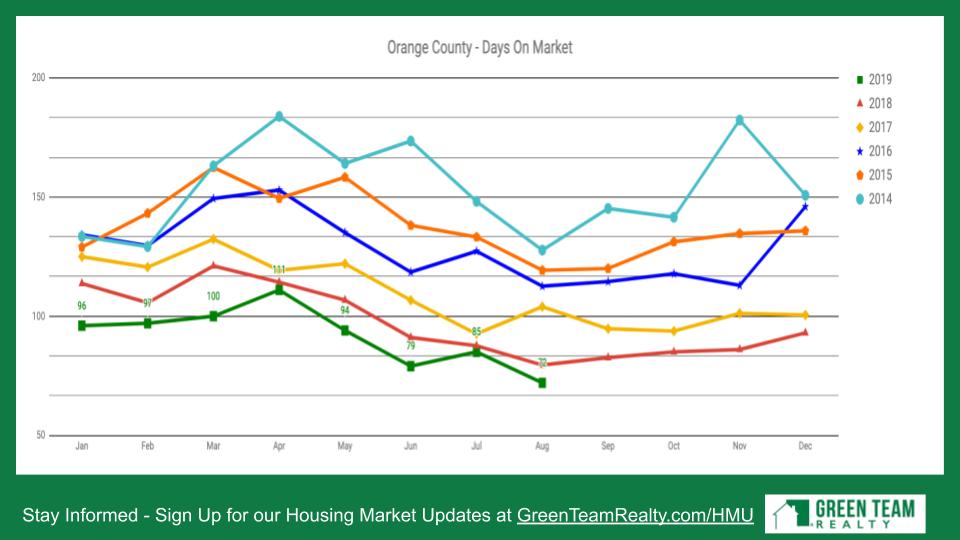
Days on Market
The days on market have consistently been lower than the previous 6 years, remaining a strong factor in the market.
Sussex County, New Jersey
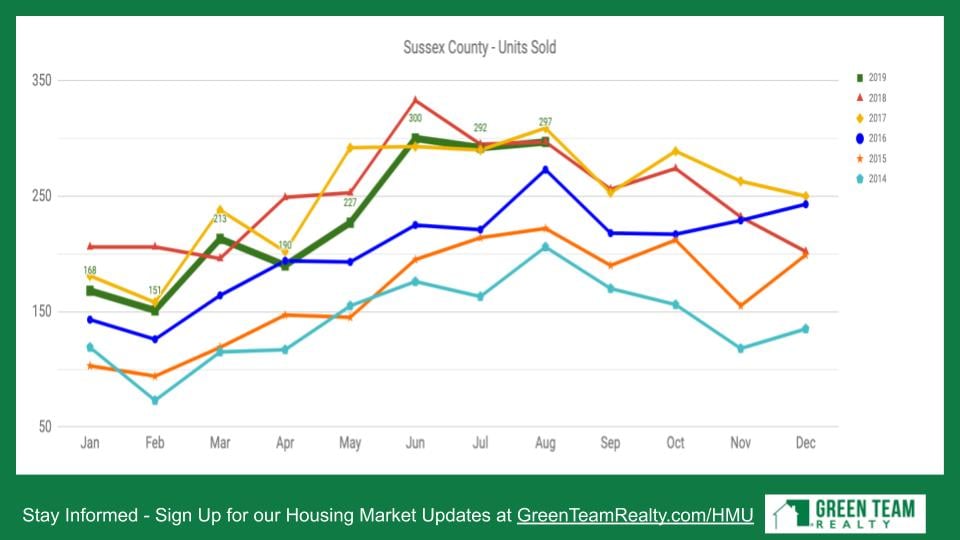
Units sold
There is a similar situation here in Sussex County; a mixed bag, up and down. However, it’s clear that in the last 18 months or so, the number of units sold has been slowing.
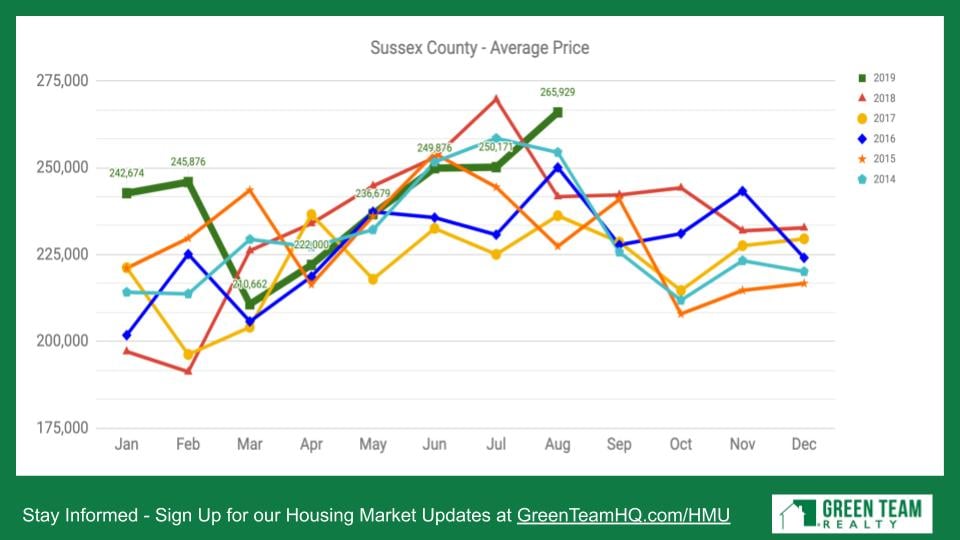
Average Price
It’s interesting that all through this time period average price in Sussex was kind of languishing. And now we see prices taking off,. almost the highest level of prices in the county in almost 8 years. Only July of 2018 was slightly higher.
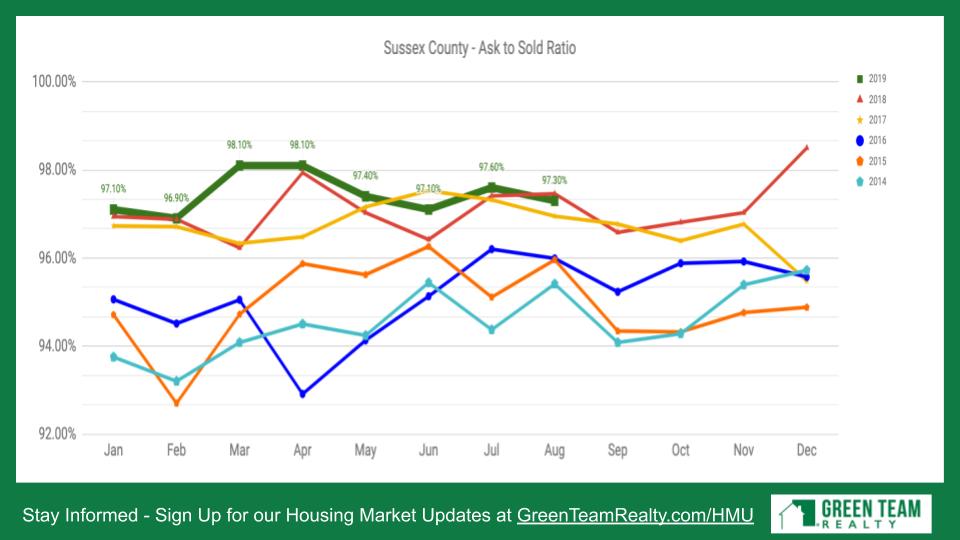
Ask to Sold Ratio
The ask to sold ratio is again similar to what we’re seeing in Orange County. at 97, 98%, it’s still a strong market with sellers only having to come down a little bit off their asking price.
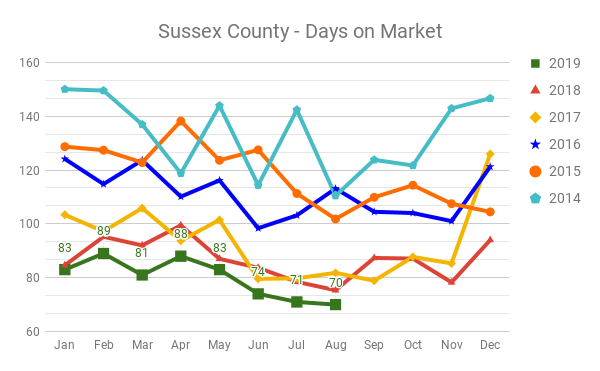
Days on Market
Days on market are lowest over last 6 years. The market continues to be strong. Further discussion will take place with our panel.
Thank you to our sponsor
Meet our Panel
Keren Gonen is from Green Team New Jersey Realty and is a regular panelist on our Housing Market Updates.
Geoff asked Keren what’s actually happening in the field; if there are signs of the market taking a downturn.
Keren stated that it’s important to note that there are still people buying. still people selling, and there are still bidding wars due to low inventory. On both sides of the border we’re dealing with a lack of good houses. Now that it’s so easy and affordable to buy a good home, it’s really a question of inventory. Some sellers are on the fence, waiting to hear what will happen in 2020. Agents and Sellers would like more inventory to choose from. However, if agents educate their sellers we’ll see a lot more houses on the market in the coming months.
Geoff asked if Keren has found buyers becoming more picky as time goes on. Keren replied that it’s the opposite; Buyers are rushing to put in offers on the houses that they like. She said we want to make sure that good houses on the market do sell quickly, because that makes everyone look good. Whether it’s the listing agent or selling agent, everyone does better in that type of a market.
From the Seller’s perspective, Geoff asked if Keren agreed that we’re not in a market where they can list at any price and sell. Keren stated that surprisingly all the listings she’s had have either come in on point asking price or a few thousand dollars above asking price due to bidding wars. In addition, they’re going under contract very quickly. Attorneys are moving them along, with attorney review much faster than earlier in the year and last year. She had one listing got out of attorney review in literally 48 hours, which was a first for Keren.
Pricing
Geoff said he was sure that Keren was choosing comparables carefully to make sure the information is accurate and she’s setting a good asking price. She replied, absolutely. That’s the first thing – Listing Agent 101. You want to make sure you do your comps properly so that you don’t sit on the market. Geoff stated that ‘s the message to all Sellers. The hardest conversation to have as realtors is price reduction. It’s kind of like having mud on your face. We’re the ones who bring in the comps, make recommendations on what we feel the fair market is for their home, Many Sellers don’t listen and just want to list at the price they want. But many people do listen. However, sometimes a price reduction is necessary. However, no matter what market you’re in, you have to price it right.
Keren said one of the things she does with all of her Sellers is ask them what their time line is for selling their home. Meaning, are we okay to sit on the market for 3, 4, 5, 6 months? Or are we looking to get an offer within the next month to 2 months. Then, according to what they tell her that’s where she prices the house. She has had clients that tell her they don’t care when they move, the house is paid off and they’re not in a rush. And they want a specific amount for their house. So Keren tells them that’s okay as long as they understand that according to her market analysis, they won’t sell until we reach this price. As long as they understand that, she’s fine with listing it at that price. Ultimately it’s always the Seller’s decision.
The recommendation
Price it right from the beginning. Price it to sell from the get go. You’re likely to get a higher price. There is never a better time to sell your home than when you first list it. It’s new, there are buyers out there waiting for the next house to come out on the market. They’ve been out there looking and haven’t found what they’re looking for yet. Now your home is new and it’s on the market.
Bank Inventory
Geoff asked Keren what she is seeing as far as bank-owned inventory. He considers Keren to be a leading expert in Sussex County on the subject. Keren stated that they are not seeing too much being released by the banks. Whatever was out there was sold. She hasn’t seen anything new that’s affordable for an investor or flipper or someone who wants to take on renovations on their own. It has been quite a few weeks since she’s seen those. She has seen some that are borderline, with a few things missing, but those are priced too high. There really isn’t any new release of inventory from them.
Geoff then asked if Keren is still seeing bank-owned properties continue to be rented, an anomaly that we’re seeing over the last 5-6 years. As far as Keren knows, they are, remarking that it seems banks now want to be landlords as well. Geoff mentioned some clients who rented a bank-owned property and once they got in there was problem after problem. It was discovered that there was a lot of substandard that had been done. Caution people buying inventory to make sure that the renovations have been done correctly. The flips that Keren has seen by banks are usually bid out to the lowest bidder and that reflects in the workmanship.People can get caught up in the moment; the price seems right. And they may think they’re getting a better deal because the property is bank-owned.
Wrapping it up
Geoff has been in the real estate industry for going on 15 years. He has worked a lot of hours every week during those years and developed a great appreciation for agents like Keren, working in the field.The housing market in this country would not be what it is without the hardworking agents. They keep data accurate, make sure clients needs are met. Other market places around the world are not nearly as well run as they are here. We are getting into an age where it may be possible to just buy a home from Zillow offers, etc. However, the expertise, knowledge and support offered by real estate agents cannot be duplicated. Geoff’s final word… Find a Realtor!
It’s October in Orange and Sussex Counties – and we know what that means!
Fall is in full bloom and pumpkins dot the fields throughout these sister counties. Leaves change color, providing a breathtaking landscape. During October in Orange and Sussex Counties, there is a lot to see and a lot to do, culminating in Halloween. And Green Team Realty is delighted to share activities and events with you to help you enjoy this beautiful fall month.
Fall Recipes and indoor and outdoor home projects and decorating ideas for the season
And, as the weather cools down, using the oven seems like a fitting idea. So Southern Living gives us 30 Fall Cookie and Bar Recipes Every Baker Needs. Finally, Southern Living also gives us 68 Fall Table Decor Ideas That Will be the Hit of Your Party. These gorgeous seasonal decorations will enhance entertaining and family meals (and dessert), as well. And there are beautiful creations to help you start planning for your Thanksgiving table.
Pumpkin Festival at Hill-Hold Museum. 128 Route 416, Campbell Hall. Saturday, October 5, 12 p.m. to 4 p.m. Pumpkin rolling, face painting, waxing leaves, scarecrow making and hay rides. Refreshments available for sale. $3/person.
Applefest. Downtown Warwick. Sunday, October 6, 9 a.m. to 5 p.m. Vendors, live music and entertainment, children’s carnival, food and, of course, all things apple.
Warwick Children’s Book Festival. Railroad Green Park, Warwick. Saturday, October 12, 11 a.m. to 4 p.m. Live music and visits from 75 children’s authors and illustrators. In case of rain, the event will be held at Warwick Valley Middle School, 225 West St.
Sugar Loaf Arts & Crafts Fall Festival. Kings Highway, Sugar Loaf. Columbus Day Weekend, October 12, 13 and 14, 10 a.m. to 5 p.m. Enjoy arts, crafts, music, food and a beer garden in this charming artisan crafts village.
Sussex County, NJ – Things to do, places to go
Harvest, Honey and Garlic Festival. Sussex County Fairgrounds, 37 Plains Rd, Augusta. Saturday, October 12, 10 a.m. to 4 p.m. Farmers Market, vendors, children’s activities, and a variety of honey and garlic products. There will also be educational displays from the beekeepers. 973-579-0500.
Newton Fall Festival. Spring Street, Newton. Sunday, October 13, 11 a.m. to 3 p.m. Free family event with classic car show, live music, costume contest, vendors and crafts. 973-383-3521
Dog Walk of the Dead. Sussex County Fairgrounds, 37 Plains Rd, Augusta. Saturday, October 19, 5 p.m. to 8 p.m. All proceeds benefit “Oscar: One Step Closer Animal Rescue.” There will be vendors, costume contests, live music, food, a classic car showcase. Most importantly, there will be animal adoptions.
Last – but not least – Things to do on Halloween
And, since October in Orange and Sussex Counties ends in Halloween, take your pick of the events in these sister Counties.
Heaven Hill Farm’s Great Pumpkin Festival.is the largest Fall Festival in Northern New Jersey. There is plenty of room on this 110 acre farm for the 40 family-friendly activities, and lots of food. Of course, that includes apple cider and apple cider donuts. Plus, there are Corn and Hay mazes, There are just too many activities to list here, so check out the website for activities, days and hours, and ticket prices.451 State Route 94, Vernon. 973-764-5144
Pure Terror ScreamPark and Haunted Houses at Museum Village, Monroe, Thursday Oct 31 – 7:30 p.m. to 9:30 p.m. Friday and Saturday, Nov 1 & 2, 7:30 to 10 p.m. According to the website, Pure Terror is a 9 Haunted House walk through attraction. It’s one of the world’s largest and scariest haunted houses.. Also, there is a huge Halloween-themed midway with lots of music, food and photo ops for everyone. 1010 State Route 17M, Monroe NY. Visit the website for more details. Also, you can purchase tickets online.
For those that prefer a little less “terror,” Museum Village offers No Scare Halloween on Saturday Oct. 19 and Sunday Oct. 20. 11 a.m. to 4 p.m. Parade around the grounds in not-so-scary costumes and take part in lots of kid-friendly crafts and games. The website will offer more details as event gets closer. 1010 State Route 17M, Monroe, NY. 845-782-8248
If you prefer to spend a quiet Halloween with the family, redbookmag.com has recommendations for the 47 Best Halloween Movies for Kids. This link will also lead you to easy recipes, crafts and costumes.
We often refer to Green Team Realty as a family. And the sudden, tragic passing of Denise Schmidt has left the Green Team family reeling in shock and disbelief. Yet in grief there is also a coming together. And a desire to support Denise’s children and siblings, as well as each other at this sad time.
Denise was one of the first sales associates to join what was then Green Team Home Selling System. And for the past 12 years, Denise has been a bus driver for the Warwick Valley Central School District. She was a friend as well as a business associate. And she was a vibrant member of the community. Denise’s story is about a life well-lived and the impact she had and continues to have on those around her, inspiring heroism, friendship, caring and love.
The Warwick Varsity Tennis Team – Heroism in Action
Much has been written in local media about Denise, and about the Warwick Varsity Tennis Team. Denise was the regular driver for the girls’ away matches. They were heading home after an away game when Denise suffered a medical emergency, slumping over the steering wheel. The bus veered off the I-84 on ramp at Exit 28, down into a grassy ravine, and hit a tree. On that bus were 22 students and their coach. Thankfully, the students and coach were not injured. To many, it seemed that Denise was taking care of her team, making sure they’d be safe, even as she was herself in crisis. And her team took care of her. The coach and one of the students, who is studying nursing at BOCES, went into action. They provided CPR until the paramedics arrived. And despite the frightening experience, the girls remained focused on Denise and her condition.
While waiting for updates on Denise’s condition, the team began making plans. They dedicated their next home game to honor Denise. Sadly, when she passed away the game became a memorial tribute. Team members wore green ribbons to remember Denise and to show support of her work at the Green Team. The girls then created a memorial homecoming parade float. And they began selling green wrist bands to help raise money to Denise’s family. As in most small towns, communities rise up to face challenges together. This group of young women has shown grace, courage and commitment to a woman who was dedicated to them.
Green Team Realty – A Call to Action
There is another truth about small towns. News makes its way quickly throughout the community. Geoff Green, President of Green Team Realty, and Lucyann Tinnirello, Broker Manager at Green Team New York Realty began receiving texts about the accident. Immediately they made their way to Orange Regional Medical Center to be with Denise’s family. She was then transferred to Westchester Medical Center. Geoff began sending updates and prayer requests to everyone at Green Team. And a fundraising effort was undertaken to raise money for Denise’s children.
The Visitation and Memorial Service
The Memorial Visitation was held on Friday the 13th at Lazear-Smith & Vander Plaat Memorial Home in Warwick. Dennin, Donald, Derek and Dana graciously greeted those who came to pay tribute to their mother. And come they did. Denise touched many lives.
Her friends and co-workers from the Green Team gathered to gain comfort from each other, and to share memories of this remarkable woman. Amidst the tears there were smiles and there was laughter. Knowing that a tribute would be written for Denise, the question went around. What one word would you use to describe her? And the descriptions poured out. Kind. Caring. Amazing. Spitfire. Vivacious. Real. Ballsy. Determined. Humble. Feisty. Supermom.
Geoff Green stepped in to arrange for the location for Denise’s memorial service. On Saturday, September 14, family and friends gathered together at Spring Brook Farm to celebrate the life of this extraordinary woman.
Denise Schmidt was the kind of Realtor who would never consider the paycheck, but would simply focus on who needed help. There are a countless number of people in our marketplace who were in tricky Real Estate situations. And Denise would turn those situations into positive outcomes. Her determination was remarkable.
But it didn’t end there. The determination with her children was even more impressive. Denise did whatever needed to be done to provide a good environment for her four children. She left the four kids in great shape. They are all successful in their own right, but most importantly they are kind and caring individuals who will inevitably go out of their way to help others.
As a friend Denise was a “barrel of laughs”. Inevitably, after every Green Team social event, my wife and I would be convinced by Denise to continue the festivities. The laughs never stopped. Denise was a bus driver with a trucker’s mouth! One of her endearing traits was her ability to tell it the way it was. I always appreciated that from her. I could always count on her direct nature to give me feedback on things.
In the end, she worked until she died, and I don’t think she would have had it any other way. She always felt better when she was working to help someone and she did just that right until the end. She will be sorely missed by us all.
Donna Roberts, Agent Service Manager & Property Manager at Green Team New York Realty:
She was this quiet angel. If you mentioned something to her, like you were having a tough time or needed something, she’d do everything she could to help you. I stayed after work one day to help her with a listing. Then, when I came home the next day, there was a bottle of wine and a thank you note that Denise had left on my front porch. And last year some of us had been talking about how nice it would be to have a small fridge in the office for our lunches. So, the next day she brought in a fridge for us. These are the kind of things that Denise would do for people. No fanfare, no accolades. She just reached out in kindness. I will miss that about her, along with her “tell it like it is” view on the world.
Karen Gauvin, Licensed Agent & Realtor, Green Team New York Realty:
As a friend of Denise long before becoming a business associate, and as a mom of one of the team members on the bus that night, there is so much to share. Parents of girls on the team were notified that there had been a bus accident. We were told the kids were being checked at the scene and we could pick them up at the State Police barracks in Montgomery. Denise had been driving, so I knew the team was in good hands. We didn’t know much else at the time.
I was fortunate to have the help of another friend and co-worker, Tammy Scotto. Tammy drove me to pick up my daughter; I was too anxious to go on my own. We passed the site of the accident and just hugged each of the girls as they were released from the State Police to their families. It was truly frightening.
Learning what happened
We learned more details. Hailey told us what a happy time the team had with Denise prior to the crash. And, as their regular bus driver for their away games for the past several years, the girls knew her well. Hailey also spent a few minutes alone on the bus with Denise. She told me what a great mood Denise had been in, happy and chatty. I also learned how amazing the girls had been after such a terrifying event. Despite having gone through such a difficult and harrowing experience, the girls were strong, caring more about Denise’s condition than what they had been through.
After learning that Denise had passed, the team wanted to pay tribute to her. The girls dedicated their September 9 game to Denise’s memory. And while they did win, the lessons learned from sudden and tragic loss were what really mattered. Appreciating what is truly important, cherishing memories, being kind. They also dedicated their homecoming parade float to Denise and have been raising money for her family to help with expenses. And they will continue to hold Denise’s memory in their hearts. I’ll be sharing information on future events as they are planned, so we can support our team in their efforts to remember Denise. Together we will keep her legacy alive. And we can all remind ourselves what really matters.
Denise was a special person, and that carried through to her professionalism. She was always willing to help, and to share her knowledge. She served as a mentor to several of the newer agents, teaching them what she knew. Denise was an incredibly hard working single mom, and there lies her greatest accomplishment. Four incredible children who share their mom’s kindness and capacity for sharing.
Jennifer DiCostanzo, NYS Licensed Real Estate Associate Broker, Green Team New York Realty:
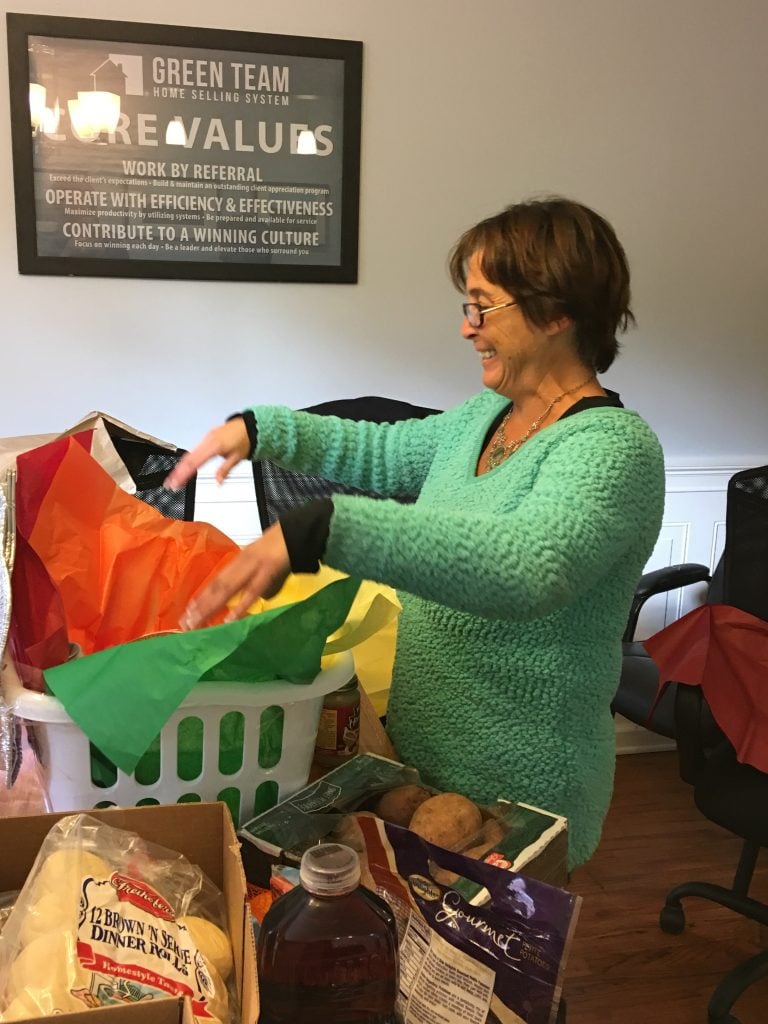
Looking through my photos I came across these and was filled with lovely memories. I had to smile, remembering years of wrapping Holiday Baskets for the food pantry with Denise and our group of volunteers. Each year we waited for her to arrive after her morning school bus run. And each year we nominated her as our official Green Team Basket Wrapper. I know when it’s time to wrap our Thanksgiving and Christmas baskets we’ll be remembering Denise with love and laughter. And be grateful that we had this wonderful person in our lives.
Lucyann Tinnirello, Jennifer DiCostanzo, Linda Vandeweert, Denise Schmidt and Donna Roberts
Denise Schmidt
Please share your memories of Denise
Denise Schmidt made an impact on so many lives. We hope that your memories will become part of this memorial. She will always be a part of the Green Team family, always loved, never forgotten.
As a homeowner, it’s always tempting to dream about the next big project you’re going to tackle. The possibilities are endless. Should I renovate? Should I refinance? Should I stay? Should I move? The list goes on and on. One of the things you’re probably wondering is “How much is my home worth?” To find out, click here.
In today’s housing market, it’s actually a great time to shift your thoughts toward selling your house and moving up into the home of your dreams.
Here’s why:
Inventory is on the rise, but there’s still an overall shortage of houses for sale (less than a 6-month supply found in a more normal market), so homes are going under contract quickly. In fact, the National Association of Realtors (NAR) Confidence Index reports that right now homes are only staying on the market for an average of 27 days. That’s less than one month, an even more accelerated pace from the 36-day trend we saw last spring.
The same report also indicates there are more interested buyers than active sellers today, which is one of the big factors driving home prices higher. (1)
There’s no doubt that today’s housing market is changing, and everything we see right now indicates it is time to sell. Here’s a look at why selling now is likely to drive the greatest return on your largest investment.
Home values have been appreciating for several years now, and prices are expected to keep climbing over the next few years, but they are not projected to continue to increase at such a high rate.
The latest Home Price Expectations Survey (HPES), forecasts an average annual appreciation rate closer to 3.2% over the next five years, which is more in line with a historically normal market (3.6%). The good news is, there’s still time to take advantage of the current strength of home prices by selling your house now.
Looking at the projections as they stand today, 2019 is slated to drive the strongest appreciation as compared to the upcoming few years. With average home prices still on the rise, the pace at which they are predicted to continue increasing will likely soften by 2020. (1)
SOURCES: (1.) KEEPING CURRENT MATTERS (2.) NAR 2018 BUYER AND SELLER SURVEY
[/et_pb_text][/et_pb_column][/et_pb_row][/et_pb_section][et_pb_section fb_built=”1″ _builder_version=”3.18.2″][et_pb_row _builder_version=”3.18.2″][et_pb_column type=”4_4″ _builder_version=”3.18.2″ parallax=”off” parallax_method=”on”][et_pb_button button_text=”Thinking About Selling? Find Out What Your Home Is worth” button_alignment=”center” _builder_version=”3.18.2″ custom_button=”on” button_text_size=”17px” button_border_radius=”35px” button_font=”||||||||” button_url=”https://greenteamrealty.com/home-value-estimate/”][/et_pb_button][/et_pb_column][/et_pb_row][/et_pb_section]
It seems like only yesterday we were looking forward to the beginning of Summer. And now here we are in September, with Summer ending and Fall on its way. There is something very special about September in Orange and Sussex Counties. Known for our abundance of apple orchards and wineries, there are lots of places to explore on weekends. Before we know it, leaves will be turning vibrant reds and oranges. And the natural beauty of these counties, lying side by side in adjoining states, is spectacular.
Places to go, things to do…
It’s Apple Picking Time!
Here’s a list of just some of the places to go to pick your own apples from hvparent.com. Further, it’s almost pumpkin picking time, too. Visit their websites for more details on each location, including any admission fees, picnicking rules, etc.
Apple Ridge Orchards, 101 Jessup Rd, Warwick. Friday through Sunday, 9 a.m. to 6 p.m. Tractor-pulled hay wagon, friendly farm animals, honey bee observation hives, and farm stand. 845-987-7717.
Apple Dave’s Orchard (Formerly known as Applewood). 82 Four Corners Rd, Warwick. Daily, 9 a.m. to 5 p.m. Music, hayrides, puppet shows, food.and farm store. 845-986-1684.
Masker Fruit Farms, Inc., 45 Ball Road, Warwick. Open 7 days a week, 9 a.m. to 5 p.m. Barnyard baby animals, pony and wagon rides, and country store. 845-986-1058.
Ochs Orchards, 4 Ochs Ln, Warwick. Pick Your Own, Wed. through Sun., 9 a.m. to 5 p.m., but always call before you come (845) 986-1591 as they may close at any time due to weather or picked out fields. The store is open 9 a.m. to 6 p.m.
Pennings Orchard. 169 State Rt. 94S, Warwick. Open 7 days a week, 9 a.m. to 5 p.m. Farmer’s market, beer garden, pumpkin fields, hayrides, farm animals, and more. 845-986-7080.
Soons Orchards & Farm Market. 23 Soons Circle, New Hampton. Apple picking weekends 10 a.m. to 4 p.m. Country store open daily 9 a.m. to 6 p.m. Orchard Hill CIder Mill Tasting Room Thursday – Sunday, 12 p.m. to 6 p.m. 845-374-5471.
Warwick Valley Winery & Orchards. 114 Little York Road, Warwick. Orchard hours Mon-Sun, 11 a.m. to 5 p.m. Live music every weekend from 2 p.m. to 5 p.m. There is a tasting room bar and cafe with a bistro menu as well as the Black Dirt Grill, open on Thurs.and Fri. 12 p.m. to 4 p.m., and Sat, and Sun., 12 p.m. to 5 p.m.
Wright Family Farm. 329 Kings Highway, Warwick. Sept. hours are Sat. and Sun.10 a.m. to 6 p.m. (last admission 5 p.m.). Farm Stand and Granny’s Basket with knitting creations. The Barnyard includes corn box, farm animals, rubber duck races, hayride, pedal carts, pumpkin bowling, cow train, tube slide, and community campfire. Save money on tickets to Barnyard by buying online. 845-986-1345
Beemerville Orchard. 73 Lusscroft Rd, Sussex. Small family-run orchard. On-site store with apples, honey, and more.
Pochuck Valley Farms Market and Deli. 962 McAfee Glenwood Rd, Glenwood. Pick your own hours 8 a.m. to 3:30 p.m. Entertainment on weekends starting Sept. 14. Country store with bakery, deli, and gift items. 973-764-4732.
For a listing of wineries, click here for our blog post from May of this year.
Places to go, things to do in Orange County, New York
25th Annual Taste of Warwick. Sept. 10, 6 p.m. to 9 p.m. Warwick Valley Winery, 114 Little York Road, Warwick. Music, food, and wine sampling. Visit the web page for a list of participants and ticket information. 845-986-2720.
New York Renaissance Faire. 600 Rt. 17A, Tuxedo. Every weekend through Oct. 6, 10 a.m. to 7 p.m. Themed weekends, music, dancing, food, and live entertainment. 845-351-5171.
Wawayanda Music on the Farm, Sept. 14-15. Sunflower Valley Farm, 366 County Rd 12, New Hampton, NY – 2 days of magical music, fabulous food, and family fun, featuring local and national music artists and artisans. Tickets starting at $30.
Bellvale Farms Creamery. 1390 Route 17A Warwick, Ranked #2 among the top ten ice cream parlors in the U.S. by Trip Advisor, you’ll want to make sure to get there before they close for the season on Oct. 30! Mon, Tues & Wed open 12 p.m. to 8 p.m., Thurs-Sun, 12 p.m. to 9 p.m. 845-988-1818.
Events – Sussex County, New Jersey
Vernon Street Fair and Farmers Expo. Sept. 7. Main Street between Route 94 and Guthrie Road, Vernon. 11 a.m. to 4 p.m. Hosted by the Vernon Chamber of Commerce. Contests, music, amusements for the kids, and local vendors for shopping! And… Food!!
Great Pumpkin Festival. Weekends from Sept. 14 – Nov. 3, 10 a.m. to 6 p.m. Heaven Hill Farm, 451 State Route 94, Vernon. The largest fall festival in Northern New Jersey, ride the hay wagon tractor to the Pumpkin Patch and find your perfect pumpkin. There’s a large corn maze, visiting farm animals, spider web crawl, barnyard sports, obstacle course, and much, much more. Check the website for admission prices and other details.
Sussex County Day, Sept. 15. Sussex County Fairgrounds, 37 Plains Rd, Augusta. 12 p.m. to 5 p.m. Celebrate Sussex County at this free event. There will be lots of vendors, exhibits, food, contests, giveaways, and much more! Check the web page for entry forms for the contests, which include the Sussex County Idol Singing Contest! And for those whose culinary skills exceed their vocal abilities, there are lots of cooking and baking contests.
49th Annual Peters Valley Fine Craft Fair. Sept. 28 & 29, 10 a.m. – 5 p.m. Sussex County Fairgrounds, 37 Plains Rd, Augusta. 12-5 p.m. This event is the largest fundraiser for Peters Valley School of Crafts. With over 150 exhibiting artists, demonstrations, live music, and more, odds are that you will find a unique,l hand-crafted item to take home with you!
Newton Theatre. 234 Spring Street, Newton. If you haven’t discovered The Newton Theatre yet, now is a great time to check it out. The historic theatre, founded in 1924, presents diverse programming, ranging from world-renowned music acts, comedians, family productions, holiday shows, and movie nights. It is also home to the Newton Theatre Arts Academy for children 5 and above. This 501(c)(3) non-profit organization also finds ways to give back to the community. Box Office: 973-940-NEWT.
Fall projects for your home
While it’s not quite time for Fall/Winter home maintenance, there are some end-of-summer chores you might want to put on your to-do list. Charles and Hudson features Your End of Summer Home Maintenance Checklist.
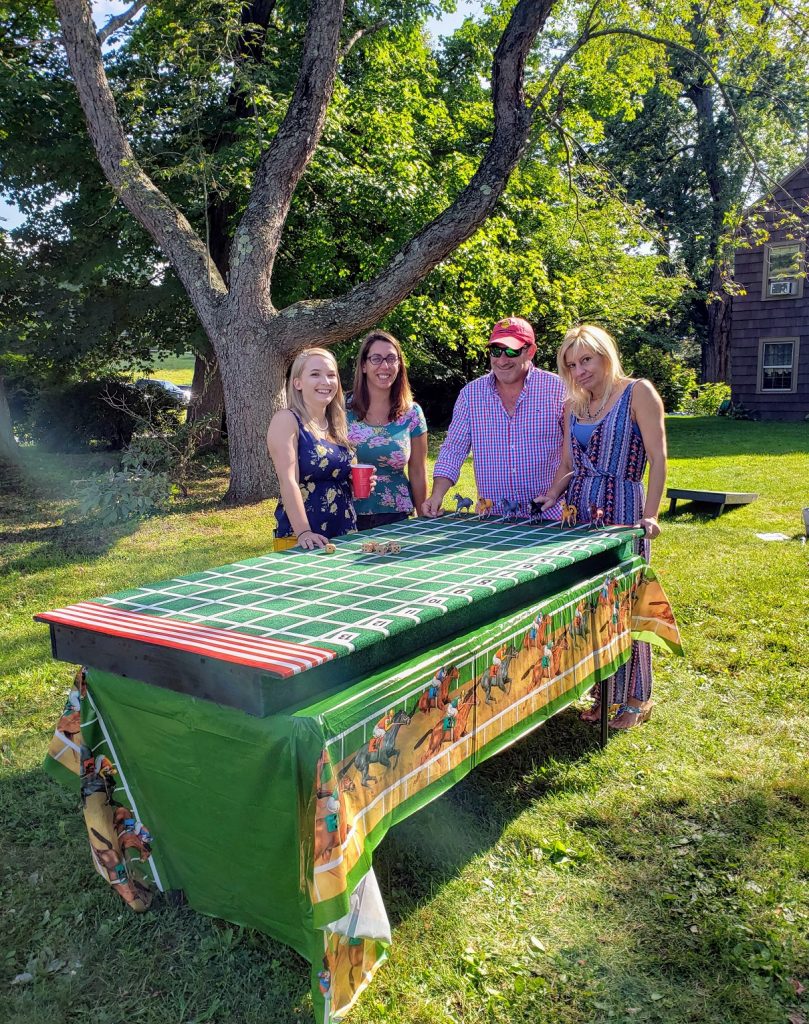
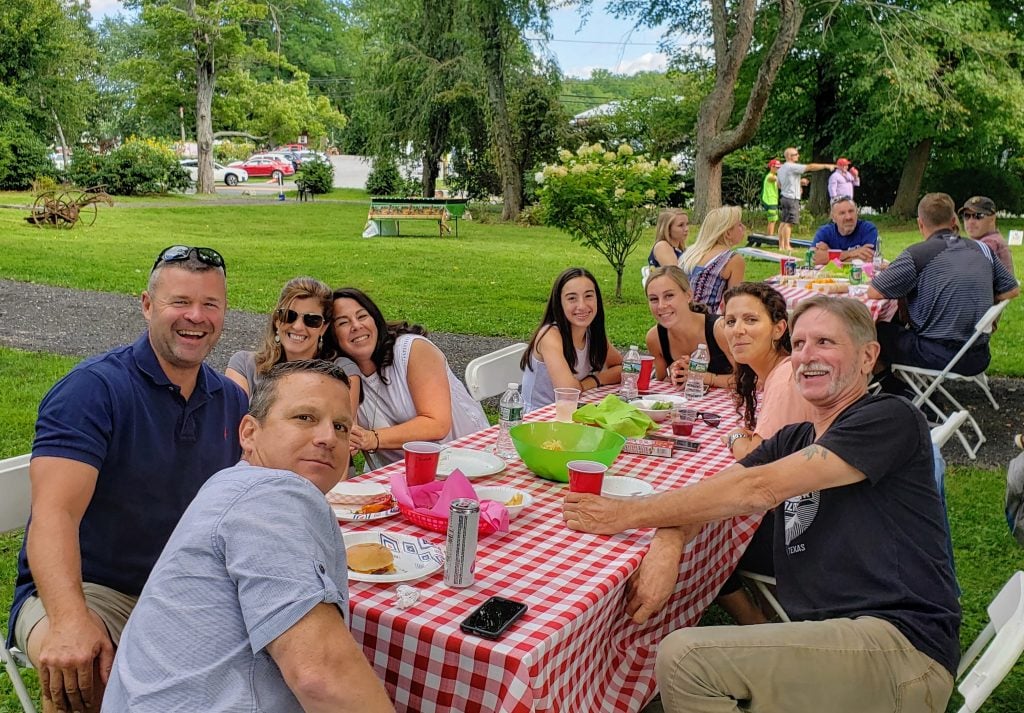
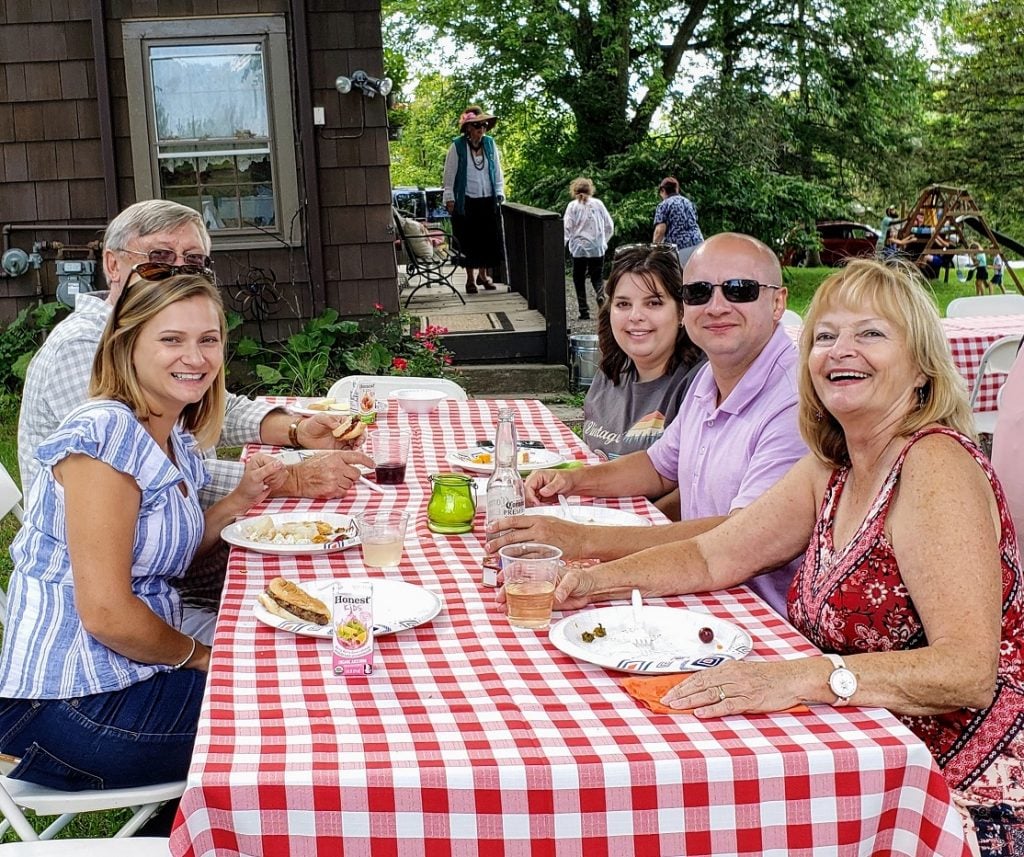
Green Team Realty 2019 Summer Social … A Family Gathering
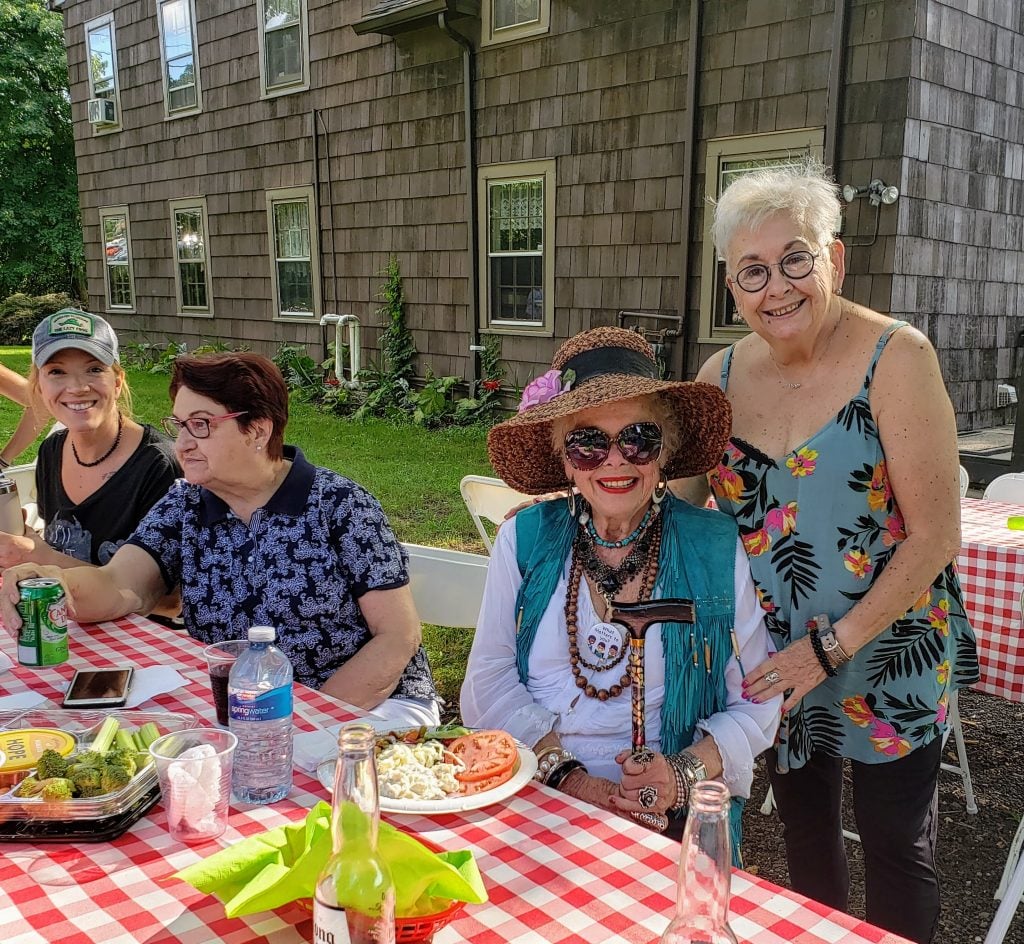
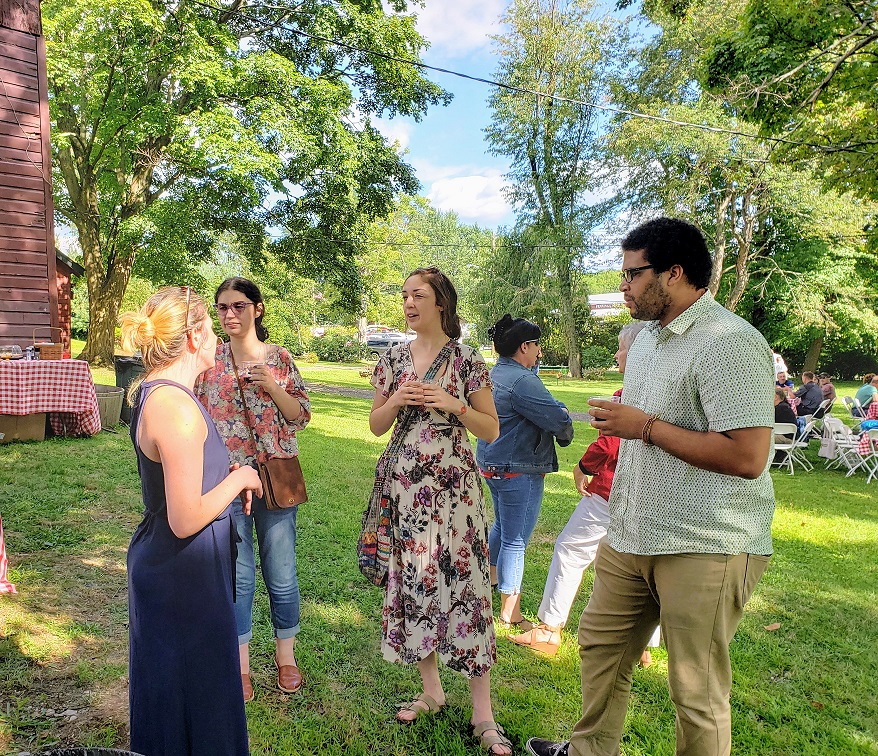
It’s a familiar scene. As summer ends, families gather to enjoy one more fun day in the sun. And the Green Team is no different. Children race around the grounds, laughing and playing. Adults gather at picnic tables, enjoying the food, beautiful weather, and the company. The Sales Associates of Green Team New York Realty and Green Team New Jersey Realty work hard all year. However, the Summer Social is a day to unwind and introduce their families to their Green Team Family. Geoffrey Green, President of Green Team Realty, understands the importance of having days like this. Events where everyone can kick back, talk shop or talk family. And just relax and be together!
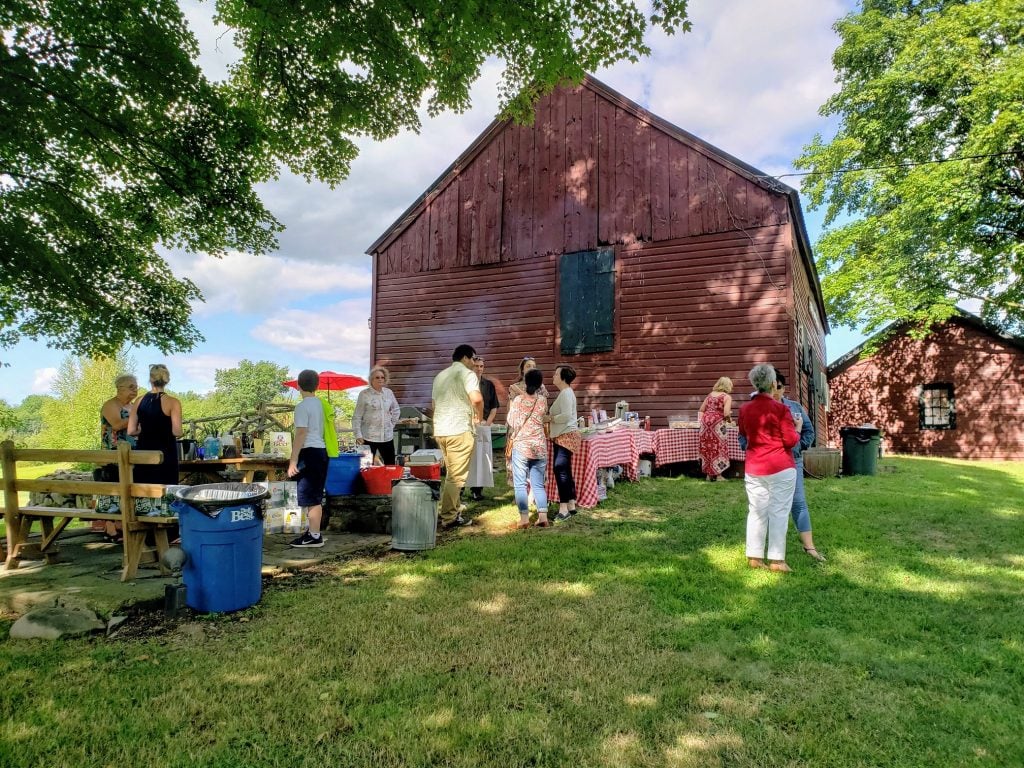
Thanks to our sponsors, and to all the Green Team’ers who brought Pot Luck dishes! The food was fantastic. Further, the weather could not have been more perfect. Finally, we could not have asked for a more wonderful setting than Spring Brook Farm.
Spring Brook Farm
This beautiful family farm is owned by Marie Pennings. Spring Brook Farm is a wedding and special event destination. But it was also the perfect venue for the Green Team Summer Social! Besides the acres of land, perfect for games and just running around, many also took advantage of the swimming pool. Of course there was lots of room for tables and food stations. And the lovingly restored barn provided a look back at the history of this special place. Finally, there were the absolutely gorgeous views.
Thank you to all our wonderful sponsors!
The sponsors for our Summer Social helped make this a day to remember! We appreciate their contributions to what was an incredible event. Thanks to:
Party Heroes
Amy Green, Vice President of Mortgage Lending, Guaranteed Rate
[et_pb_section fb_built=”1″ _builder_version=”3.0.47″][et_pb_row _builder_version=”3.0.48″ background_size=”initial” background_position=”top_left” background_repeat=”repeat”][et_pb_column type=”4_4″ _builder_version=”3.0.47″ parallax=”off” parallax_method=”on”][et_pb_text _builder_version=”3.0.74″ background_size=”initial” background_position=”top_left” background_repeat=”repeat”]According to the Pew Research Center, around 37% of U.S students will be going back to school soon and the rest have already started the new academic year. With school-aged children in your home, buying or selling a house can take on a whole different approach when it comes to finding the right size, location, school district, and more.
Recently, the 2019 Moving with Kids Report from the National Association of Realtors®(NAR)studied “the different purchasing habits as well as seller preferences during the home buying and selling process.” This is what they found:
When Purchasing a Home
The major difference between the homebuyers who have children and those who do not is the importance of the neighborhood. In fact, 53% said the quality of the school district is an important factor when purchasing a home, and 50% select neighborhoods by the convenience to the schools.
Buyers with children also purchase larger, detached single-family homes with 4 bedrooms and 2 full bathrooms at approximately 2,110 square feet.
Furthermore, 26% noted how childcare expenses delayed the home-buying process and forced additional compromises: 31% in the size of the home, 24% in the price, and 18% in the distance from work.
When Selling a Home
Of those polled, 23% of buyers with children sold their home “very urgently,” and 46% indicated “somewhat urgently, within a reasonable time frame.” Selling with urgency can pressure sellers to accept offers that are not in their favor. Lawrence Yun, Chief Economist at NARexplains,
“When buying or selling a home, exercising patience is beneficial, but in some cases – such as facing an upcoming school year or the outgrowing of a home – sellers find themselves rushed and forced to accept a less than ideal offer.”
For sellers with children, 21% want a real estate professional to help them sell the home within a specific time frame, 20% at a competitive price, and 19% to market their home to potential buyers.
Bottom Line
Buying or selling a home can be driven by different priorities when you are also raising a family. If you’re a seller with children and looking to relocate, let’s get together to navigate the process in the most reasonable time frame for you and your family.


 Facebook
 X
X
 Pinterest
 Copy Link