Facebook
 X
X
 Pinterest
 Copy Link
February 2019 Housing Market Update
Green Team Realty’s February 2019 Housing Market Update went live on Facebook February 12 at 2 p.m. If you were unable to view the webinar live, you can watch it at your convenience by clicking here. Sign up for future updates here.
Meet this month’s panelists…




Moderating the Market Update is Geoffrey Green, President of Green Team Realty. In addition, Geoff presents national statistics as well as local updates for Orange County, NY and Sussex County, NJ. This month he is joined by Jennifer DiCostanzo of Green Team New York Realty, Michael Giannetto of Residential Home Funding, and Keren Gonen of Green Team New Jersey Realty.
The National Perspective
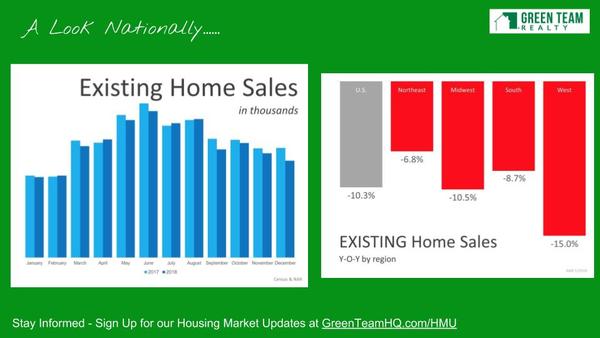
According to Geoff, this time last year no one was really talking about a slowdown in the housing market. The conversation was more about how fast and how far everything would go. A few months later some chinks in the armor appeared. And now we’re looking at national numbers, comparing 2018 to 2017, Sept – Dec, all below the year over year numbers from 2017. The year over year drop by each region, 10.3% overall, 6.8 in the northeast, 15% in the west, etc., is also of interest.
A quote by Mike Fratantoni, chief economist for the MBA, is relevant: “The spring home buying season is almost upon us, and if rates stay lower, inventory continues to grow, and the job market maintains its strength, we do expect to see a solid spring market.” In Geoff’s experience, this just seems to be a very slow moving market pace; unlike the fast paced ups and downs of the stock market. From the perspective of number of units sold, we’re clearly trending down. It seems that every region in the U.S. is on that same path.
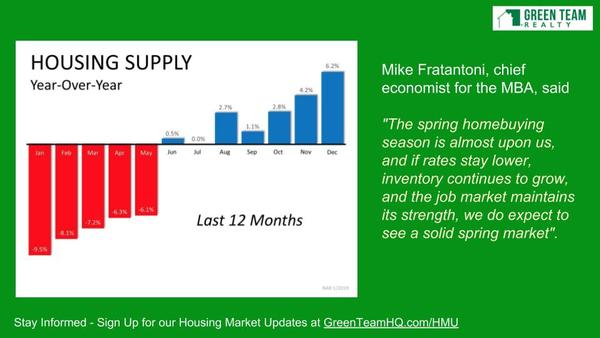
Over the last 12 months, housing supply was in the red, meaning there was a lack of it. In June there was a turnaround, with more supply. Some people are saying that transactions are going to catch up again, with more supply becoming available. However, Geoff is not entirely sure that is going to happen at this time. While he does believe there will be a strong market in 2019, the real debate is what is going to happen in 2020, 2021, 2022.
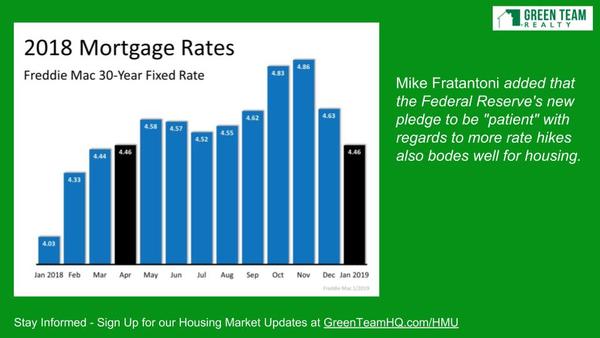
There was a period of time when rates were climbing, but now they are almost 1/2 a point lower than they were in October, November. The Fed is pledging to be patient with raising short term rates, as they’re seeing indicators of a potential recession on the horizon. They’re slowing down anticipated rate hikes which had been slated at the end of last year.
The Local Perspective – Orange and Sussex Counties
Units Sold
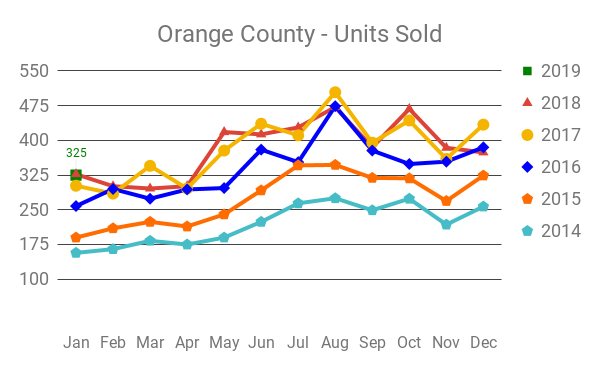
There is a lot to glean from the local stats, even as they play out on the national stage. In January, while the same as in 2018, it’s still higher than the previous four years. This is a good indicator.
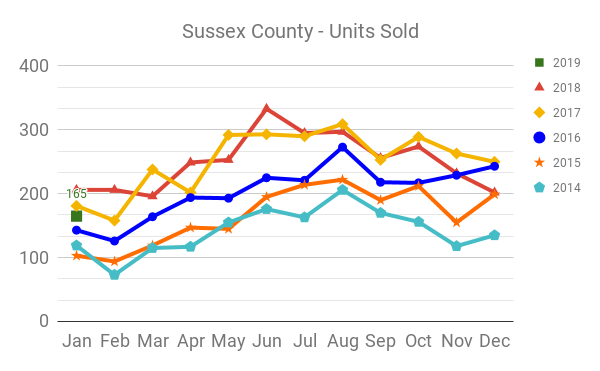
In Sussex County, we’re just above 2016, but below 2017 and 2018, for the month of January.
Days on Market
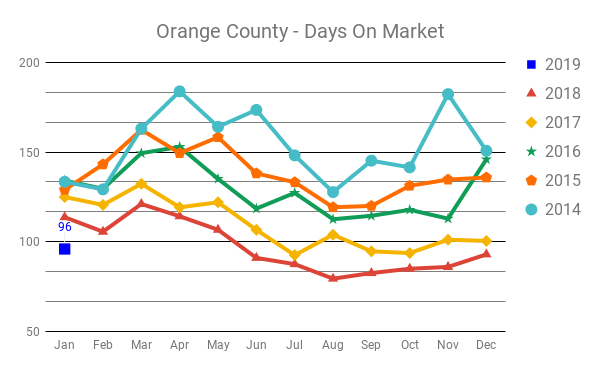
This stat is an indicator of how fast things are moving. In Orange County, January 2019 is the lowest it’s been for this month in five years.
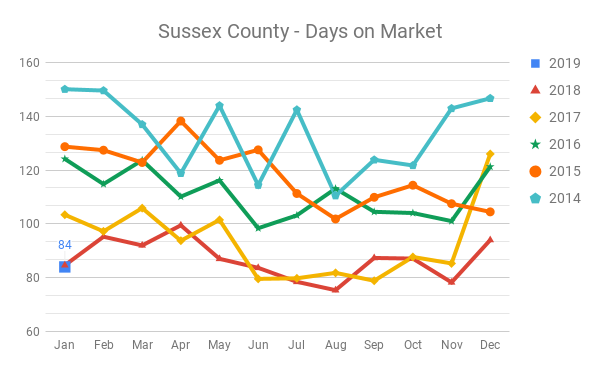
In Sussex County, the number of days on the market is tied for the lowest it’s been in five years.
Average Sales Price
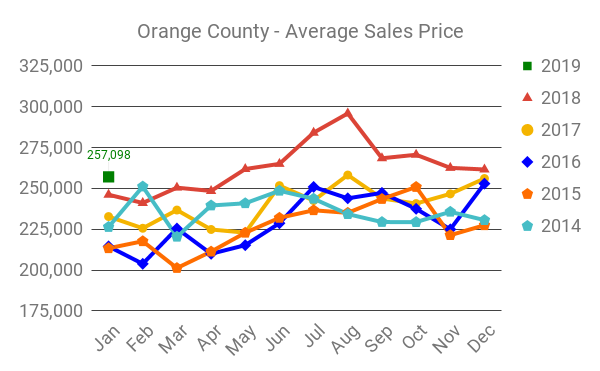
As Geoff has mentioned in the monthly housing market updates, price lags activity. Price appreciation should be seen throughout the first half of 2019, but he believes in the second half of the year, prices will start to come down.
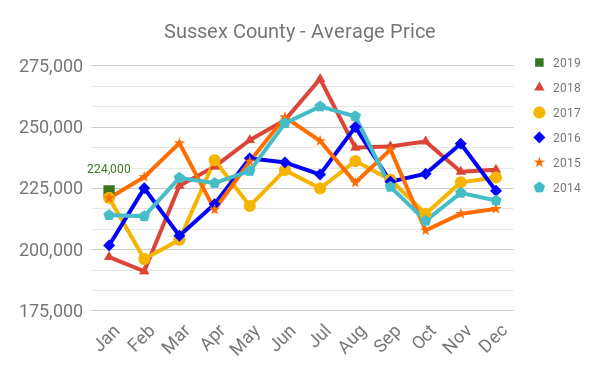
The highest peak was in 2018. January 2019 has the highest price for that month in the last five years. In general, higher prices should bring out more sellers, which should create more inventory and allow more units to sell.
Asking to Sold Ratio
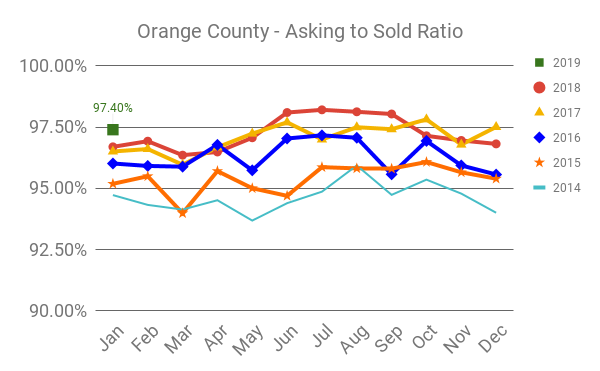
This is the ratio of the last asking price versus where are homes selling. This shows on average how much sellers are having to negotiate off the price of their property. This is the highest ratio for this month since 2014.
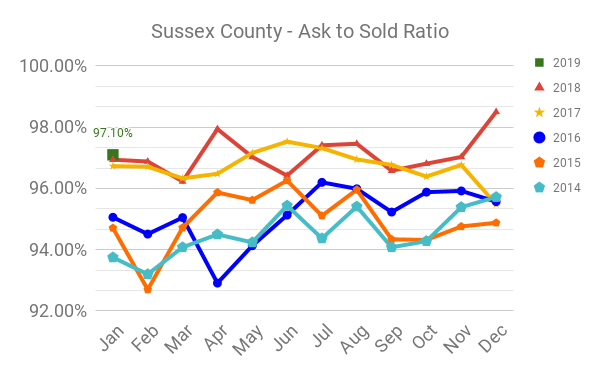
This number is strong in Sussex County as well as in Orange. The numbers are still showing a strong market.
And thanks to our Sponsor…
The Housing Market Update is sponsored by REALLY – a better, smarter, faster real estate referral network for Agents. Learn more at ReallyHQ.com.
Panel Discussion:
Geoff introduced Jennifer DiCostanzo of Green Team New York Realty, the top producer in the company. According to Jen, supply and demand are a real challenge. On the Orange County side, sellers are afraid to list because they have nowhere to go if they’re shopping in the same market. If sellers are relocating, it’s easier for them to let go as they don’t have the same issues and can secure housing. She is welcoming this market because she finds buyers to be more educated and sellers more realistic. Jen is hoping to see the market open up.
Keren Gonen of Green Team New Jersey is a regular panelist on the Housing Market Update. Her thoughts on the January sales numbers were that the totals were a reflection of inventory not being available. Sales were higher last year as there was more inventory to sell. It still is a seller’s market due to lack of inventory. And there are several sellers on the fence, waiting to see what will happen in the near future. There is hope that these sellers will soon be listing.
According to Geoff, the lack of inventory is a real problem. Nationally and locally, seeing the numbers going down, it seems like less people are buying homes. There has been a lot of frustration for some trying to buy a home, and some may have rented when they couldn’t find anything. Some may now be locked into leases.
What will the market look like over the next few years?
Geoff asked Jen what she thinks the market will look like in 2020, 2021,2022 as far as pricing, activity… She feels that we’re at a more stable point now; that it will not be quite as erratic. After the last downturn, when prices finally started going up in 2016, 2017, it was a very poignant time. If you bought at the height of the market, you could actually sell and recoup equity. That is the silver lining in helping sellers make that decision when they need to sell. And now is that time. If job growth is good and stable and interest rates make home buying and financing affordable, the market should stay at a steady pace. Real estate is fueled by circumstance, regardless of the market. People will always need to buy and sell. If we can give leverage to the market by educating our buyers and sellers and strategically strategizing, you put them ahead of the game.
Geoff asked if Jen had been referring to those buying homes in 2006, 2007 and 2008 when she talked about recouping equity. Jen replied that basically, it would go short. Jen purchased her own home in 2007, and almost immediately she would have been unable to sell her home for what she bought it for. Where we are now is a good time to step back and walk away with equity. Whether you’ve been in your house for 10 years or 50 years, you’re going to recoup on your investment. Geoff recalled the downturn. There was a huge loss, almost 50% of the number of transactions from 2006 to 2008 disappeared, and it was a very difficult time. He found Jen’s point valid; that people should finally be able to move on and move into something else should they want to.
Geoff then asked for Keren’s 2-3 year view. She hopes that we remain in a strong market. With rates coming down, she sees more people who had been renting once again looking to buy. However, the issue remains inventory. Keren sees growth in the area, with people moving to Sussex from other counties in New Jersey and some from New York, attracted to lower taxes, etc. Buyers are more educated, but so are the sellers. Therefore you see homes that are priced correctly. She believes the market will remain good for at least a couple of years.
Mortgage trends
Mike Giannetto of Residential Home Funding was asked if he sees the trend of lowering interest rates continuing. Mike replied he hopes so. There has been a decrease in interest rates. There is a global slow down. The economies in China and Europe are getting weaker. We’ve had a downturn in our rates because we are the safest investment at this point. This definitely had an affect on mortgage backed securities and hopefully the stronger US market will continue.
Geoff recapped. The more risky other assets are, the more money wants to seek a haven in bonds, which drives down the rate that people need to give to attract people to buy those bonds, which ultimately lowers interest rates on mortgages. Instability and uncertainty around the globe actually can be good for mortgage rates to come down.
We know a recession will be coming; just don’t know when. Those that went through the last downturn in the housing market are waiting “for the other shoe to drop.” As long as there is no global meltdown economically, we should be okay. The market is pretty healthy. Geoff has heard of some subprime lending happening; he asked Mike if he’s seen it occurring at levels similar to 2005-2007. Mike replied that there are safeguards in place, even as some new products are being introduced. Some of the products are necessary in order for some people, such as self-employed, to purchase a home. The money behind these products is portfolio money or hedge fund money, which is why the loans are scrutinized. The banks are lending their own money, so are therefore quite careful.
To reach the panelists:
Michael Giannetto, Residential Home Funding: 845-496-0836, rhfunding.com/michaelgiannetto
Jennifer DiCostanzo, Green Team New York Realty: 917-916-9995
Keren Gonen, Green Team New Jersey Realty: 551-262-4062
The next Housing Market Update will be held on Tuesday, March 19 at 2 pm. Stay informed and sign up for updates at GreenTeamHQ.com/HMU.
Green Team New Jersey Realty is #1 in Vernon
Green Team New Jersey Realty is the #1 real estate office in Vernon* and they couldn’t be prouder.
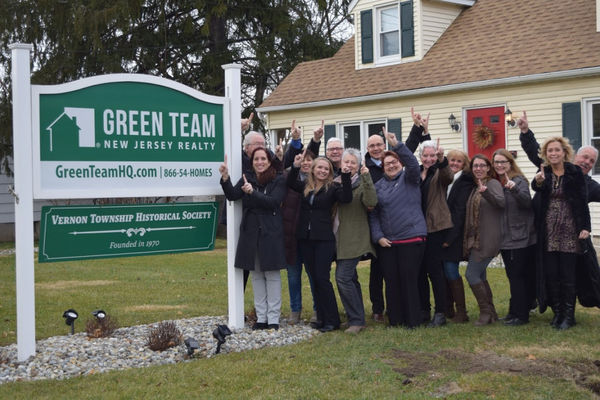
Some of Green Team New Jersey Realty Partners share their thoughts
According to Equity Partner Charles Nagy, “2018 was an exciting year for Green Team New Jersey Realty on a number of fronts. First and foremost, it was a year of great accomplishments for the team. Not only did we bring on some new and experienced talent, but we also bought our own office building. And, as a result of the team effort, we ended the year as the #1 real estate office in sales volume and transactions in all of Vernon, NJ after only our second year in business. It is exciting to see what we accomplished as a team for the entire year.”
Kim Lasalandra, Managing Broker, described how she felt. “I’m ecstatic! To be the #1 office in terms of sales volume within two years of opening our doors is truly remarkable. And it’s a tribute to the incredible work ethic and determination of our sales associates.”
Geoffrey Green, the founder of Green Team New York Realty and a partner in Green Team New Jersey Realty, shared his thoughts. “I’m very proud of everyone at Green Team New Jersey Realty for taking Green Team Realty’s model, bringing it to Vernon, growing it, and achieving #1 status. I just can’t wait to see what 2019 brings!”
Green Team Realty’s dedicated approach…
Green Team Realty’s dedicated approach has proven that the results are impressive when you provide productive, dedicated agents with continual training and support, a culture that values clients through excellent service and an appreciation program, and an array of competitive advantages. Furthermore, Green Team Realty’s commitment to local community and charities is another aspect that attracts like-minded real estate professionals.
Green Team New Jersey Realty’s new office is located at 293 Route 94, Vernon, NJ. To learn more, visit GreenTeamHQ.com or call 973-814-7344.
*As compared to all GSMLS Offices located in Vernon Township by closed sales volume for the time period of 1/1/18-12/31/18.
January 2019 Housing Market Update
The Green Team’s January 2019 Housing Market Update was held on Facebook Live Tuesday, January 15 at 2 p.m. If were unable to view the webinar live, you can watch it at your convenience here. You can also sign up for future updates at GreenTeamHQ.com/hmu.
This month’s panelists…




Geoffrey Green, President/Broker of Green Team Realty, moderates the monthly webinars. He also presents national statistics, together with local updates for Orange County, NY and Sussex County, NJ. This month he is joined by Carol Buchanan of Green Team New York Realty, Keren Gonen of Green Team New Jersey Realty and Patrick “PJ” Keelin of Family First Funding.
The National Outlook
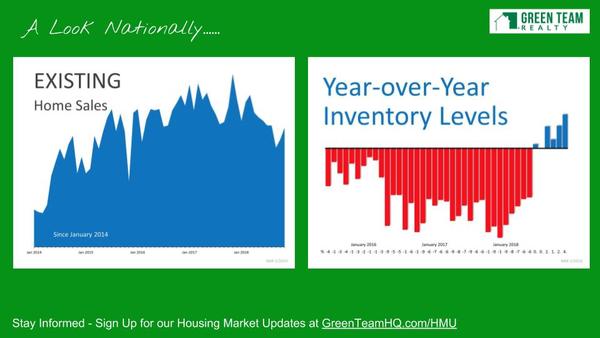
The above charts are raw numbers – the number of homes that were sold from 2014-2018. It appears that things are softening a bit, but it doesn’t appear that it will be drastic.
The analytic showing inventory levels is important. It has been difficult to find homes for buyers over the last few years. However, it appears that inventory levels may be coming back a bit. Lower demand should yield more inventory, but hopefully what some inventory may do is bring some people back into the game who may have been been frustrated previously.
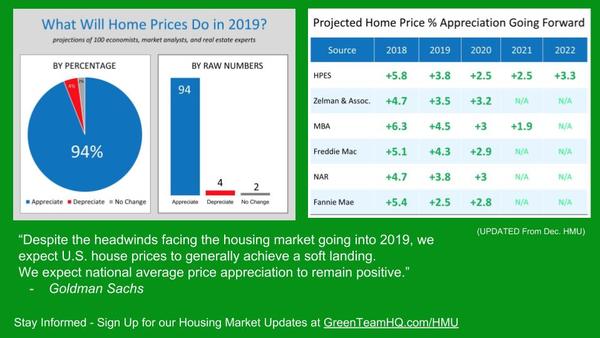
This survey of experts, market analysts, etc. addressed the question, “What Will Home Prices Do in 2019?” 100 people were surveyed and 94% projected that housing prices on a national basis will continue to appreciate. Geoff aligns himself with that 94%. He believes that in 2019 prices will come up again in spite of the fact that activity went down. Price always lags activity.
According to Geoff, this quote from Goldman Sachs is a good one. “Despite the headwinds facing the housing market going into 2019, we expect U.S. house prices to generally achieve a soft landing. We expect national average price appreciation to remain positive.” If this comes true, it’s music to Geoff’s ears. He lived and worked through the last downturn, where 50% of the number of homes that sold went away within a 2-year period of time once the market starting declining. It was a difficult time
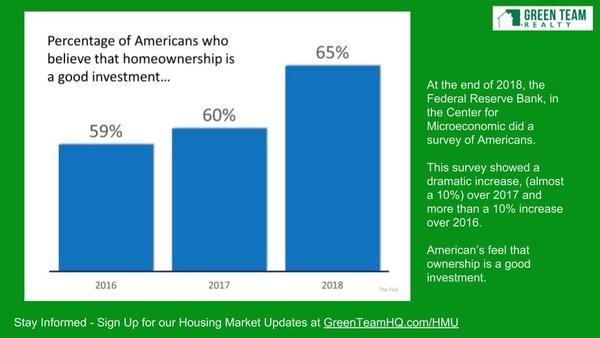
The percentage of Americans who believe homeownership is a good investment continues to increase. The market is at a peak and confidence continues to increase. However, Geoff finds that people tend to buy high and sell low. They should be buying low and selling high. The bottom of the market, 2011, 2012, and 2013 would have been a good time for investment.
However, people are confident that it’s a good time to buy now. And one thing that will never change is that homeownership is a good thing.
January 2019 Local Housing Market Update for Orange and Sussex Counties
Units Sold
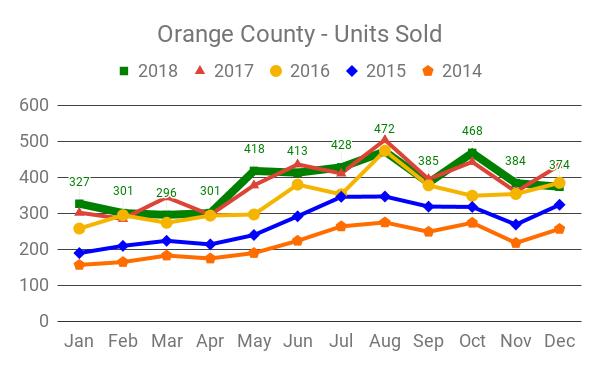
Five year look back. The thick green line is 2018 and while it’s been a mixed bag throughout the year, we ended up just a tad bit lower than the past two years.
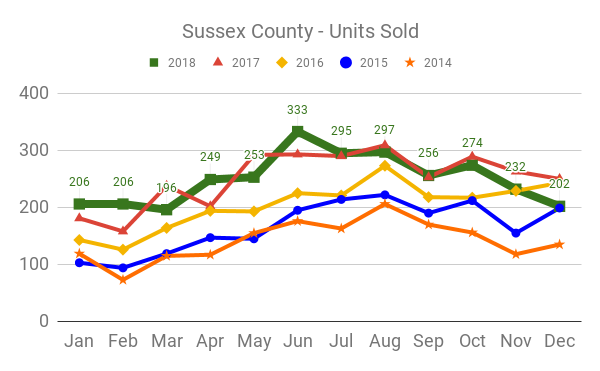
In Sussex County, Units Sold was also a mixed bag, with one of the lowest totals in almost 4 years.
Average Price
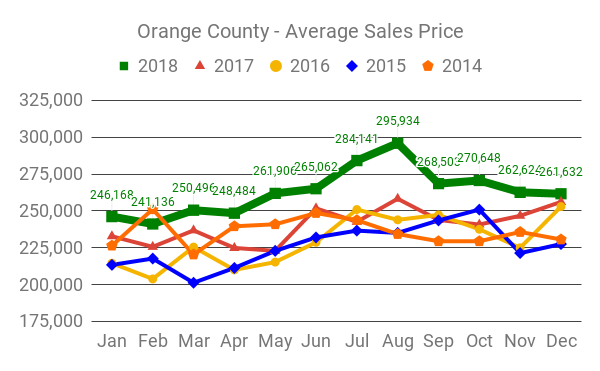
In Orange County, prices were up substantially for a good part of the year. However, there was a cooling-off period towards the end of the year.
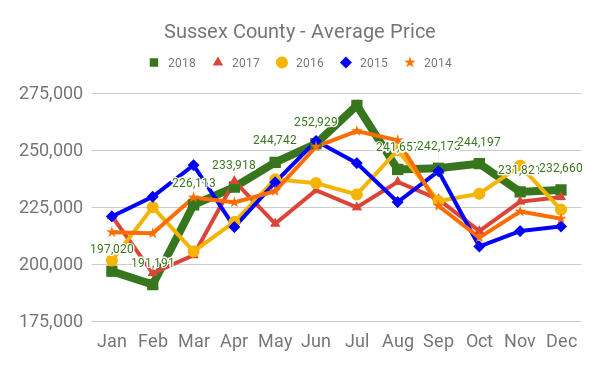
Sussex County never saw as much of an appreciation as Orange County did. However, 2018 was still a leading year over the past 5 years.
Asking to Sold Ratio
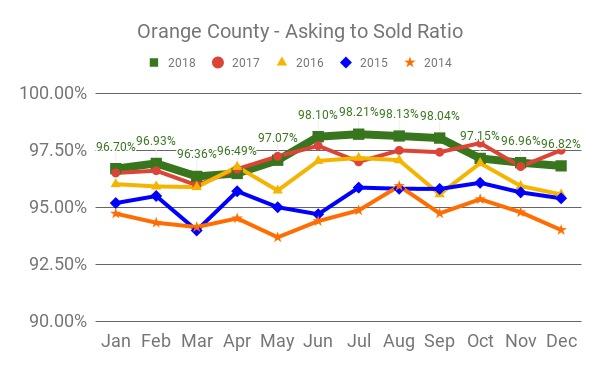
What price do homes on average sell for versus the last asking price? The higher towards 100% the hotter the market. The numbers have been strong for Orange County throughout the year.
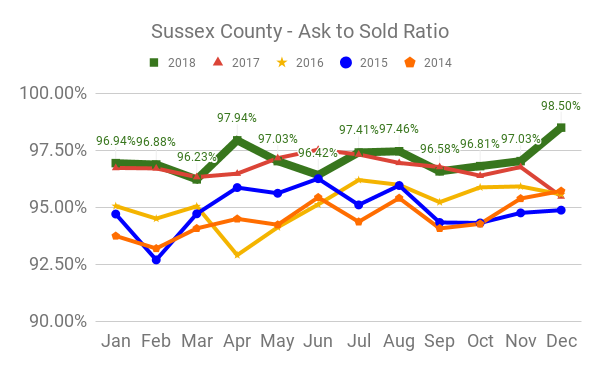
Sussex County was strong in this category throughout the year. However, it hit its highest point in December 2018 with a ratio of 98.50%.
Panel Discussion
Geoff asked Carol Buchanan and Keren Gonen what they think of the market, as it appears a softening is underway. Carol stated that inventory is still low, and January and February are common months for the market to slow down. Carol does believe that 2019 is going to be a very good year. People seem undaunted by higher interest rates. Still a lot of buyers; just not enough homes.
Keren also agrees that 2019 will be a very good year. She thinks that people will start listing homes for sale within the next few months. Right now buyers are looking but there is still not enough inventory. She feels there are sellers sitting on the fence, not sure what to do and just holding out for a few more weeks or months. Geoff commented that the bread and butter of the season is March through August. So it’s natural for many homeowners to wait until March to list their homes.
Talking with Keren regarding foreclosure activity, Geoff asked if she see a decline? Banks are fixing up houses and putting them up at market prices. If the quality of work was good, that would be fine. However banks are bidding jobs out and the resulting work is not necessarily good work. Buyers expect to see good quality and are disappointed with what they’re finding. They often would prefer to pay more for a house that is in good shape. Therefore, many of these homes being sold by the banks are just sitting on the market. Banks are now competing with flippers who, generally speaking, do a better job at fixing up homes than the contractors. Buyers most often prefer paying full price for a home that was “flipped” well than on an REO that was not done well.
Geoff mentioned that this was not the trend in the past. Banks would not fix up their properties and try to sell them for more money. They’d just try to unload them at lower prices and buyers could get a good deal. Over the course of time we’ll see if banks decide to go back to the way they used to handle foreclosures.
Regarding the financing environment, Geoff asked Patrick “PJ” Keelin what we’re looking at for 2019. As Geoff put it, at the end of the day we’re really in the land of the banks, dependent on what they’re willing to do. And how many times the Federal government is willing to let banks leverage their money. PJ indicated that on a global scale, at the end of the year there was talk of the Feds raising the interest rate. That usually indicates a stronger economy; stronger aspects coming from the financing angle and mortgage-backed securities, etc. Unfortunately, at the end of the year there was a huge difference and the Dow dropped significantly. The drop in the Dow affected reports of things they were coming out with. So trends and thoughts of increased interest rates by the end of the year through that New Year boom fizzled out. There are reports that there is potentially going to be a decrease in interest rate for the year 2019. PJ believes that is something being put out there for a little bit of hope.
However, the biggest thing we’re competing with is the lack of inventory and what people will be able to purchase. Looking at an average household income of $60,000 to $70,000, that probably puts a person on average of what they can afford in terms of a property at $1,500 to $1,600 range. That gives them a certain price point that they have to stay in, and with increases in interest rates that is going to affect their eligibility to be able to purchase properties within a certain price range.
Geoff stated that all signs point to Fed raising interest rates. He asked PJ if he thinks that won’t be the case in 2019. PJ replied that there will be a lot less than they were expecting in 2018. They may skip the first interest rate rise. Hopes on the industry side are that there will be a potential interest rate drop. That may push that boom for people who are still sitting on the edge. He sees a stronger trend with the amount of people who are actually motivated in purchasing. They may finally be believing the reports that interest rates are not going to stay historically low and will go up. So many reports are going in different directions that it’s unsure what to make of it. Industry leaders are saying the market is staying relatively steady, but be prepared. There could be a drastic change.
Right the now trend is slow and steady. PJ commented that Geoff is proactive in all that he does; communicating with his sales associates and with the lenders they work with. Because ultimately these transactions need to happen quickly in order for them happen. When they remain open, bigger changes are coming.
Geoff wrapped up, saying that at the end of the day, interest rates are impacted by bond markets. As long as there is no major economic collapse, the housing market should be fine. He predicts a good 2019. PJ agrees, that it will be a good, strong year. People are getting more motivated.
Join us for the next Market Update
The next Housing Market Update will be held on Tuesday, February 12 at 2 p.m., when the Green Team will again be going live on Facebook. Sign up for updates at Greenteamhq.com/hmu.
Green Team 2018 Awards Ceremony celebrates another year of growth and success

Agents and staff of Green Team Realty gathered together on January 18 at the Warwick Country Club to celebrate a year that was momentous in many ways. Geoff Green welcomed everyone and outlined some of the year’s milestones.
Among them, a new home for Green Team New Jersey Realty and a beautiful renovation of the Warwick Office. Add to that the many new sales associates that have joined Green Team New York Realty and Green Team New Jersey Realty.
Growth was an important topic. Through dedication, hard work, support, creative marketing and consistent training programs, many Green Team sales associates saw their businesses grow. And both offices saw sales volume increase. In fact, Green Team New Jersey Realty became #1 in Vernon (based on a comparison to all GSMLS offices in the township by closed sales volume for the period of 1/1/18-12/31/18). This achievement is made even more impressive considering GTNJR first opened its doors in 2016.
Award Presentations
Geoff Green believes in acknowledging and rewarding both growth and achievement. And what makes the award presentations so special is the support and pride that the whole Green Team family shows to the recipients.
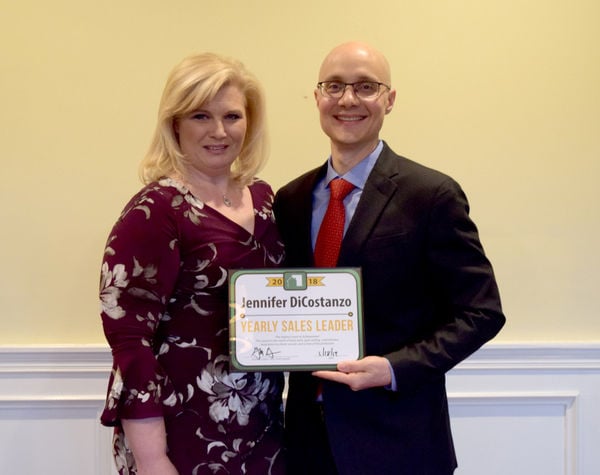
Yearly Sales Leaders & 4th Quarter Sales Leaders

President’s Club
As several sales associates achieved between $5 and $10 Million in Sales Volume, a new award category became necessary. Meet the charter members of the President’s Club.

From Left to Right: Jennifer DiCostanzo, Ted VanLaar, Joyce Rogers, Charles Nagy, Pip Klein, Tammy Scotto, Nancy Sardo and Dean Diltz.
Captain’s Club
This established award is given to those who do $3 to $5 Million in Sales Volume.
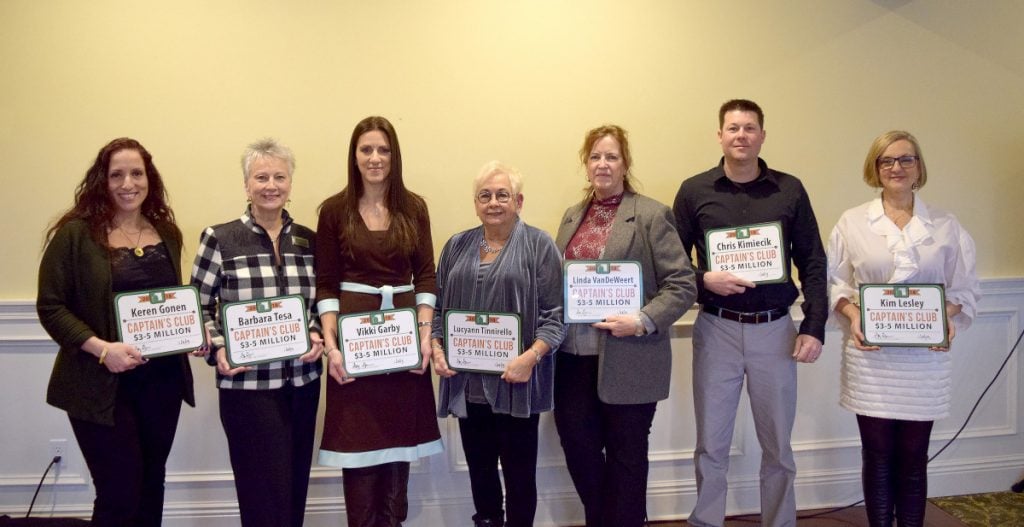
From Left to Right: Keren Gonen, Barbara Tesa, Vikki Garby, Lucyann Tinnirello, Linda VanDeWeert, Chris Kimiecik and Kim Lesley.
Honorable Mention
This new category was created to acknowledge those Sales Associates who had $1.5 to $3 Million in Sales Volume.
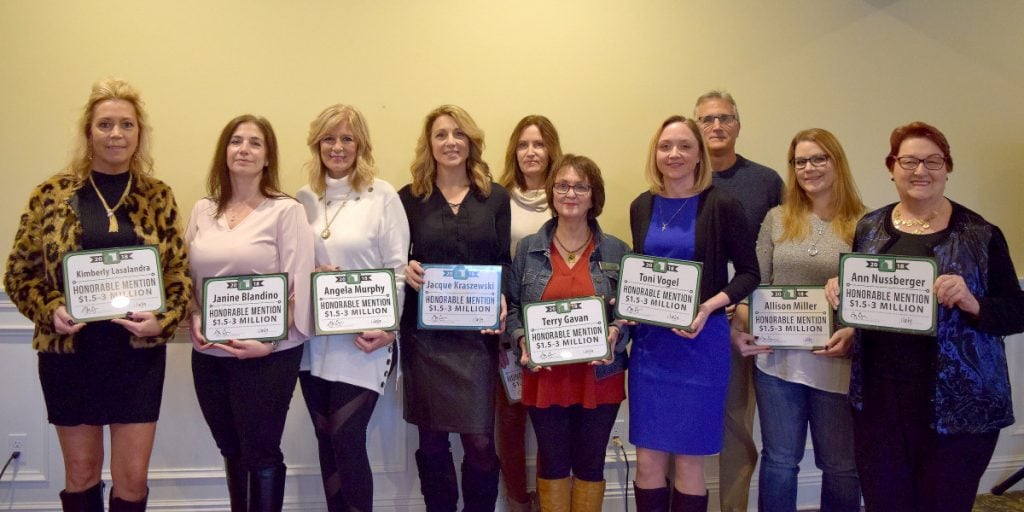
From Left to Right: Kimberly Lasalandra, Janine Blandino, Angela Murphy, Jacque Kraszewski, Mary Lynch, Terry Gavan, Toni Vogel, Tom Folino, Alison Miller, Ann Nussberger.
Not shown: Julianna Green, Toni Kreusch, Connie Marines, Denise Schmidt.
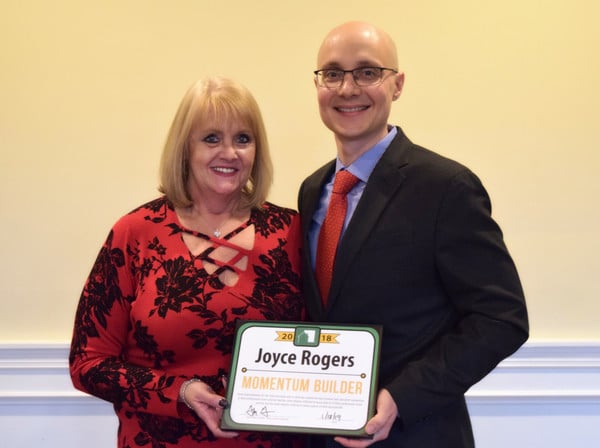
The Momentum Builder Award
The People’s Choice Awards
The winners of these awards are selected by their peers.
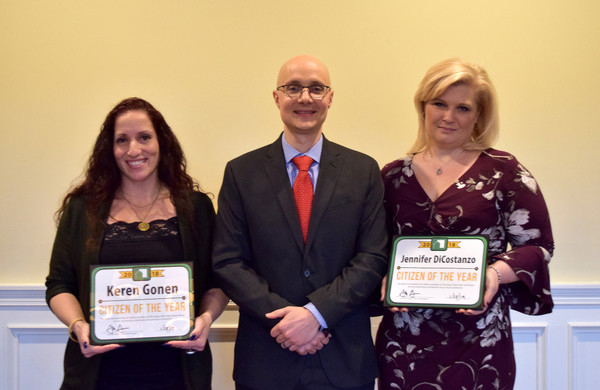
Citizen of the Year
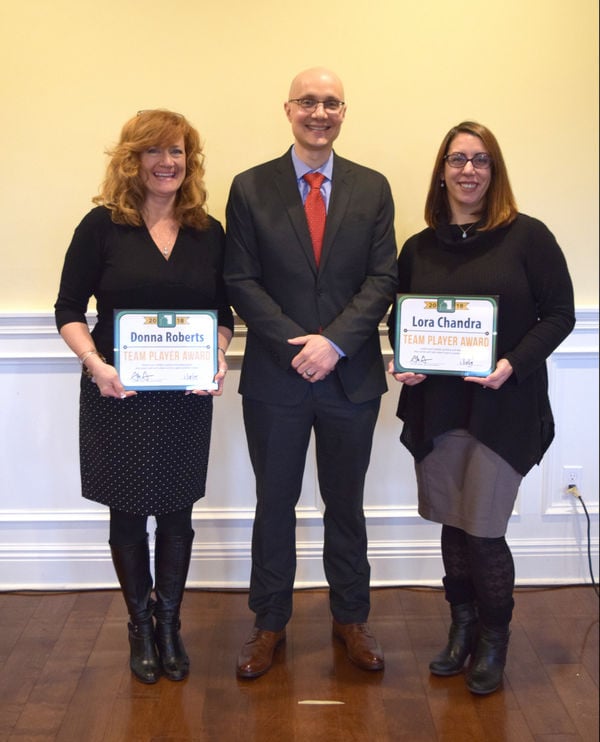
Team Player Award
And a special thank you goes to…


Thanksgiving Pie – A Green Team Tradition

Thanksgiving Pie – A Green Team Tradition
 Thanksgiving. It’s a time of gratitude, friends and family; of turkey and all the trimmings. And at the Green Team, it’s a time to let clients know how much they are valued. The Client Appreciation Program, or CAP, is the cornerstone of the Green Team’s foundation. The Green Team doesn’t take its clients for granted. Through the CAP program sales associates find ways to say “I appreciate you” throughout the year. However, one of the highlights of the program is Thanksgiving Pie. A Green Team CAP tradition, clients are invited to come to the office for a casual party. And to pick up their Thanksgiving pie. Because this gift from their sales associate is a way of saying “Thank You.” Thank you for your business, your referrals, and your friendship.
Thanksgiving Pie… A “family” event for both the Warwick and Vernon Offices
Walking into either office you can feel the warmth and joy and know that you are welcome. Pies are stacked high, waiting to be distributed. Being a local brokerage, it’s important to the Green Team to support other local businesses. Thus Noble Pies has become part of the tradition. Their pies are baked from locally sourced ingredients when available. Cider, wine, donuts and more await the clients as they drop in to pick up their pies. And, of course, there is laughter; lots of laughter!
Green Team Sales Associates agree that the Client Appreciation Program is something they themselves appreciate. It keeps the focus on the people who are most important to their businesses: their clients. And events like this one bring everyone together, strengthening bonds between associates and between clients and associates. Probably one of the best things is that two days later pies from the Green Team’s sales associates will be sweetening Thanksgiving Dinners at many homes. Again letting clients know how much they are appreciated.
October 2018 Housing Market Update

The Green Team’s October 2018 Housing Market Update was held live on Facebook Tuesday, October 16 at 2 p.m. If you missed the live webinar, you can view it at your convenience by clicking here.
You can also sign up for future updates at GreenTeamHQ.com/hmu
Meet this month’s Panelists from Green Team New Jersey Realty and Green Team Home Selling System
Geoffrey Green, President/Broker of Green Team Home Selling System, is the moderator of the monthly webinar and presents stats and market updates for Orange and Sussex County. He is joined this month by Keren Gonen, Pamela Zachowski and Alison Miller of Green Team New Jersey Realty in Vernon and Jacqueline Kraszewski of Green Team Home Selling System in Warwick.




Market Update – The National Perspective
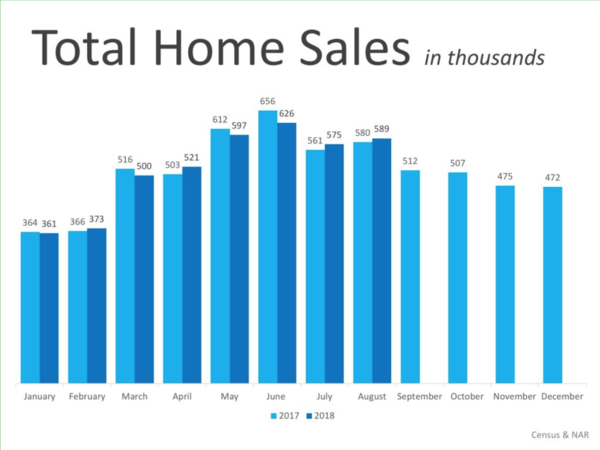
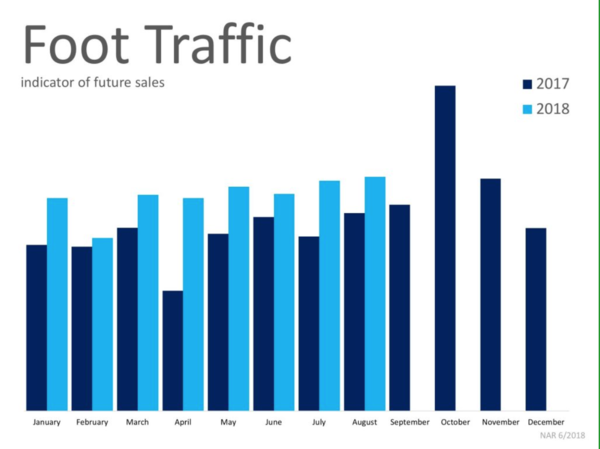
A look at Total Home Sales Nationally
Things seem to be shifting in the housing market. For Geoff, the stats of homes sold are the “mother’s milk” of the industry. Nationally it’s been a mixed bag through 2018. September’s numbers are not yet in, but August numbers for total home sales were just about even for 2017 and 2018. It appears that things are shifting in the market, with the number of sales not increasing like last year, year over year. However, foot traffic in August was much higher in 2018 than in the same period in 2017.
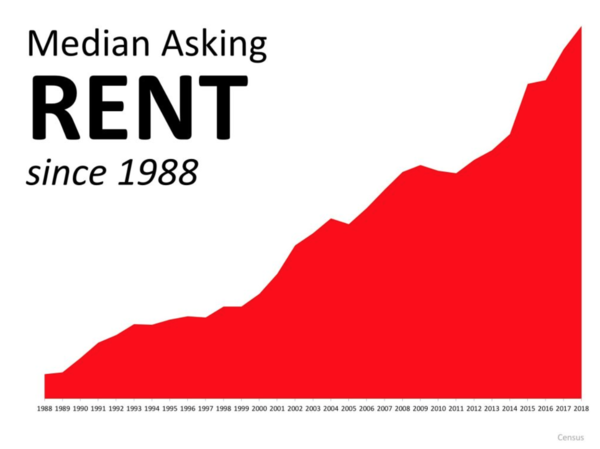
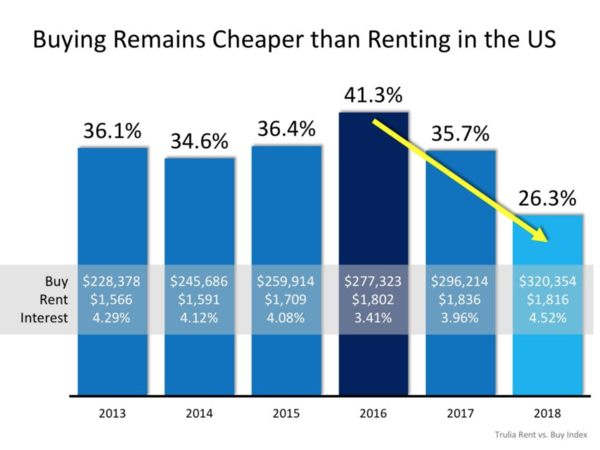
Buying versus Renting…Which is the best way to go?
Lawrence Yun, the economist of NAR, has said that we’ll probably see growth in terms of the housing market on the lower end because the job market is strong. People are working, making money and want to invest their money in real estate. However, there may be a slowdown in the higher end because interest rates are rising. How does affordability of renting compare with buying? There is a steep curve, not a good outlook for renters. Since 2013 it has been cheaper to buy instead of rent on an overall national basis. If you have the ability, it costs less to buy than to rent on an overall monthly basis.
October 2018 Housing Market Update – Orange County
Units Sold
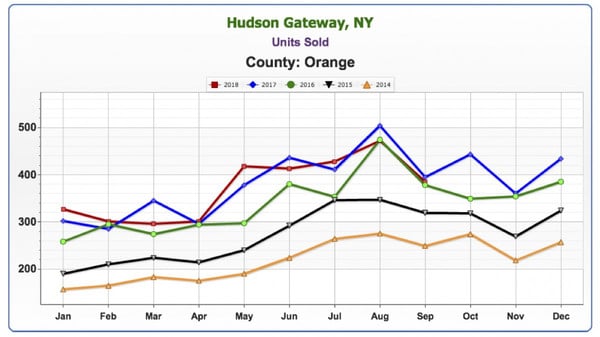
As stated before, Geoff sees this number as the mother’s milk of the housing market. This all-important number gives us a snapshot of how many homes are selling. The number of units sold in Orange County appears to be cooling off. He believes we’ve seen the peak of the last runoff and that it’s behind us. Geoff’s view seems to be backed up by an article that appeared last week in the Wall Street Journal, which referred to a soft downturn in the market.
Average Price
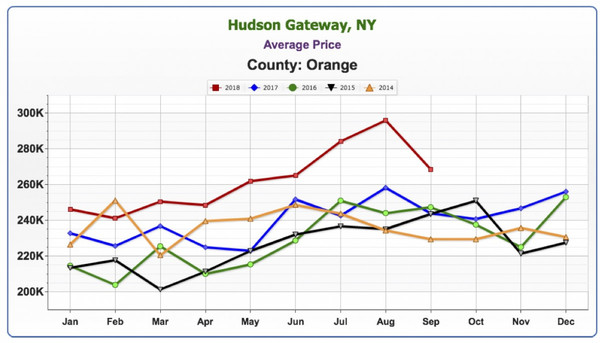
There is a big variance in price from where we were last year. The downward trend is a seasonal fluctuation and not a cause for concern. Price always lags units sold at least 6 months or more. Price increases may occur over the next 6 to 12 months, even though the number of units sold is dropping.
Average Sold to Asked Ratio
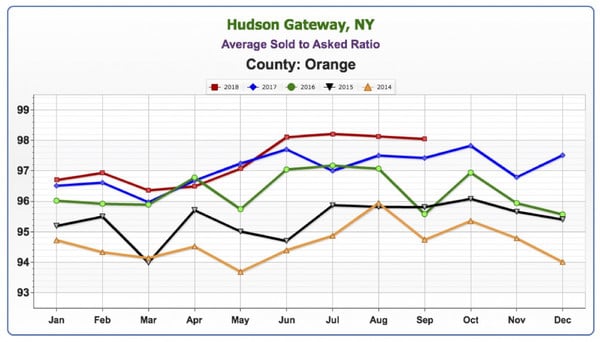
We are still pretty high, still over 98%, which means sellers are only having to negotiate 2% from their asking price.
October 2018 Housing Market Update – Sussex County
Units Sold
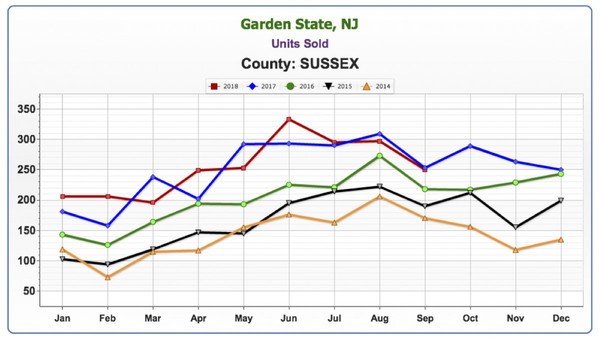
A similar trend to Orange County, where some months are up, some down, on a year over year basis. It’s a mixed bag, and the numbers seem to indicate a cooling off.
Average Price
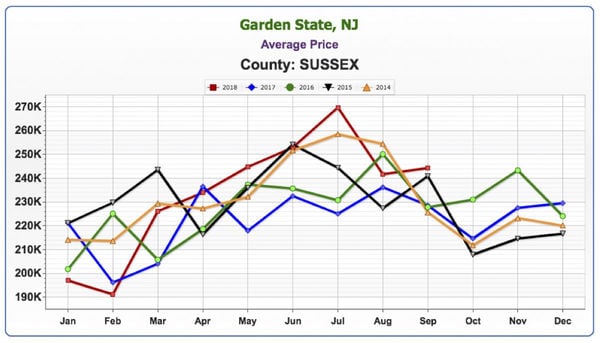
Average prices never rocketed in Sussex as they did in Orange County. In previous updates, we’ve spoken about how there is simply more foreclosure inventory and activity which has dragged down the average. However, that doesn’t mean that homes that are well maintained and well located haven’t done well.
Average Sold to Asked Ratio
Average price never rocketed here like it did in Orange County. There has been much more foreclosure inventory and activity in Sussex and that has dragged down the average home price. However, that doesn’t mean that well-located, well-maintained homes haven’t done well.
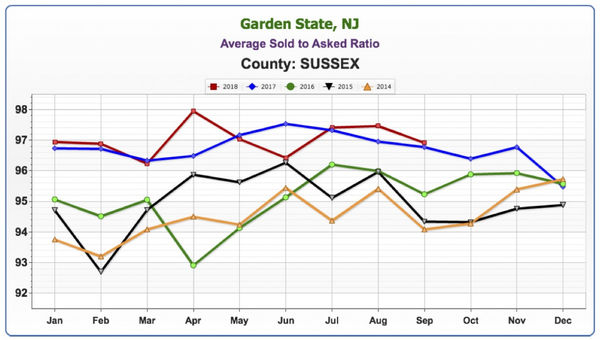
Slightly below Orange County, the numbers are still hovering around 98%.
Panel Discussion
The Sales Associates Point of View
Geoff believes the market is cooling. He asked the panelists what they were sensing in the field. Keren replied that there are fewer houses that are updated and nicely done, and buyers have higher expectations. During the summer, people were rushing to find homes in order to get situated before the start of the school year. Without that added stress, many buyers are being pickier. Alison finds that people are looking for something that is just not there. Inventory is not meeting the demand. In addition, many of her closings were delayed, affecting numbers for September.
Jacque is finding that there is a lack of finished, move-in-ready homes under the $400,000 price point in Warwick. In addition, many families with school-aged children are waiting for the spring to resume their search. Also, the seasonal fluctuation impacts the market as people are beginning their holiday preparations. Pam is also seeing the issues mentioned by the other sales associates. The inventory shortage, buyers being very picky, even homes that have been flipped that aren’t good enough. It’s difficult for people to find what they’re looking for in their dollar amount.
Geoff summed up these comments by stating it is still a very good time to sell a house. However, there is nothing to stop the housing market from slowing down. Thus he advises sellers not to put off listing their home if they are planning on selling.
Guest Panelist, Matt Zagroda, discusses the bond market…
 Matt Zagroda is a Sales Manager at MBS Highway, the leading provider of real-time market data for mortgage professionals. As such, Geoff welcomed his input on the bond market. Geoff asked Matt what is happening with the bond market, as rates seem to be increasing by the minute. Matt explained that at the end of last year the Fed wanted to do quantitative tightening. Previously they had been reinvesting gains from the bond market back into the bond market, which brought their balance sheet up greatly.
They wanted to wind that balance sheet down and made a plan just before Janet Yellen stepped down as Fed Chair. So, October of last year they wanted to reduce it by $10 billion. January of this year, $20 billion, April $30 billion, July $40 billion and October, $50 billion. That was the last tightening session. They weren’t going to continue to reinvest it. There is no Fed buying into the bond market, which is why we’re seeing changes in interest rates. There was a drop in the bond market and a rise in rates.
Matt expects that in the upcoming months we’ll be experiencing volatility. However, this is actually a more normal bond market. If there is any economic news that would potentially hurt bonds, we’ll notice it more. Previously the Fed was buying back into it, softening the blow, creating almost a safety net. Now there is no safety net, so if it’s going to hurt – it’s going to hurt. That doesn’t mean that if there’s good news that it will be the opposite and that it will help the bond market… Again, the Fed is not juicing the good news to buy and make that increase even more so.
More volatility is expected into the future, potentially more to the downside, but it’s not expected to be a straight downward line. Rates may continue to get worse, though the hope is that they’ll remain steady. Much depends on what happens with the Fed and their plans for rate hikes.
Geoff recalled buying his first home around 2003. His 30 year fixed rate was at 6.5%. We’re hovering now at about 5% now. Matt agreed that was about right.
Looking back, it hasn’t been higher than this since 2009. Previously, it was much higher. Rates have been pretty much below 5% since then. The largest run on the housing market was 2005, 06, 07 and rates were pretty high back then. The rates may impact the mortgage industry insofar as refinancing. However, when rates eventually come down, the refinancing market should open up again.
… the stock market, and global contagion
Geoff asked Matt his thoughts on the stock market and its unbelievable run. Matt expects that eventually we can’t go much higher and things will come back to a more normal range. Not a crash, but just a more normal range that will help bonds and interest rates even a little bit. When money comes out of stocks it is generally invested in bonds, especially when there’s talk of trade wars, etc. When there is uncertainty in the market, many people invest in safer, long-term investments like bonds.
Geoff had a final question… The idea that there could be a global contagion. By and large, there is a lot of risk around the globe. Many governments are not in a good fiscal situation. Currencies are all over the place. There’s a lot of risk around the globe. The US seems like the shining city on the hill, on our own pedestal for some time. He asked Matt his thoughts on the global market. Matt replied that there is turmoil in Europe, and especially Italy right now. The world is interconnected. However, we’re not expecting great leaps and bounds right now because of that turmoil. However, it does affect us.
In closing, Geoff recommends the article he mentioned at the beginning of the update. Written by Laura Kusisto, it was published in the Wall Street Journal on October 13. “Housing Market Positioned for a Gentler Slowdown Than in 2007″ provides a good, historical outlook on the market and its future.
Green Team New Jersey Realty celebrates the opening of their new office building.
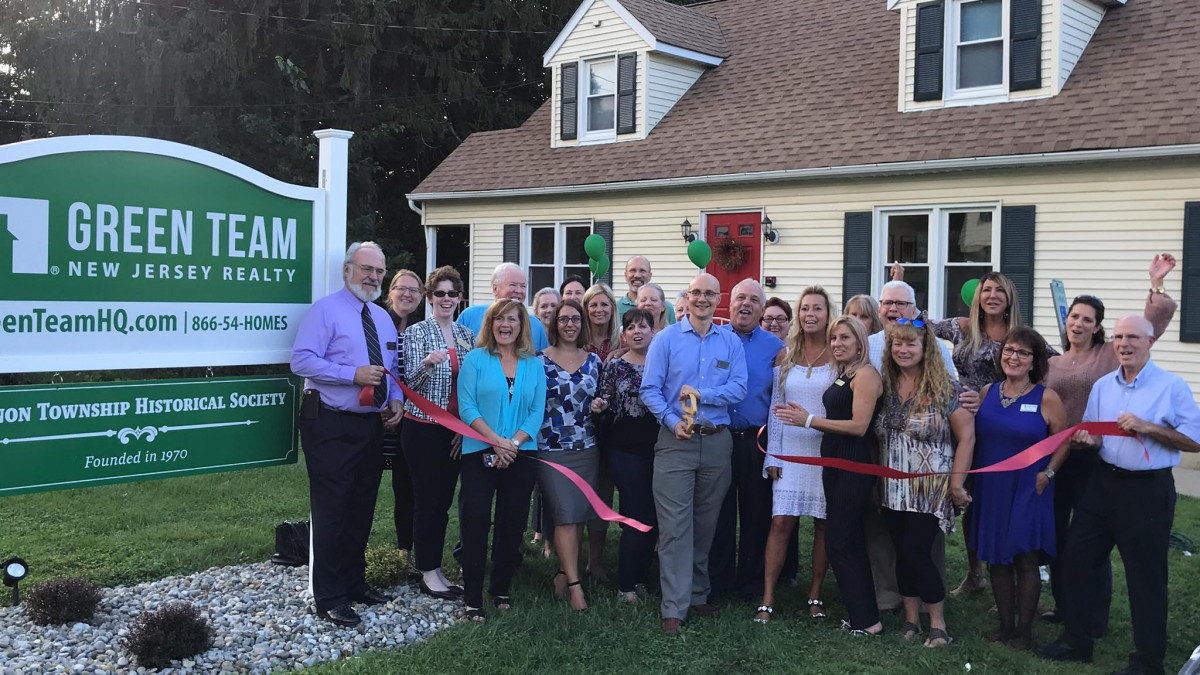
Green Team New Jersey Realty celebrates the opening of their new office building
Just two years and five days after the ribbon cutting that launched the opening of the Green Team’s Vernon office, a new ribbon cutting was held. On Thursday, September 13, Green Team New Jersey Realty (“GTNJR”) celebrated the official opening of its new office building at 293 South Route 94, Vernon, New Jersey. And the ample parking lot was perfect for the celebration that followed.

A little history…
The Green Team Home Selling System, founded in 2005, is in the top ten of all brokerages in Orange County, New York. When Geoffrey Green was approached by agents wanting to open an office in Vernon, New Jersey, it made perfect sense. Vernon was an underserved market, just across the border from Warwick, New York where the Green Team is based. However, even Geoff and equity partners Kim Lasalandra, Charles Nagy and Ted VanLaar couldn’t foresee the rapid growth of Green Team New Jersey Realty. For Charles, real estate has always been about people and making relationships. It’s what he truly loves about the business. However, his long term plans included retirement and relaxation. Now Green Team New Jersey Realty and its rapid success has put all talks of retirement on hold. There are new people to meet, new relationships to forge, and an exciting business to grow.
Utilizing the systems developed by Geoff Green, the Vernon office flourished. At six months there were 8 sales associates. That number kept growing as agents learned about the Green Team’s core values, its unique training and mentoring programs, and its commitment to providing the best possible client service.
In 2017, six GTNJR sales associates were recognized by the New Jersey Association of Realtors for achievement and excellence in sales. Considered among the most prestigious honors awarded to Realtors in the Garden State, the NJAR Circle of Excellence recognizes members who have excelled in the field of salesmanship. Ann Nussberger achieved the Silver Level ($6.5 million and 20 units minimum or 70 units). Recipients of the Bronze award ($2.5 million and 15 units minimum or 30 units) were Barbara Tesa, Joyce Rogers, Charles Nagy, Keren Gonen and Theodore Van Laar.
The future looks great…
As Geoff Green so eloquently put it, “Even though we’re here to celebrate the grand opening of the new building, it’s really a celebration of the people of the Green Team.” In less than two years, Green Team New Jersey Realty has become one of the top 20 real estate agencies in all of Sussex County and is one of the top five in Vernon. Thus, with 18 Sales Associates and a new home, the sky’s the limit. Yes, the Green Team has good reason to celebrate.
August Housing Market Update

The August Housing Market Update was held live on Facebook on Tuesday, August 14, at 9 a.m. If you missed the live webinar, you can view it at your convenience by clicking here.
Next month, the Housing Market Update webinar will take place on Tuesday, September 18 at 2 p.m. You can sign up for updates at GreenTeamHQ.com/HMU.
Meet the Panel
Geoff Green
Keren Gonen

Patrick Keelin

Jeff Lobb
Geoff Green moderated the webinar and presented statistics for Orange and Sussex Counties. Keren Gonen, of Green Team Real Estate New Jersey and Green Team Home Selling System, gave her perspective on the market from the sales associate’s view. Guest panelists were Patrick Keelin, Branch Manager of Family First Funding’s Warwick office, and Jeff Lobb, Founder and CEO of SparkTank Media. Green Team’s Marketing Director, Melissa Bressette, was on hand to make sure everything ran smoothly.
Housing Market Update – National
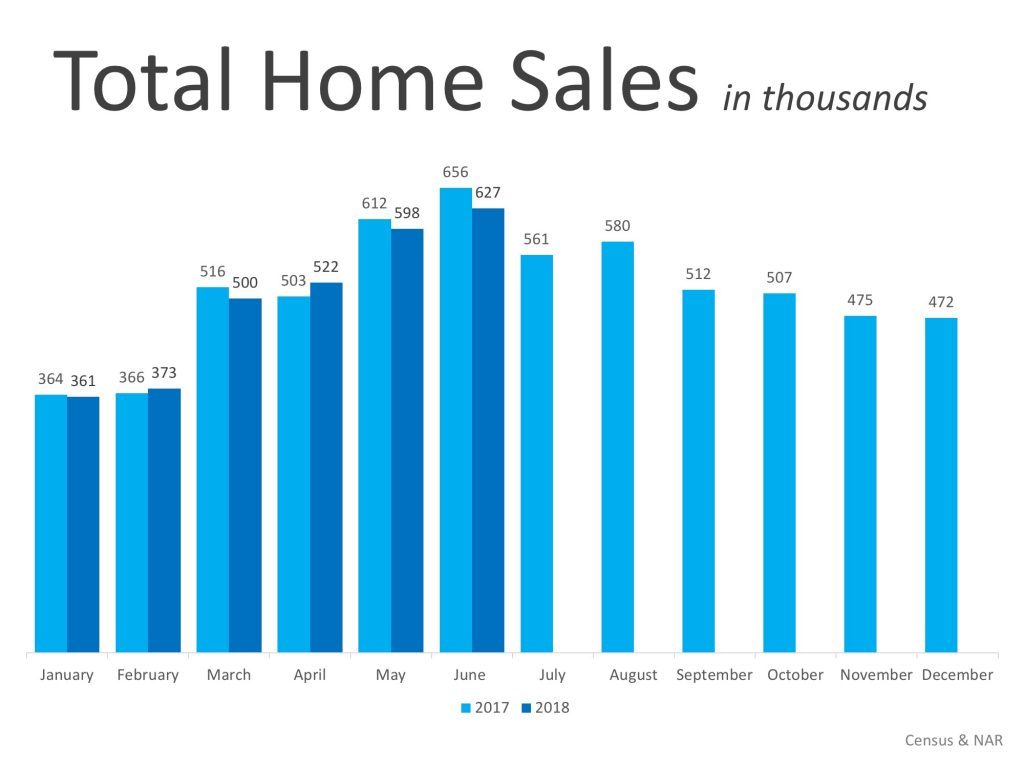
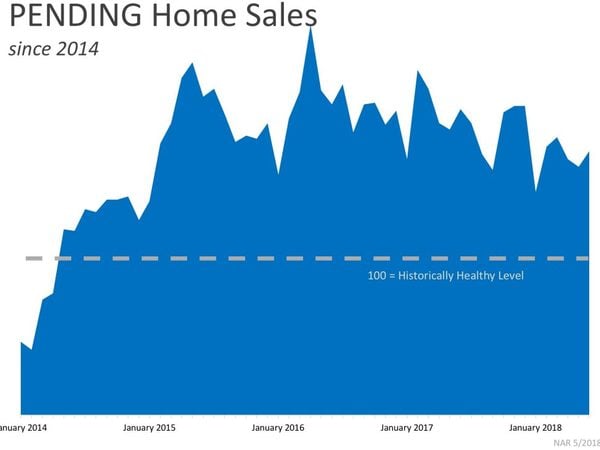
Nationally, for the last two months, the number of homes selling is down slightly from 2017. Earlier in the year it was almost even. There is a mixed bag, not a continued trend. Common knowledge says it’s all about inventory. There are just not enough homes for all the buyers out there.
Pending home sales seem to be trending downward nationally.
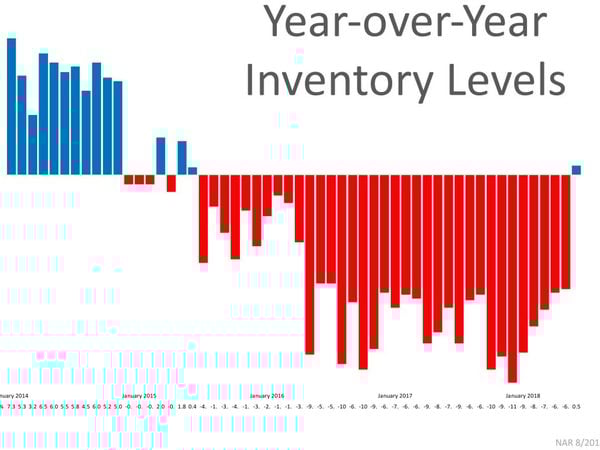
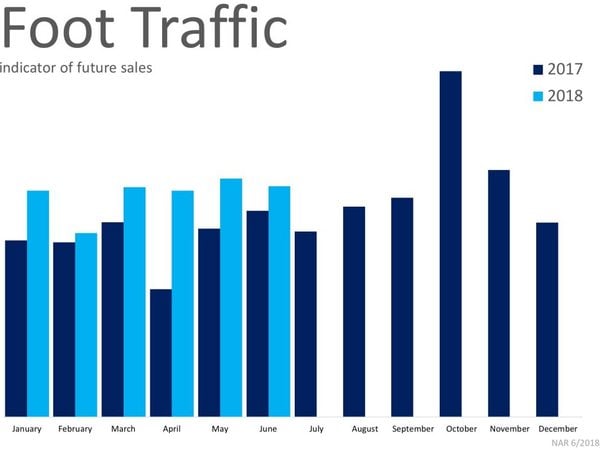
The National Association of Realtors shows year-over-year inventory levels up for the first time in 36 months. It may be a good sign, though it may also be indicative of the market slowing a little. However, foot traffic is up in 2018, compared to 2017. This graphic represents the numbers of people actually in homes, looking to buy. This number has been up consistently all year, though sales are down on a national level. From a national perspective, it’s still a very solid market.
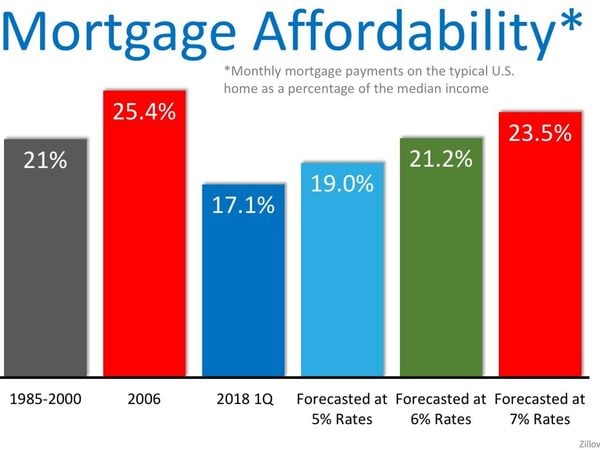
From 1985 to 2000, 21% of household income was dedicated to mortgage payments. In the first quarter of 2018 we’re well below that number. At 17.1%, we’re about 4 points below the historical average over the last 25 years. Therefore, even though prices are rising and inventory is tight, homes are still relatively affordable compared to 1985 to 2000. Even if rates do get to 6% or so, household income dedicated to mortgage payments will be only a few points higher than the 1985 to 2000 average.
Housing Market Update – Orange County, NY
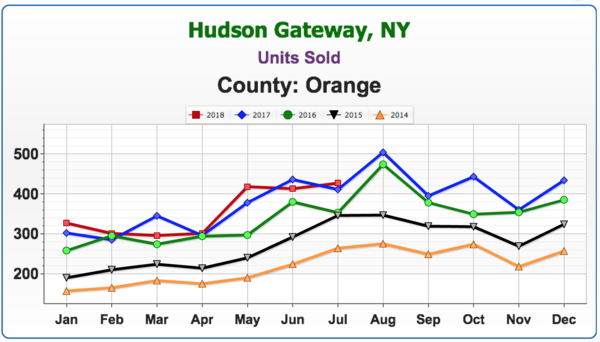
Getting down to local stats, although at a slowing pace, the numbers are still at historical levels. In our area, where the current number of homes selling is the equivalent of 2006 (which was one year after the absolute peak in the market that occurred in 2005), the rate of sales is historically very high. This is a very hot market.
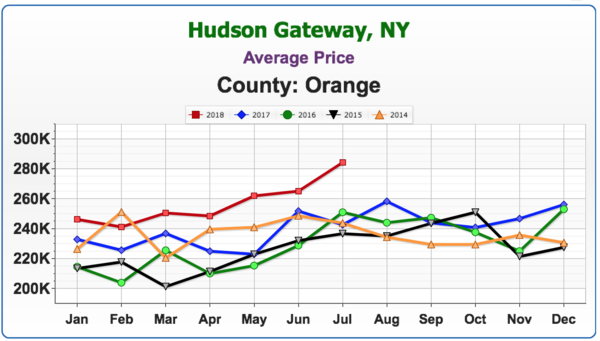
Average price is clearly rising in 2018. Geoff noted that in his experience units sold would increase, but average price didn’t quite get there. Then, units sold would start to decrease but price didn’t follow that trend, with a lag of about 6 months. There was almost a 2-year lag in average price that came after the downturn in the market.
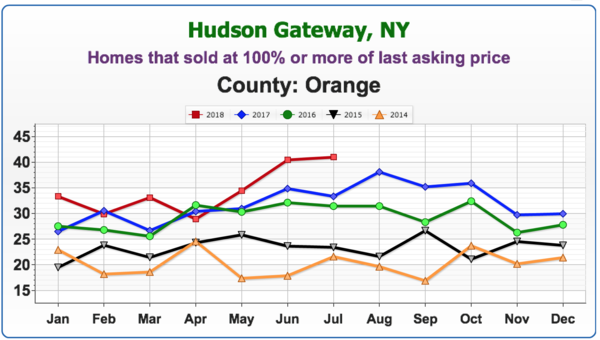
Approximately 40% of homes are selling at 100% or more of their last asking price. There are a lot of bidding wars going on, and this is indicative of how hot the current market is.
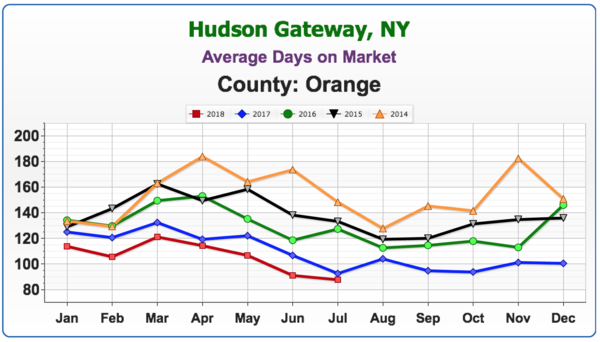
This number continues to decline, another sign that this market is hot.
Housing Market Update – Sussex County, NJ
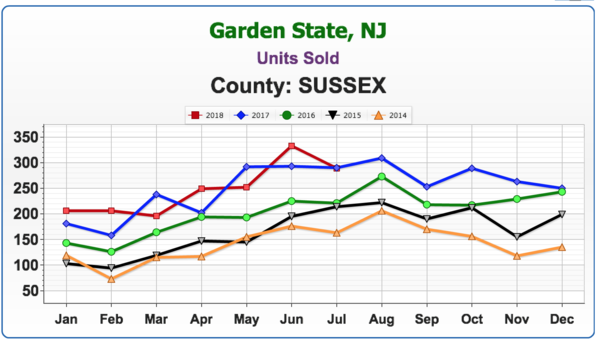
The stats are showing a fluctuation in the number of units sold in Sussex County. It’s a mixed bag – some months below, some months above. No definitive trend has emerged.
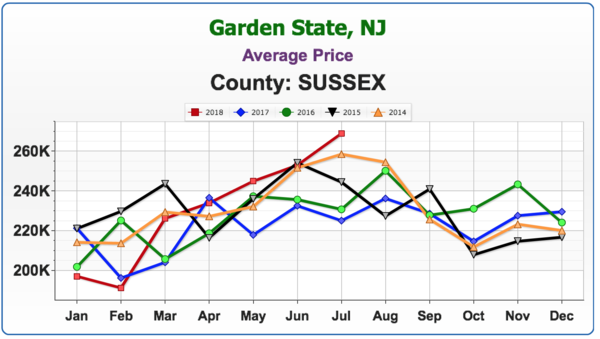
Not quite the lift-off that’s occurring in Orange County, but after the first two months of 2018, there is a definite rise in average price and July is at the highest point of the last five years.
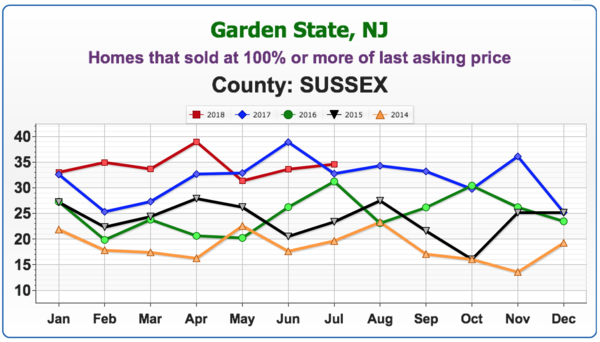
While not quite as high as Orange County, between 30 to 40% of homes are selling at 100% or more of last asking price.
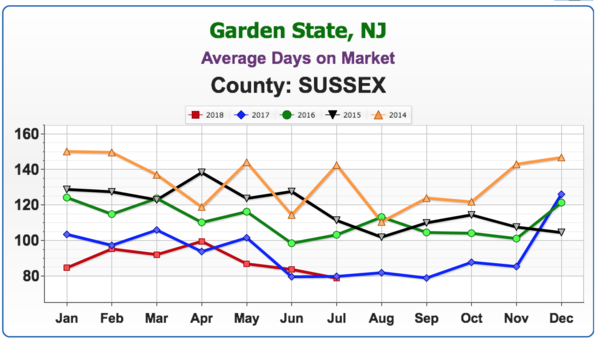
We’re seeing a similar trend to New York, with homes selling at around the 90-day mark.
Keren Goren – A Sales Associate’s Perspective on the Market
Geoff asked Keren Goren, one of Green Team’s top producers, for her thoughts on the current market. Licensed in both New York and New Jersey, Keren finds that there are many prospective buyers for both Orange and Sussex Counties. Lots of bidding wars are going on.
She does feel that some of the flippers in the area are doing less and asking for more. This appears to be a new trend. Keren recalled that flippers used to do a much better job, but many houses on the market now are unfinished and are scaring buyers away as opposed to inviting bids. Therefore, some outdated homes are actually selling for prices higher than they should or would have a few months ago.
Keren sees no sign of the market slowing down. However, she is seeing delays in closings due to issues with some mortgage companies, and with buyers making poor decisions with their finances. Keren did note that her experiences with Family First were extremely positive, and she highly recommended them.
Geoff noted that the current market upturn stands a chance at longevity. Following the downturn, as deep and as long it was, people weren’t moving. Banks have since cleaned up their balance sheets, tightened programs up, and are making money. There are fewer defaults happening. Basically, everything depends on how much money the banks are willing to lend.
PJ Keelin – A Lender’s Perspective
The mortgage industry is doing well, offering a lot more first-time homebuyer programs with as little as 3% down, USDA becoming very popular in Orange and Sussex County areas. Also trending is loosening up a bit and coming up with more portfolio loan products, personal products and using common-sense underwriting and ability to fund when looking at today’s borrowers.
With homes in the $200,000 to $300,000 price range becoming few and far between, they are looking at different programs, such as adjustable rates, less money down, and interest only type payments. However, in these cases, information and education should be given to borrowers upfront. It’s necessary to prepare the borrower for everything that will come together throughout the process. It’s extremely important for borrowers to be aware of what they are getting into with these products and understand how they work.
Geoff noted that with the last downturn, banks were not requiring people to have much “skin in the game.” Zero down, lying about income, jamming loans through. Geoff asked if PJ was seeing any of those practices coming back, or if there remains more oversight. scrutinizing income and the buyer’s comprehensive financial situation, down payments, etc. before loans are going out.
PJ replied that FANNIE and FREDDIE are doing a great job operating more with common sense with people who can have a little more risk, etc. They are requiring more skin in the game. Banks are protecting themselves and borrowers by not letting people put themselves under water.
Where are mortgage rates headed?
Geoff noted that the Fed has been raising short-term interest rates and will probably continue to do so to stifle inflation. He asked PJ where he saw mortgage rates landing over the next 12 to 18 months. PJ answered that he believes rates will be consistently in the 5’s through most programs. The market is being built into where those rates are and is slowly trending. Supply and demand are balancing each other out. Geoff feels that if you buy now, the value of your home won’t drop out like it did 12, 14 years ago. Pricing levels appear to be realistic and should hold for some time in the future. Buyers want to know if the asset they’re buying will be worth at least as much or more than they’re paying now. Even though it is a seller’s market, Geoff and PJ concurred that it is a good time to buy.
Furthermore, PJ stated that appraisers are not allowing appraisal inflation to come above where the market truly should be. It’s better for appraisers to be a little tight because that will keep the longevity of this strong market going on for 12, 18, 24 months. Geoff replied that appraisals have been challenging over the last 3 years. Prior to the upturn, prices were a mixed bag, leaving appraisers unwilling to take a chance as they couldn’t see where the market was going. However, he noted that now some appraisers are more willing to take a chance and make an allowance because of the steady upward-trending market, even though there might not be a comp that can exactly substantiate it. There are fewer appraiser issues, though there are still times when they won’t go along with the offering price. This hurts the seller but protects the buyer. And it’s another way of controlling the market.
Jeff Lobb – A Marketing Expert’s Perspective
Geoff asked Jeff for his views on the future of service providers in the real estate industry in this age of technology. Are realtors going to be the next victims of business models like Amazon? Will technology replace realtors just as retail stores (like ToysRUs) and their employees have been replaced?
Jeff’s view? While buzzwords like “disruption” do sell media, there are things happening at higher levels. However, the real estate agent is not going away anytime soon for one simple reason. There are too many moving parts to a transaction, and emotion is one of those. Technology has not reached the stage where it can handle all these parts.
Disruption occurs with more brands trying to change the way we are doing business, making it faster, more tech, or more niche. New companies are coming into play. Compass, Redfin models, Purple Bricks. And new people are coming into the space trying to change and elevate what we do. At the same time. the industry has seen some large teams leave major brands, saying they can do things better by themselves, without the big brand box.
Taking care of business…
One way to keep track of business is to every day look at local inventory. If there are 500 listings, see how many of those you got. If it’s only 2, there is a lot to be done. The business is a marathon; it’s a competitive race, but not many have enough drive to do the hard work that’s needed. To say the business is slow is not valid. Every day more homes come on the market and more get sold. Someone is getting those listings. And that is where the challenge comes in. It’s about doing the day-to-day work. All the technology that is available can make us work faster and smarter, but we still have to do the work.
Philosophically speaking…
Geoff has a broader perspective as to where realtors stand and what the future holds. As an example, despite all the tools available online there are more travel agents now than in the year 2000. It takes time to do all the research, etc., and many people are finding it more desirable to hire someone to do that work for them.
There has been an explosion of information and technology, but at the end of the day, it’s time. Do most people want to spend the amount of time it takes to properly sell their house or negotiate to buy a home? Most people prefer to hire a real estate professional to handle all the parts of the puzzle. In addition, Geoff believes the housing market is important to the overall US and global economy. The economy is revving. largely because of the housing market healing and coming back. And real estate agents are critical to the health of the economy.
Jeff added, “Will Amazon and Facebook get into the real estate marketplace? Probably!” The big picture is that some companies are coming in trying to acquire agents and market share. Others are trying to change the way technology is driven. However, you still need the people to execute the transactions and deal with the emotional process of a sale.
Geoff’s final analysis? We, humans, are complicated beings, and it takes a human to navigate this process of buying a home. And after much consideration, we should continue to invest in real estate agents and our industry because we’re needed and timeless.
Visit our website, greenteamhq.com/HMU to register for our next Webinar on Tuesday, September 18 at 2 pm. You can also view previous webinars videos and access other recaps like this.
Charles Nagy and Theodore Van Laar win Second Quarter Sales Leader Award
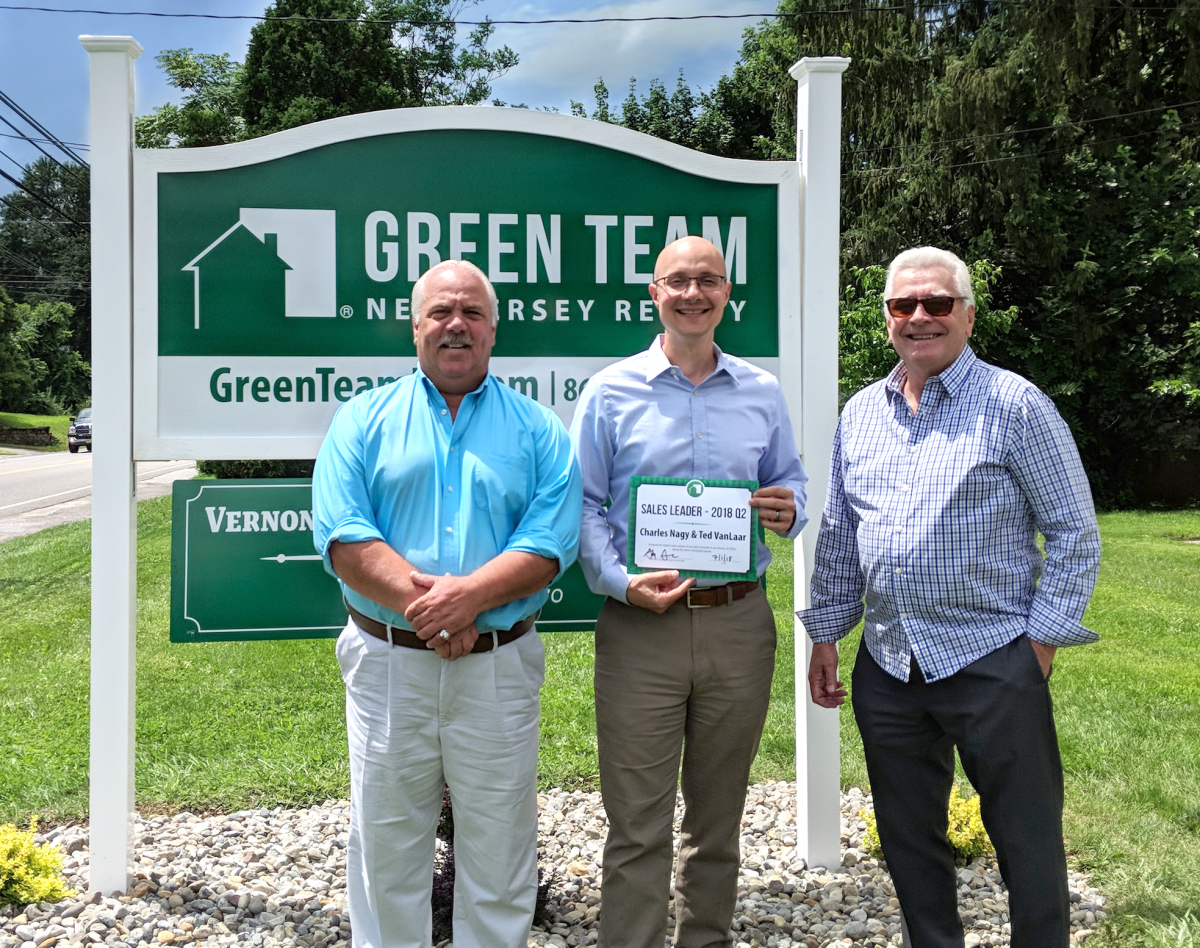
Green Team New Jersey Realty is pleased to announce that Charles Nagy and Theodore Van Laar have won the Second Quarter Sales Leader Award for the second year in a row.
As Geoff Green likes to call them, the “Dynamic Duo” took home the prize for Second Quarter Sales Leader in 2017, as well as this year. This team’s commitment to GTNJR and the clients they serve are part of the reason the New Jersey office is experiencing its rapid growth and success.
Over 7 Decades of Experience Combined

Ted has a reputation for integrity and honesty, as well as appreciation and understanding of the resort lifestyle. Therefore, his clients like and trust his expertise, whether they’re looking for a private residence, second home or investment property.

A truly dynamic duo
For some reason, these two diverse backgrounds meld together to form a productive, successful team. Charles and Ted have also been recipients of the Circle of Excellence Award multiple times between 2014 to 2017, which requires a minimum sales amount of $2.5 million and 15 transactions to qualify. And this second quarter, they did a combined $6,555,000 in sales volume. They don’t take winning this quarterly sales leader award for granted. Ted and Charlie know they were up against a highly motivated and knowledgeable group of sales associates. However, they also appreciate the friendship and camaraderie that exists within the New Jersey office. Most of all, it’s the unique system of training and support which ensures that everyone has the tools to provide the best possible customer service and experience.
And they’re looking forward to next year, wondering if they will be three for three second quarter 2019!
July Housing Market Update

The July Housing Market Update was held live on Facebook on Tuesday, July 10, at 9 a.m. If you missed the live webinar, you can view it at your convenience by clicking here.
Meet the Panel
Geoff Green moderated the webinar and also presented relevant statistics in a historical context. Keren Gonen of Green Team Real Estate New Jersey conveyed the sales associate’s perspective on the housing market. Melissa Bressette, Green Team’s Marketing Director, rounded out the company’s participants. This month’s special panelists were Kevin Dolan, Branch Manager and Co-Director of Renovation and Construction Lending at Annie Mac Home Mortgage and Joe Panebianco, CEO of Annie Mac.
Orange County Historical House Price Index
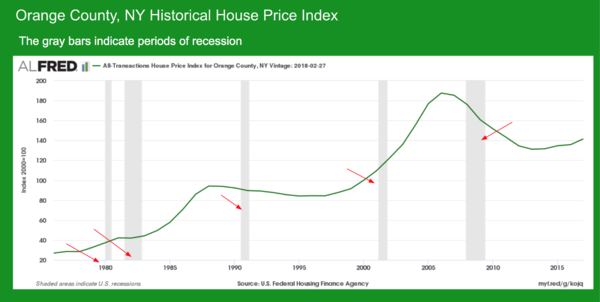
Geoff presented a historical view of national and local prices, and a look at the market before, during and after recessions. In this chart of the Orange County, NY price index, gray bars indicate periods of recession. As shown in the graph, recessions don’t necessarily trigger downturns in the housing market. The inverse is usually true, with downturns in the housing market generally triggering recessions. Exceptions include the recession between 2000 and 2005. The housing market actually started to downturn around 2005, long before the financial collapse of 2008. Prices peaked in 2006, then continued to slide for over a decade. The steepness and duration of the curve is what is of special interest.
Sussex County NJ Historical House PriceIndex
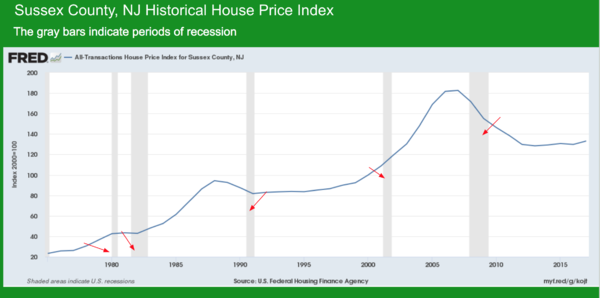
In a historical context, the Sussex County and Orange County stats show a similarity, reflecting national trends.
National Stats
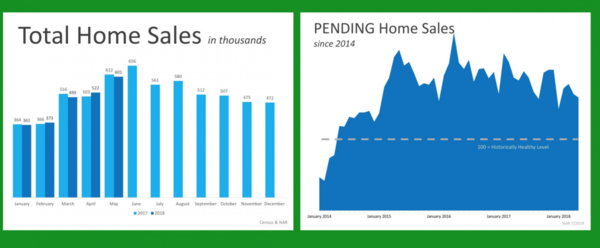
In Total Home Sales in thousands there are no major increases in the year over year stats.
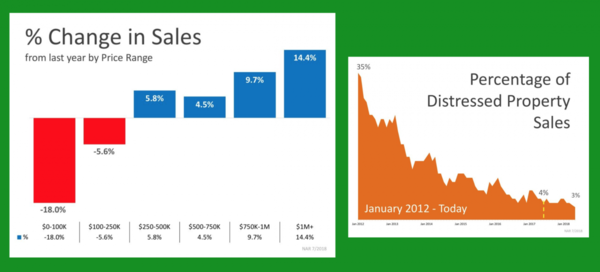
The number of houses available in lower price ranges is way down. However, there is an uptick in higher priced homes. Because of lack of inventory, buyers are being pushed into that higher price bracket.
The percentage of distressed properties for sale is way down from 2012.
Orange County Market Stats for June 2018
Units Sold
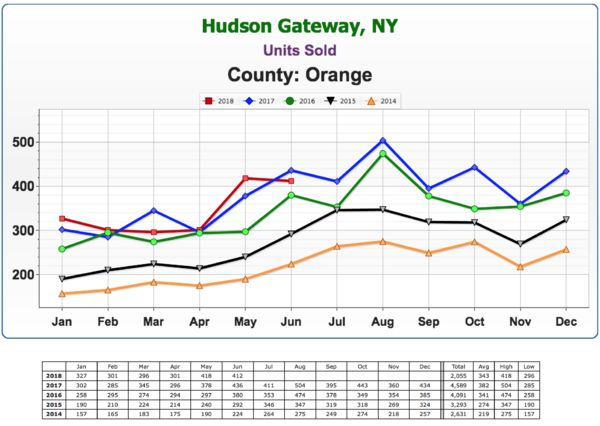
According to Geoff, this is one of the most important analytics in the housing market. No matter where pricing is, you can get an idea of the market by how many houses actually sold. There has been a great year over year increase for the past five years, but now it’s slowing down and we’re seeing a flattening now.
Homes that sold at 100% or more of last asking price
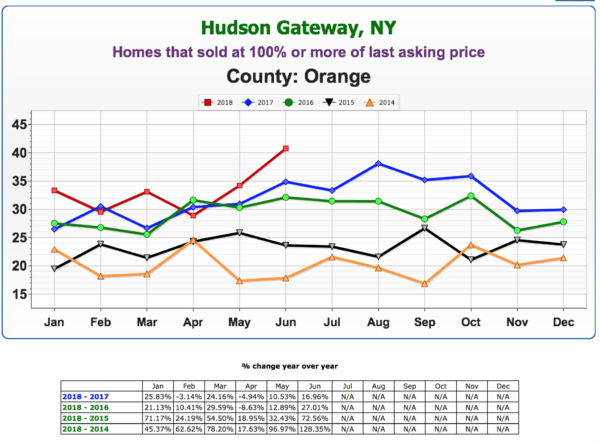
There’s a spike in this number. This is a hot market, and any home that is well located and in good condition will most likely have multiple offers at any one particular time. Basically, almost half of every listing on the market is being bid over asking. Note: Stats are based on last asking price, not original asking price.
Average Days on Market
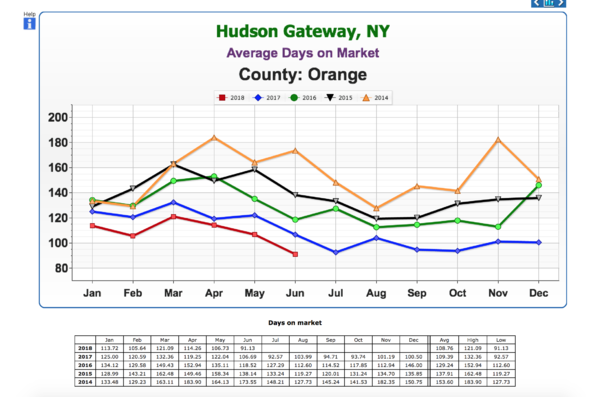
This number continues to decline, again showing a strong seller’s market.
A Comparison of Units Sold from 2005-2010 versus 2014-2018
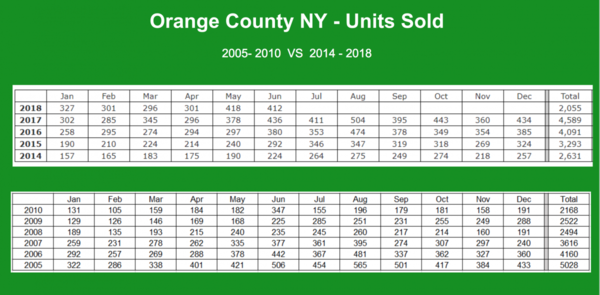
Geoff researched units sold in Orange County from 2005-2010 versus 2014-2018. Trends here follow National trends. The peak year was 2005 in terms of units sold. 2006 was the highest average home price the County has seen.. However, in 2010, the number of units sold had slid to almost half of the 2005 figure. Last year, we were above 2006 numbers, and close to 2005 in terms of units sold. Whether we’ll match or exceed that number in 2018 remains to be seen.
Recession
In a capitalist society, it is not a question as to whether or not there will be another recession. The question is when.
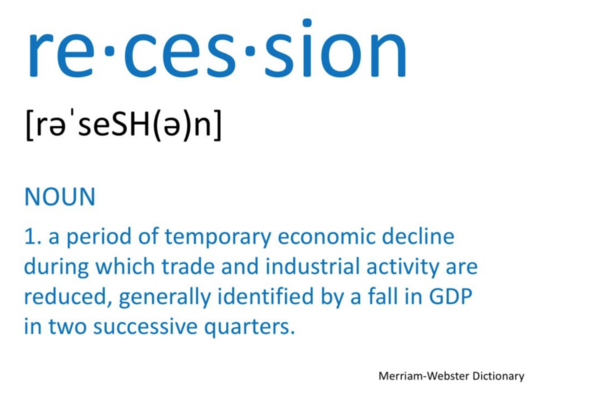
As defined in Merriam-Webster Dictionary, recession is “a period of temporary economic decline during which trade and industrial activity are reduced, generally identified by a fall in GDP in two successive quarters.” There is, of course, great interest in when the next recession will hit, and what impact it will have on the housing market.
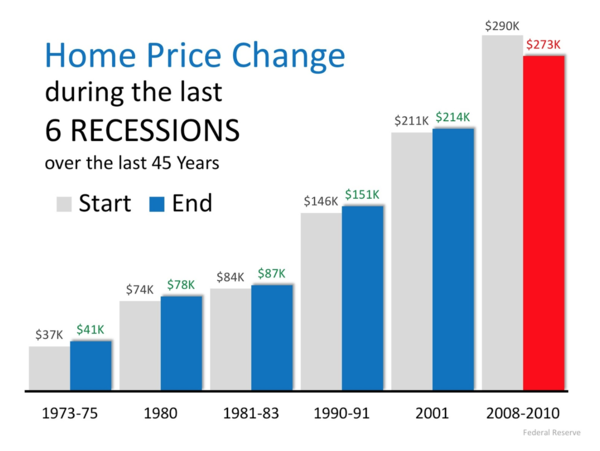
The graph shows home price changes during the last 6 recessions, over 45 years. The recession periods as designated by economists do not include the housing market downturns. Historically, prices haven’t been that affected during the recession; however, the definition of recession doesn’t include the whole downturn. And the real estate market takes time to recover.
‘
Keren Gonen’s perspective on the market from a sales associate’s point of view…
The market is very hot, in both Orange and Sussex Counties. In Warwick, if you don’t jump on a house right away, you can lose it. Keren is seeing bidding wars on homes within days of listing them.
When asked how long she thought the market would remain strong, she estimated about a year. One of the reasons we’re not seeing the lower priced homes sold, Keren indicated, was that banks that do have foreclosures are releasing them at much higher prices. Some banks are also renovating and flipping homes and charging even more.
Geoff commented that previously, when the market was really bad, there was shadow inventory. Banks would hold on to foreclosures, creating fear in the market that they would dump their inventory of low-priced homes, driving down prices. However, the banks seem to be changing their ways of doing things by renting out some homes, and fixing up others and selling them at higher prices.
The Mortgage Market – Where are we now?
Geoff stated that we’re definitely in an increasing rate environment and the Fed has signaled that they are going to continue to increase the overnight lending rates into the foreseeable future. Geoff asked Kevin Dolan to address where we are at now…
Kevin responded that where rates are concerned, they’re turning higher for the foreseeable future. Partly due to media coverage, people are starting to take the rise of interest rates and home prices seriously. They see continual coverage of higher rates on news shows. Thus, people are becoming proactive, buyers and sellers alike, driving productivity level.
Interest rates, inventory and recession. Oh my!
Joe Panebianco does economic analysis and strategy for Annie Mac. His expertise made him the perfect person to discuss specifics and timings of interest rates, inventory and recession.
Interest Rates: We will most likely be range bound from a 10-year treasury perspective from approximately 2.75 to 3.05 yield in the ten year. In other words, we’ll be relatively stable. Should this estimate be incorrect, Joe believes a slightly higher rise in interest rates will not significantly hurt the housing market. At some point, rates rising will have a deleterious effect and purchasers’ ability to afford a home may be impacted. However, we’re not at that point now.
Inflation and economic growth are the two primary components of interest rates. Inflation has remained stubbornly low and will most likely remain so. Hence, one reason why rates should remain relatively low. People talk about the Fed increasing rates, but they are increasing the short end of the curve.
As the Fed continues to hike rates, the result will be 10 and 30-year rates looking more like 2 and 5 year rates. Most of the duration of a mortgage-backed security is in a 7, 10 and 30-year part of the curve. And Joe believes that the more the Fed increases rates, the more likely we are to be in a recession and more likely to have lower, longer-term rates remain where they are or go lower. The mortgage market on Adjustable Rate Mortgages could be hurt because they’re much more likely to rise as they’re sensitive to the shorter end of the curve. 30-year fixed mortgages are more likely to stay in the aforementioned range.
The Global Connection
We live in a globally connected network and there is a yield spread between US 10-year Treasury bond and bonds in other countries, like Germany, Japan, Australia.. For central banks, very large institutions,etc., putting their money in US Treasuries provides a safer, purer investment over countries with significantly lower yields. However, regarding tariffs, trade wars are inherently bad for economies and may throw a curve ball into any predictions.
There are some who refer to our current economy as a “Goldilocks economy.” Not too hot, not too cold, just right… in some ways. The economy is growing enough to create jobs. And, according to Joe, jobs are far more important to home purchases than interest rates are. In the early 1980’s, interest rates were at 15% and yet homes were flying off the market. When rates go up, prices tend to come down. And there is always a buyer, especially if there is value to be had.
The history is if the Fed goes too far, it will drive the country into recession. Joe believes we have approximately 12 to 18 months left in this cycle. And that at the end of this period, we’ll be in a more normal market with a healthier balance between demand and sup
Factors that impact inventory
Labor, or lack thereof, is a major component. Many significant builders have unused land on their balance sheets, on hold because of the great recession of 2007 to 2010. About 70 to 75% capacity of the productive capacity of the home building industry was lost. Brick layers, sheet rockers, carpenters, plumbers, electricians, etc. – left the industry to seek employment in other fields. In addition, when major storms hit Texas, Florida, etc., many people in the industry picked up and went to work in those cities where they could make much more money. There are simply not enough craftsmen and laborer to build all the homes necessary to meet current need.
Municipal Fees, laws – Fees, regulations, etc., have made building a home both difficult and expensive. To help increase taxable base, some municipalities are now trying to make things a little easier for those seeking to build new construction.
Tariffs – The “War of Words” regarding trade with Canada is not good news for the housing industry. A disproportionate share of home building lumber comes from Canada, and price of lumber futures has already risen on expectation of tariffs.
Easing of Credit
In the next 12 months, we may see easing of some requirements. At this time, no one knows how this will be done. However, some options might include reducing Mortgage Insurance on the FHA side, especially for first-time buyers. Also, Freddie Mac might follow Fannie Mae’s lead in reducing Long Term Debt and Debt to Income Ratio. Average renters spends 50-55% on rent. However, the current Debt To Income ratio is in the low 40’s for purchases. There might be a move to update the DTI.
Demand is not going to Cease
According to Joe, by 2025 there will be approximately 10 million new household formations. 35% will be from millenials, 35-40% from among the Hispanic community (with some overlap between the two), and 10% from the African-American community. Many of these new home buyers will be DTI (Debt to Income Ratio) challenged. They will need the services of qualified real estate agents, knowledgeable mortgage specialists/
Geoff pointed out that purchase and rental markets are both hot at the same time. This indicates a true housing shortage. The Millennial population seems to be exceeding Baby Boomers. Pent up demand and limited supply serve to elongate and stretch out the cycle.
Home ownership improves communities – and the economy
Home ownership lends itself to not only building communities, but also to building up business, including home improvement and furniture stores, furniture stores, durable goods vendors, etc., etc.- all of which will help the economy. Inventory may become less of an issue month by month by month.
Renovation Loans
Kevin Dolan is an expert in renovation loans. There are homes on the market that just won’t sell because they are not in good shape. He believes the renovation lending program is under-utilized simply because it is not understood and there are many misconceptions.
There are two types of renovation loan programs – conventional and FHA. This opens up versatility for buyers as to who it can serve, such as a down payment as low as 3-1/2%. It also allows for lower credit scores. These loans can be utilized for primary homes, second homes and investment properties. The loan allows for someone to buy a house in need of repair, and have an approved, qualified contractor bid on work to be done. Depending on scope of work, sometimes a HUD consultant will make sure prices quoted for the work are appropriate. The renovation funds goes into an escrow account, and contractor has specified time to do improvements, usually within six months. The bank pays contractor directly. The process is streamlined and efficient.
Kevin feels that educating buyers and real estate agents alike is key to opening up this market. Keren agreed, stating that she often does sell homes by telling buyers that renovation loans are available, and explaining how they work. It opens up options and vision for the buyers who cannot afford to buy a home in the $300-$400,000 range. Annie Mac does have a certification program available for real estate agents who would like to become expert in this area.
Renovation loans – not just for buyers
Kevin commented that renovation loans can also be helpful for sellers who need to update their homes in order to sell. By adding another bath or more bedrooms, the value of the home can be increased so that the seller can pay off existing mortgage and closing costs, and hopefully make a profit as well. Also, from Seller’s position, if they have a failed septic tank, they can sell the home at a lower price and buyer can get a renovation loan to cover the cost of having the work done themselves.
Joe added that in looking to build wealth in addition to creating a home for their family, renovations can help improve their property, and therefore their investment.
Geoff spoke about the importance of finding someone who truly understands these loans as they can be tricky for the loan originator. Geoff spoke highly of Annie Mac, not just for renovation loans, but for all financing needs.
Stay tuned for the next market update
The next update is August 14, 2018 at 9 a.m. You can sign up at GreenTeamHQ.com/HMU