Housing Market News December 23, 2020

Homeowner Equity Increases an Astonishing $1 Trillion

[et_pb_section fb_built=”1″ _builder_version=”3.0.47″][et_pb_row _builder_version=”3.0.48″ background_size=”initial” background_position=”top_left” background_repeat=”repeat”][et_pb_column type=”4_4″ _builder_version=”3.0.47″ parallax=”off” parallax_method=”on”][et_pb_text _builder_version=”3.18.2″ background_size=”initial” background_position=”top_left” background_repeat=”repeat”]

In a year that was financially devastating for many Americans, some good news for most homeowners is the dramatic gain in home equity over the last twelve months. Last week, CoreLogic released its 2020 3rd Quarter Homeowner Equity Insights report, which reveals four major findings:

  1. U.S. homeowners with mortgages have seen their equity increase by a total of $1 trillion since the third quarter of 2019.
  2. The average homeowner gained approximately $17,000 in equity over the past year.
  3. This is a 10.8% increase in equity over last year.
  4. The average household with a mortgage now has $194,000 in home equity.

This has given many homeowners the ability to redesign their homes to meet their changing needs. Frank Martell, President and CEO of CoreLogic, explains in the report:

“The housing market has remained a strong pillar in an otherwise tumultuous economic year. A sharp rise in demand, spurred by record-low interest rates, continues to bolster homeowner equity. And with many people now spending more time than ever before at home, some homeowners have tapped into their strengthening equity to fund renovations.”

This build-up in equity also gives more options to homeowners who have been financially impacted by the pandemic. Today, homeowners with substantial equity are in a much better position to work out a deal with their lender if they cannot pay their mortgage. Alternatively, they also have the power to sell and walk away with their equity in the form of cash or as a down payment toward a more affordable house. Frank Nothaft, Chief Economist for CoreLogic, addresses the issue in the report:

“Over the past year, strong home price growth has created a record level of home equity for homeowners…This provides an important buffer to protect families if they experience financial difficulties and is one reason for the generational-low in foreclosure rates reported.”

Here’s a map showing equity gains by state:Homeowner Equity Increases an Astonishing $1 Trillion | MyKCM

This gain in home equity is a blessing for homeowners in these trying times, and it seems that the next two years will continue to reward those who own a home.

Last week, the National Association of Realtors (NAR) held their 2020 Real Estate Forecast Summit. At the summit, they shared the results of a recent survey of 23 economic and housing market experts. The median forecast among the experts called for home values to increase further by 8% in 2021 and 5.5% in 2022.

Bottom Line

In a year that has many of us reevaluating what “home” really means, those who own their homes have been rewarded with a financial windfall that averages $17,000 individually and totals $1 trillion nationally.

Contact one of our agents today!

See our available properties!

[/et_pb_text][/et_pb_column][/et_pb_row][/et_pb_section][et_pb_section fb_built=”1″ _builder_version=”3.18.2″][et_pb_row _builder_version=”3.18.2″][et_pb_column type=”4_4″ _builder_version=”3.18.2″ parallax=”off” parallax_method=”on”][et_pb_blog fullwidth=”off” posts_number=”3″ include_categories=”34″ show_more=”on” show_author=”off” show_date=”off” show_categories=”off” show_pagination=”off” use_overlay=”on” overlay_icon_color=”rgba(255,255,255,0.14)” hover_overlay_color=”rgba(0,80,239,0.33)” hover_icon=”%%0%%” _builder_version=”3.18.2″ header_font=”Open Sans||||||||” header_font_size=”20px” body_font=”||||||||” box_shadow_style=”preset1″ custom_padding=”0px|0px|0px|0px|true|true” custom_css_title=”text-transform: none;” global_module=”31695″][/et_pb_blog][/et_pb_column][/et_pb_row][/et_pb_section]

Buying a home December 23, 2020

The Difference a Year Makes for Homeownership

[et_pb_section fb_built=”1″ _builder_version=”3.0.47″][et_pb_row _builder_version=”3.0.48″ background_size=”initial” background_position=”top_left” background_repeat=”repeat”][et_pb_column type=”4_4″ _builder_version=”3.0.47″ parallax=”off” parallax_method=”on”][et_pb_text _builder_version=”3.18.2″ background_size=”initial” background_position=”top_left” background_repeat=”repeat”]

Over the past year, mortgage rates have fallen more than a full percentage point, hitting a new historic low 15 times. This is a great driver for homeownership, as today’s low rates provide consumers with some significant benefits. Here’s a look at three of them.

1. Move-up or Downsize: One option is to consider moving into a new home, putting the equity you’ve likely gained in your current house toward a down payment on a new one that better meets your needs – something that’s truly a perfect fit, especially if your lifestyle has changed this year.

2. Become a First-Time Homebuyer: There are many financial and non-financial benefits to owning a home, and the most important thing is to first decide when the time is right for you. You have to determine that on your own, but know that now is a great time to buy if you’re considering it. Just take a look at the cost of renting vs. buying.

3. Refinance: If you already own a home, you may decide you’re going to refinance. It’s one way to lock in a lower monthly payment and save more over time. However, it also means paying upfront closing costs, too. If you want to take this route, you have to answer the question: Should I refinance my home?

Why 2020 Was a Great Year for Homeownership

Last year, the average mortgage rate was 3.93% (substantially higher than it is today). If you waited for a better time to make a move, market conditions have improved significantly. Today’s low mortgage rates are a huge perk for buyers, so it’s a great time to get more for your money and consider a new home.

The chart below shows how much you would save per month based on today’s rates compared to what you would have paid if you purchased a home exactly one year ago, depending on how much you finance:The Difference a Year Makes for Homeownership | MyKCM

Bottom Line

If you’ve been waiting since last year to make your move into homeownership or to find a house that better meets your needs, today’s low mortgage rates may be just what you need to get the process going. Let’s connect today to discuss how you may benefit from the current rates.

Contact one of Our Professional Agents Today!

See Our Complete List of Available Properties!

[/et_pb_text][/et_pb_column][/et_pb_row][/et_pb_section][et_pb_section fb_built=”1″ _builder_version=”3.18.2″][et_pb_row _builder_version=”3.18.2″][et_pb_column type=”4_4″ _builder_version=”3.18.2″ parallax=”off” parallax_method=”on”][et_pb_blog fullwidth=”off” posts_number=”3″ include_categories=”34″ show_more=”on” show_author=”off” show_date=”off” show_categories=”off” show_pagination=”off” use_overlay=”on” overlay_icon_color=”rgba(255,255,255,0.14)” hover_overlay_color=”rgba(0,80,239,0.33)” hover_icon=”%%0%%” _builder_version=”3.18.2″ header_font=”Open Sans||||||||” header_font_size=”20px” body_font=”||||||||” box_shadow_style=”preset1″ custom_padding=”0px|0px|0px|0px|true|true” custom_css_title=”text-transform: none;” global_module=”31695″][/et_pb_blog][/et_pb_column][/et_pb_row][/et_pb_section]

Buying a home December 22, 2020

Are Home Prices Headed Toward Bubble Territory?

Talk of a housing bubble is beginning to crop up as home prices have appreciated at a rapid pace this year. This is understandable since the appreciation of residential real estate is well above historic annual averages. According to the Federal Housing Finance Agency (FHFA), annual appreciation since 1991 has averaged 3.8%. Here are the latest 2020 appreciation numbers from three reliable sources:

It’s easy to jump to the conclusion that house appreciation is out of control in today’s market. However, we need to put these numbers into context first.

Inflation and the Comeback from the Housing Crash

Following the housing crash, home values depreciated dramatically from 2007-2011. Values are still recovering from that unusually long period of falling prices. We must also realize that normal inflation has had an impact.

Bill McBride, the founder of the well-respected Calculated Risk blog, recently summed it up this way:

“It has been over fourteen years since the bubble peak. In the Case-Shiller release today, the seasonally adjusted National Index, was reported as being 22.2% above the previous bubble peak. However, in real terms (adjusted for inflation), the National index is still about 2% below the bubble peak…As an example, if a house price was $200,000 in January 2000, the price would be close to $291,000 today adjusted for inflation.”

The COVID Impact on Home Prices

The pandemic caused many households to reconsider whether their current home still fulfills their lifestyle. Many homeowners now want larger yards that are both separate and private.

Their needs on the inside of the home have changed too. People now want home offices, gyms, and living rooms well-suited for video conferencing. Barbara Ballinger, a freelance writer and the author of several books on real estate, recently wrote:

“While homeowners continue to want their outdoor spaces that offer a safe retreat, that appeal has shifted into other parts of the home, coupling comfort with function. In other words, homeowners want amenities for work and leisure, and they plan to enjoy them long after the pandemic.”

At the same time, concerns about the pandemic have caused many homeowners to put their plans to sell on hold. Realtor.com just released their November Monthly Housing Market Trends Report. It explains:

“Nationally, the inventory of homes for sale decreased 39.2% over the past year in November…This amounted to 490,000 fewer homes for sale compared to November of last year.”

More people buying and fewer people selling has caused home prices to escalate. However, with a vaccine on the horizon, more homeowners will be putting their houses on the market. This will better balance supply with demand and slow down the rapid appreciation.

That’s why major organizations in the housing industry are calling for much more moderate home appreciation next year. Here are the most recent forecasts for 2021:

This Is Nothing Like 2006

Finally, let’s put to rest some of the concerns that today’s scenario is anything like what led up to the last housing crash. Lawrence Yun, Chief Economist at the National Association of Realtors (NAR), explains why this is nothing like 2006:

“Such a frenzy of activity, reminiscent of 2006, raises questions about a bubble and the potential for a painful crash. The answer: There’s no comparison. Back in 2006, dubious adjustable-rate mortgages taxed many buyers’ budgets. Some loans didn’t even require income documentation. Today, buyers are taking out 30-year fixed-rate mortgages. Fourteen years ago, there were 3.8 million homes listed for sale, and home builders were putting up about 2 million new units. Now, inventory is only about 1.5 million homes, and home builders are underproducing relative to historical averages.”

Bottom Line

Most aspects of life have been anything but normal in 2020. That includes buying and selling real estate. High demand coupled with restricted supply has caused home prices to appreciate above historic levels. With the end of the health crisis insight, we will see price appreciation return to more normal levels next year.

Work with one of our agents today!

See out complete inventory!

Buying a home December 21, 2020

How Remote Work Can Power Your Vacation Home Sale

This year, the opportunity to work remotely has increased the demand for vacation homes. Gay Cororaton, Senior Economist and Director of Housing and Commercial Research at the National Association of Realtors (NAR), notes:

“Working from home is a positive factor in demand for vacation homes.”

Buyers are taking advantage of the fact that working from home might be someplace other than their primary residence – at the beach, in the mountains, or somewhere in between. NAR explains:

Sales in vacation-home counties increased 48% on average year over year in the third quarter; overall, 81% of vacation-home counties saw a year-over-year sales increase.”

Is it Time to Sell Your Vacation Home?

If you’ve been thinking about selling your vacation home, putting it on the market now while demand is high might be your best move. Here are two reasons why.

1. Vacation Homes Are Selling Quickly

These homes are not staying in the market for very long. NAR also notes:

In September, 68% of vacation homes sold in less than a month. Historically, about 30% sell that quickly…It’s a pretty amazing uptick compared to past years.”

2. Home Prices Are Rising

With an increase in demand, prices go up. NAR continues:

“In the third quarter, prices in vacation-home counties rose by about 32% year over year. Seventy-nine percent of these counties experienced year-over-year price gains. NAR defines a vacation-home county as one in which seasonal housing accounts for at least 20% of stock.”

If your vacation home is sitting idle, maybe not attracting as many renters as you usually see, or if you simply want to sell it so you can trade up or take it off your worry list, now may be the time. Demand is high, so you’re in the ideal spot to get a stronger return on your investment today.

Bottom Line

Demand is on the rise, so let’s discuss your next steps when it comes to selling your vacation home.

Contact our agents today and see our full list of available properties!

Buying a home December 18, 2020

The Path to Homeownership

The Path to Homeownership [INFOGRAPHIC] | MyKCM

Some Highlights from The Path to Homeownership

  • If you’re thinking of buying a home and not sure where to start, you’re not alone.
  • Here’s a map with 10 simple steps to follow in the homebuying process.
  • Let’s connect today to discuss the specific steps along the way in our local area.

See our complete inventory of homes and property!

Buying a home December 18, 2020

A New Way to Shop for Homes in a Virtual World

In a year when we’re learning to do so much remotely, homebuying is no exception. From going to work to attending school, grocery shopping, and even seeing our doctors online, digital practices have changed the way we live.

This year, rather than delaying their home purchases, buyers – alongside their trusted real estate professionals – turned to the Internet to do more than just a typical home search. In some cases, they bought homes without even stepping foot inside. Jessica Lautz, Vice President of Demographics and Behavioral Insights at the National Association of Realtors (NAR), says:

“People really didn’t buy houses sight-unseen, traditionally. It’s still not a huge number, but it has gone up, and we have definitely seen that trend accelerate.”

According to NAR, throughout the coronavirus pandemic, one in every 20 homebuyers purchased a house sight-unseen.

How Your Real Estate Agent Will Pave the Way

Today, real estate professionals are using digital practices to help homebuyers and sellers walk through many steps in the process virtually. While following the regulations set forth by the CDC and all local guidelines, this year, agents quickly empowered buyers and sellers with virtual tours, 3D floor plans, high-quality photos, videos, online open houses, and more. For those who had homebuying and selling needs in 2020, trusted advisors made it possible in many markets.

Here’s a graph showing some of the digital options buyers found most helpful in their searches this year, as noted by NAR in the 2020 Profile of Home Buyers and Sellers:A New Way to Shop for Homes in a Virtual World | MyKCM

The report also mentions that buyers this year generally searched for eight weeks. Throughout that search, they viewed a median of 9 homes, but not all of them were seen in-person. Yahoo Finance notes:

Buyers viewed five homes online and four homes in-person during the pandemic, compared to nine homes in-person in 2019, according to NAR. This was the first year NAR asked buyers to specify the number of homes toured virtually.”

In true 2020 fashion, virtual practices helped buyers safely narrow down their top choices, so they didn’t have to unnecessarily walk into more homes than they needed to see throughout the process. Here’s the breakdown by region:A New Way to Shop for Homes in a Virtual World | MyKCM

At a time when health and safety are top priorities, current technology is making it possible for buyers and sellers to move their real estate plans forward at their own comfort levels, even through a worldwide pandemic. For many, this means buyers no longer have to physically tour every home they want to see, and sellers don’t need to open their doors over and over again throughout the process. Safety can come first and trusted real estate professionals are here to help.

Bottom Line

If you’re ready to make a move, you may not have to press pause on your plans this season. Let’s connect to determine the safe and effective options to buy or sell a home in our area or wherever you’re looking to move.

Contact one of our specialized agents!

Selling a Home December 17, 2020

Why It Makes Sense to Sell Your House This Holiday Season

If you’re one of the many homeowners thinking about taking your house off the market for the holidays, hang on. You definitely don’t want to miss the great selling opportunity you have right now. Here’s why this month is the optimal time to make sure your house is available for holiday buyers.

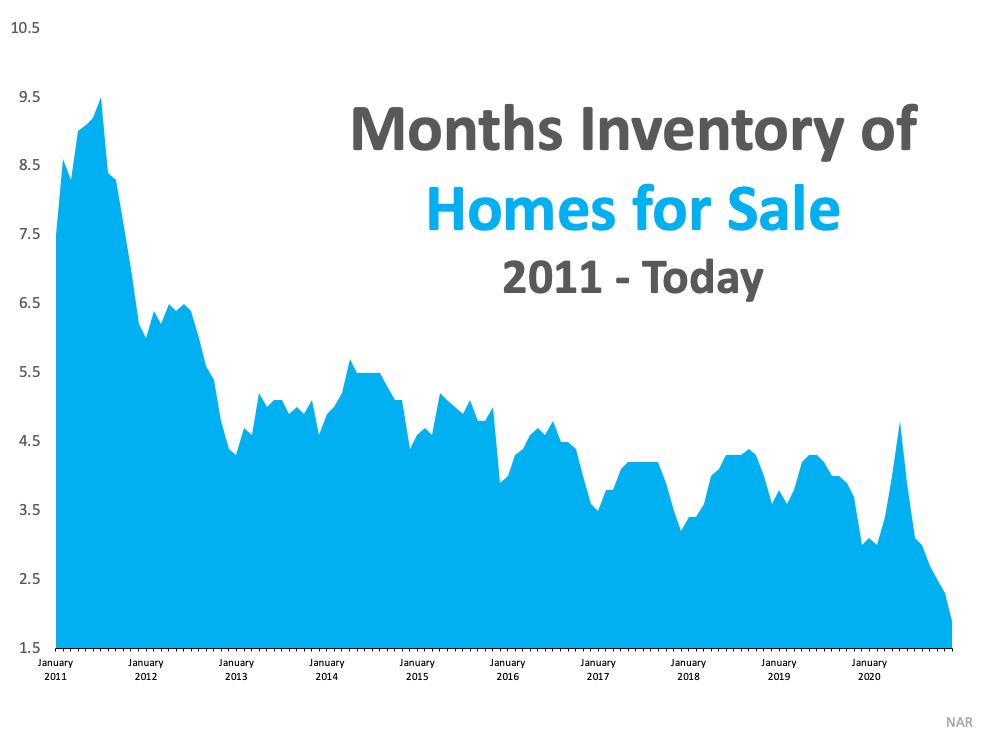
The latest Existing Home Sales Report from The National Association of Realtors (NAR) shows the inventory of houses for sale has dropped to an astonishing all-time low. It now sits at a 2.5-month supply at the current sales pace.

Historically, a 6-month supply is necessary for a ‘normal’ or ‘neutral’ market, in which there are enough homes available for active buyers (See graph below):Why It Makes Sense to Sell Your House This Holiday Season | MyKCM


When the supply of houses for sale is as low as it is today, it’s much harder for buyers to find homes to purchase. This means competition among purchasers rises and more bidding wars take place, making it essential for buyers to submit very attractive offers.

As this happens, prices rise and sellers are in the best position to negotiate deals that meet their ideal terms. So, if your neighbors decide to remove their listings this season, your house may quickly rise to the top of a holiday buyer’s wish list if you stay on the market.

Today, there are many buyers who are ready, willing, and able to purchase. Record-low mortgage rates and a year filled with unique changes have prompted buyers to think differently about where they live and to take action. The supply of homes for sale is not keeping up with this high demand, making now the optimal time to sell your house.

Bottom Line

Home prices are appreciating in today’s sellers’ market. Making your home available over the next few weeks will give you the most exposure to buyers who will be actively competing against each other to purchase it.

See our complete inventory and contact an agent today!

Buying a home December 14, 2020

With Home Values Surging, Is it Still Affordable to Buy Right Now?

Housing inventory is at an all-time low. Realtor.com just reported that there are 39% fewer homes for sale today than there were last year. At the same time, buyer demand remains strong. In a recent newsletter, research analyst Ivy Zelman explained:

“Although the headwind of severe supply constraints in most markets has contributed to slight moderation in seasonally-adjusted and year-over-year new pending contract growth for two consecutive months (albeit still growing strongly), the underlying strength of buyer demandparticularly for this time of year, remains apparent.”

Whenever there’s a shortage in the supply of an item that’s in high demand, the price of that item increases. That’s exactly what’s happening in the real estate market right now. As a result, home values are surging.

This is great news if you’re planning to sell your house. On the other hand, as either a first-time or repeat buyer, this may instead seem like troubling news. Purchasers, however, should realize that the price of a house is not as important as the monthly cost. Here’s how it breaks down.

There are several factors that influence the cost of a home. Two of the major ones are:

  1. The price of the home
  2. The mortgage rate at which a buyer can borrow the funds necessary to purchase the home

How do these factors impact affordability?

The National Association of Realtors (NAR) produces a Housing Affordability Index which takes these factors into account and determines an overall affordability score for housing. According to NAR, the index:

“…measures whether or not a typical family earns enough income to qualify for a mortgage loan on a typical home at the national and regional levels based on the most recent price and income data.”

Their methodology states:

“To interpret the indices, a value of 100 means that a family with the median income has exactly enough income to qualify for a mortgage on a median-priced home. An index above 100 signifies that family earning the median income has more than enough income to qualify for a mortgage loan on a median-priced home, assuming a 20 percent down payment.”

So, the higher the index, the more affordable it is to purchase a home. Here’s a graph of the index going back to 1990:With Home Values Surging, Is it Still Affordable to Buy Right Now? | MyKCMThe blue bar represents today’s affordability. We can see that homes are more affordable now than they were from:

  • 1990 to 2008
  • 2017 to 2018

Buying a home today is just a little less affordable than it was last year, but still very affordable compared to historical housing market trends.

Note: During the housing crash from 2009 to 2015, distressed properties (foreclosures and short sales) dominated the market. Those properties were sold at large discounts not seen before in the housing market.

Why are homes still affordable today?

The number one factor impacting today’s home buying affordability is record-low mortgage rates. There’s no doubt that prices are on the rise. However, mortgage rates have fallen dramatically. Last week, Freddie Mac announced that the average interest rate for a 30-year fixed-rate mortgage was 2.72%. Last year at this time, the average rate was 3.68%.

If you’re considering purchasing your first home or moving up to the one you’ve always hoped for, it’s important to understand how affordability plays into the overall cost of your home. With that in mind, buying while mortgage rates are as low as they are now may save you quite a bit of money over the life of your home loan.

Bottom Line

At this point, home purchase affordability is still in a historically good place. However, we need to watch price increases going forward. As Mark Fleming, Chief Economist at First American noted in a recent post:

“Faster nominal house price appreciation can erode, or even eliminate, the boost in affordability from lower mortgage rates, especially if household income growth doesn’t keep up.”

Contact our agents today!

See our complete inventory list!

Buying a home December 14, 2020

5 Tips for Homebuyers Who Want to Make a Competitive Offer

Today’s real estate market has high buyer interest and low housing inventory. With so many buyers competing for a limited number of homes, it’s more important than ever to know the ins and outs of making a confident and competitive offer. Here are five keys to success for this important stage in the homebuying process.

1. Listen to Your Real Estate Agent

A recent article from Freddie Mac offers guidance on making an offer on a home in today’s market. Right off the bat, it points out how emotional this can be for buyers and why trusted professionals can help you stay focused on the most important things:

“Remember to let your homebuying team guide you on your journey, not your emotions. Their support and expertise will keep you from compromising on your must-haves and future financial stability.”

Your real estate professional should be your primary source for answers to the questions you have when you’re ready to make an offer.

2. Understand Your Finances

Having a complete understanding of your budget and how much house you can afford is essential. The best way to know this is to reach out to your lender to get pre-approved for a loan early in the homebuying process. Only 44% of today’s prospective homebuyers are planning to apply for pre-approval, so be sure to take this step so you stand out from the crowd. It shows sellers you’re a serious, qualified buyer and can give you a competitive edge if you enter a bidding war.

3. Be Ready to Move Quickly

According to the Realtors Confidence Index, published monthly by the National Association of Realtors (NAR), the average property being sold today is receiving more than three offers and is only on the market for a few weeks. These are both results of today’s competitive market, showing how important it is to stay agile and vigilant in your search. As soon as you find the right home for your needs, be prepared to work with your agent to submit an offer as quickly as possible.

4. Make a Fair Offer

It’s only natural to want the best deal you can get on a home. However, Freddie Mac also warns that submitting an offer that’s too low can lead sellers to doubt how serious you are as a buyer. Don’t submit an offer that will be tossed out as soon as it’s received. The expertise your agent brings to this part of the process will help you stay competitive:

“Your agent will work with you to make an informed offer based on the market value of the home, the condition of the home and recent home sale prices in the area.”

5. Be a Flexible Negotiator

After submitting an offer, the seller may accept it, reject it, or counter it with their own changes. In a competitive market, it’s important to stay nimble throughout the negotiation process. Your position can be strengthened with an offer that includes flexible move-in dates, a higher price, or minimal contingencies (conditions you set that the seller must meet for the purchase to be finalized). There are, however, certain contingencies you don’t want to forego. Freddie Mac explains:

Resist the temptation to waive the inspection contingency, especially in a hot market or if the home is being sold ‘as-is’, which means the seller won’t pay for repairs. Without an inspection contingency, you could be stuck with a contract on a house you can’t afford to fix.”

Bottom Line

Today’s competitive market makes it more important than ever to make a strong offer on a home, and a trusted expert can help you rise to the top along the way.

Mortgage and Home Loans December 11, 2020

Key Terms to Know in the Homebuying Process

[et_pb_section fb_built=”1″ admin_label=”section” _builder_version=”3.0.47″][et_pb_row admin_label=”row” _builder_version=”3.0.48″ background_size=”initial” background_position=”top_left” background_repeat=”repeat”][et_pb_column type=”4_4″ _builder_version=”3.0.47″ parallax=”off” parallax_method=”on”][et_pb_text admin_label=”Text” _builder_version=”3.18.2″ background_size=”initial” background_position=”top_left” background_repeat=”repeat”]

Some Highlights From Key Terms to Know:

  • Buying a home can be intimidating if you’re not familiar with the key terms to know that are used throughout the process.
  • To point you in the right direction, here’s a list of some of the most common language you’ll hear along the way.
  • The best way to ensure your home buying process is a positive one is to find a real estate professional who will guide you through every aspect of the transaction with ‘the heart of a teacher’ by putting your needs first.

Work with one of our licensed professionals!

See out complete inventory!

[/et_pb_text][/et_pb_column][/et_pb_row][/et_pb_section]