We are pleased to share with you a Housing Market Report from December 2017 as well as a look at the trends for the entire 2017 year. We break down the local real estate activities and provide you with stats, graphs, and analysis of our local and regional real estate market.
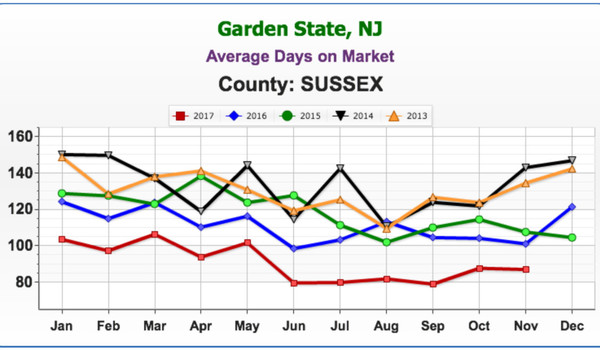
Average Days on the Market
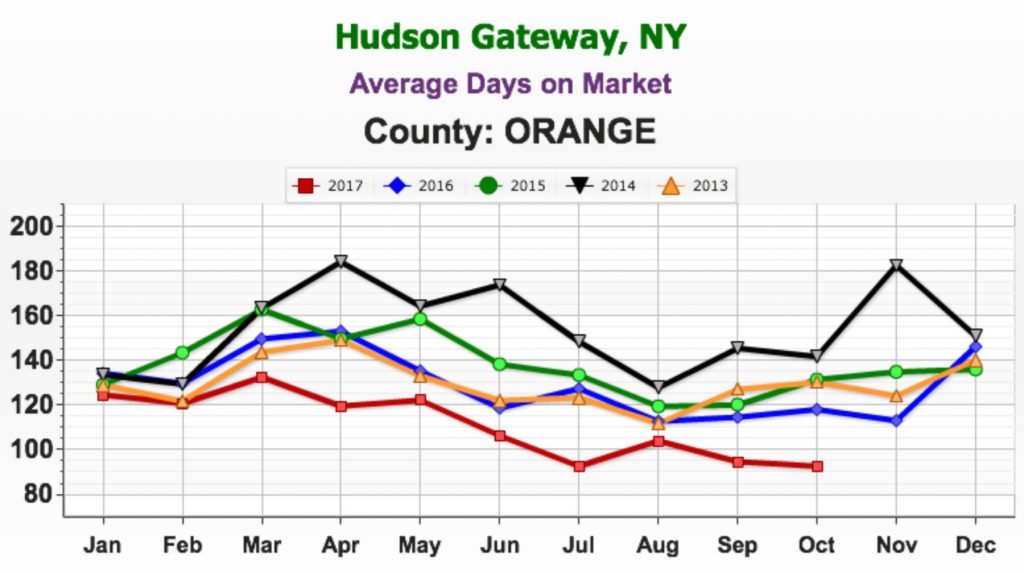
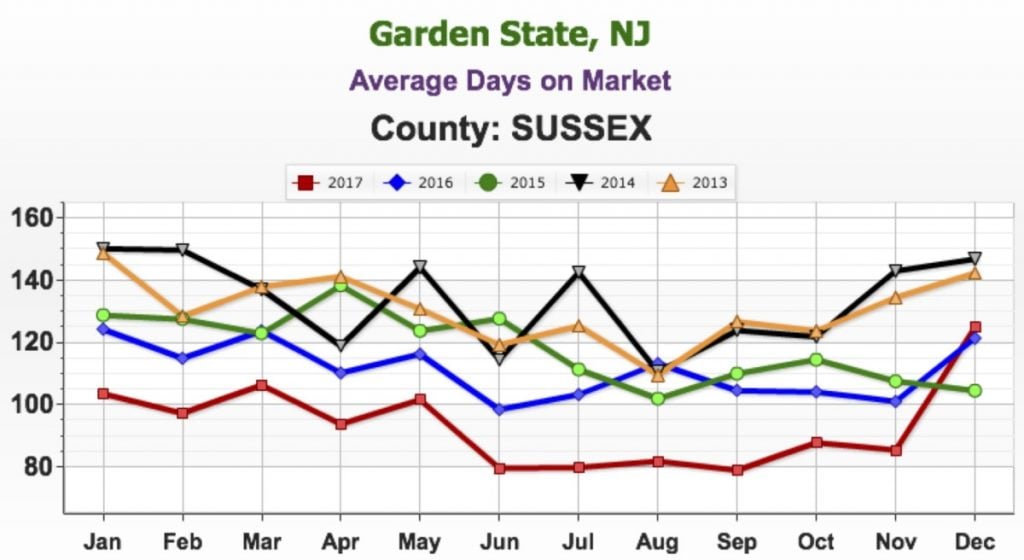
The faster things are selling, the hotter the market. Look for the lowest number on the graph as opposed to the highest.
In contrast to Orange County, the days on market shot up in December. However, this may be an outlier, due to snow and extreme cold temperatures. January’s numbers may help us understand if this is the result of specific circumstances, or part of a trend.
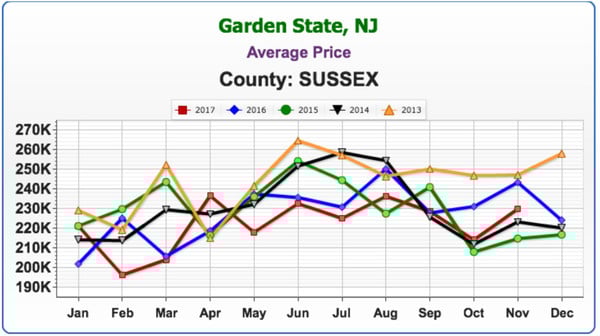
Average Price
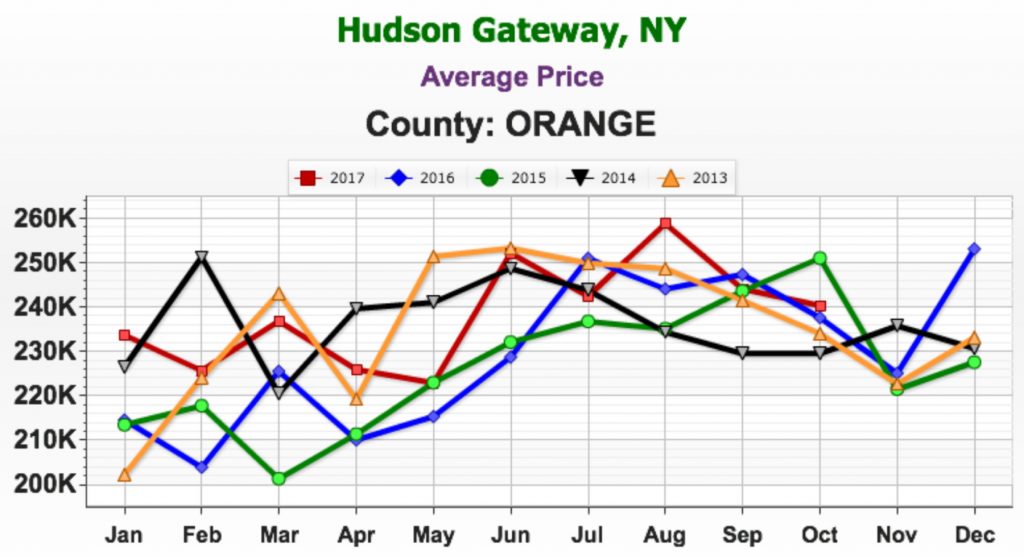
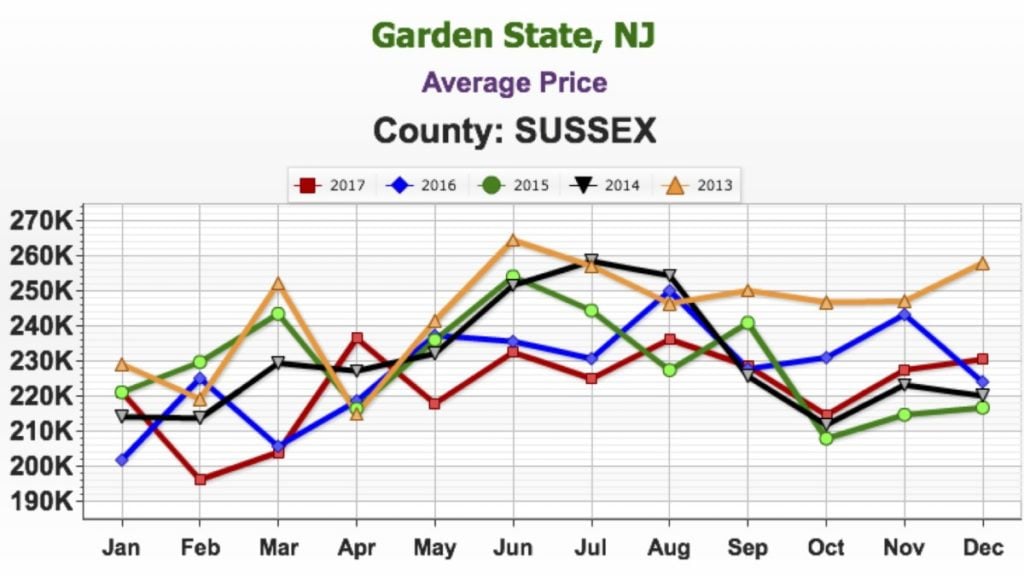
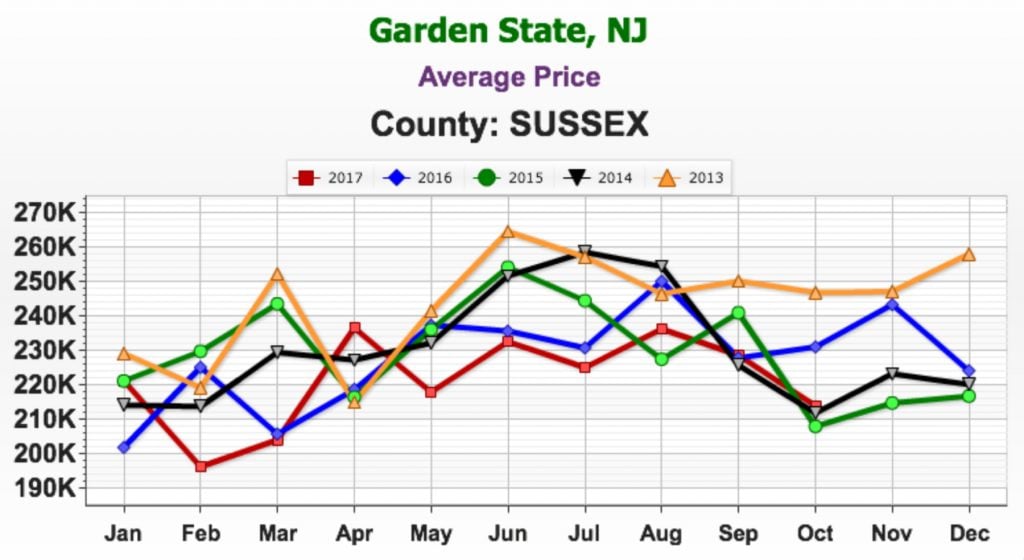
Sussex County is not seeing the upward trend in price that is being seen in Orange County, but the average price in December is still above every year except 2013. For most of the year the average price was significantly below 2016. However, this may be due to an unloading of foreclosure activity. There was a great deal of foreclosure inventory and short sales, which impacted the “average” price. It is important to remember that prices will fluctuate in hyper local markets.
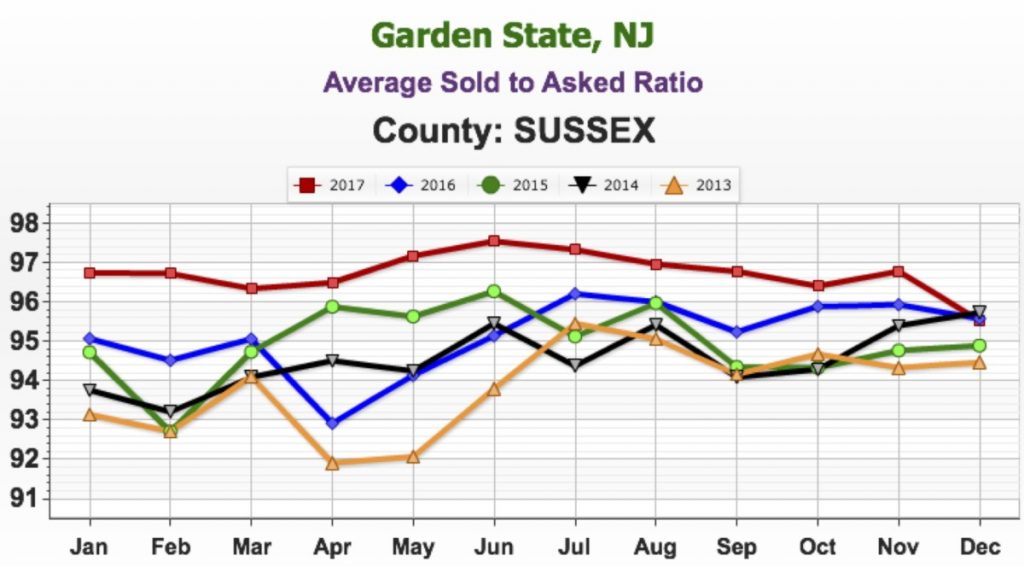
Average Sold to Asked Ratio
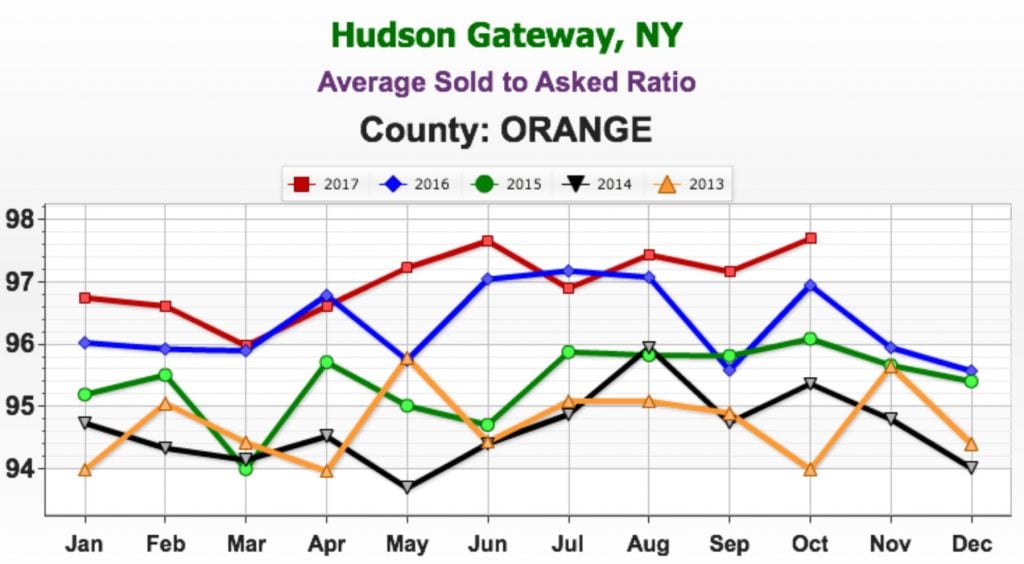
The percentage a house sold for under or over the last asking price (not the original price).
The higher the number, the hotter the seller’s market.
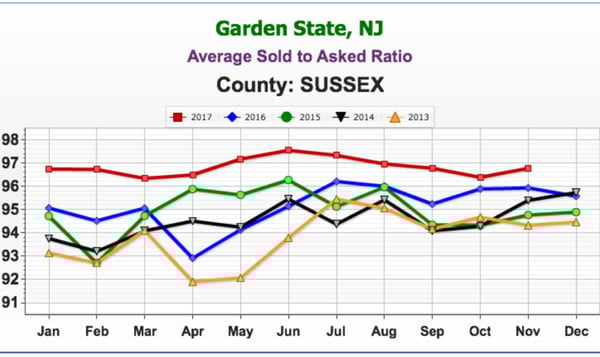
On average, sellers are having to negotiate less than 3% off their last asking price. While down slightly from November, the average sold to asked ratio is holding strong and was consistently higher in 2017 than in any year since 2013.
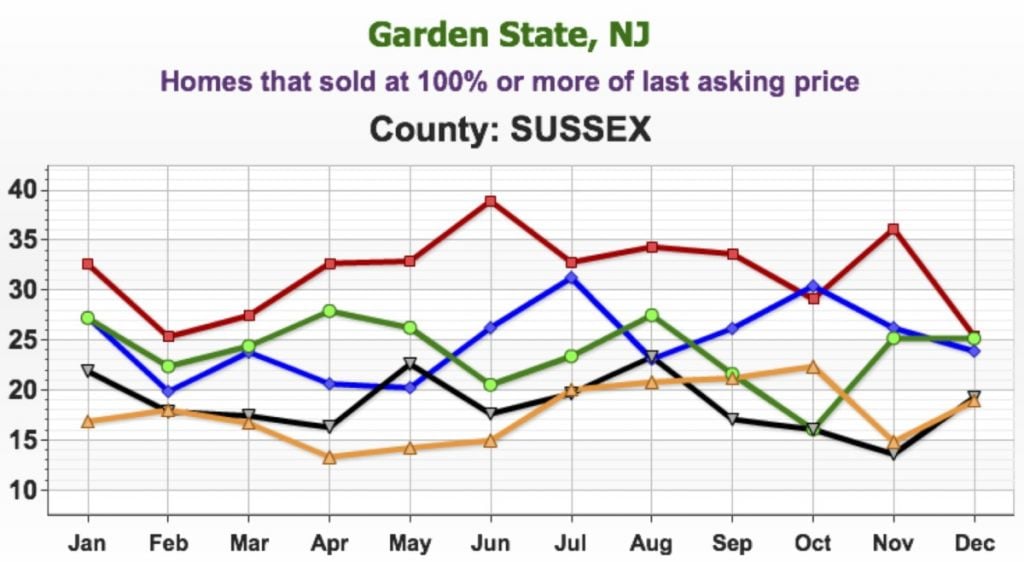
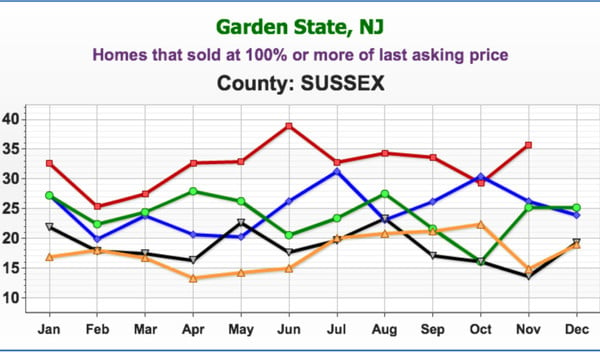
Homes that sold at 100% or more of last asking price
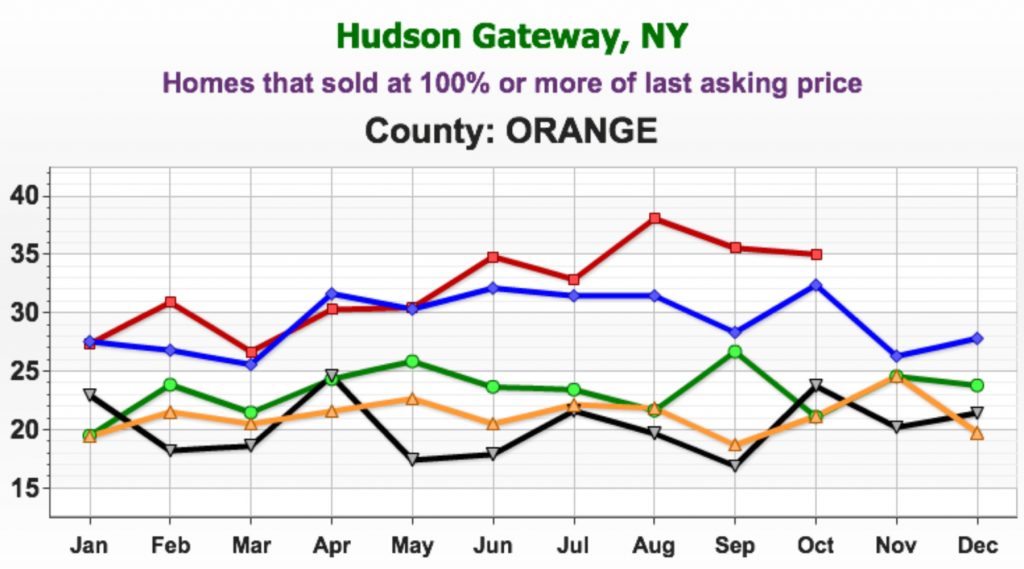
About one-third of all homes were sold at 100% or more of their last asking price, another indication of a strong market. This is very similar to the Orange County, NY which our Green Team Home Selling System office is located in.
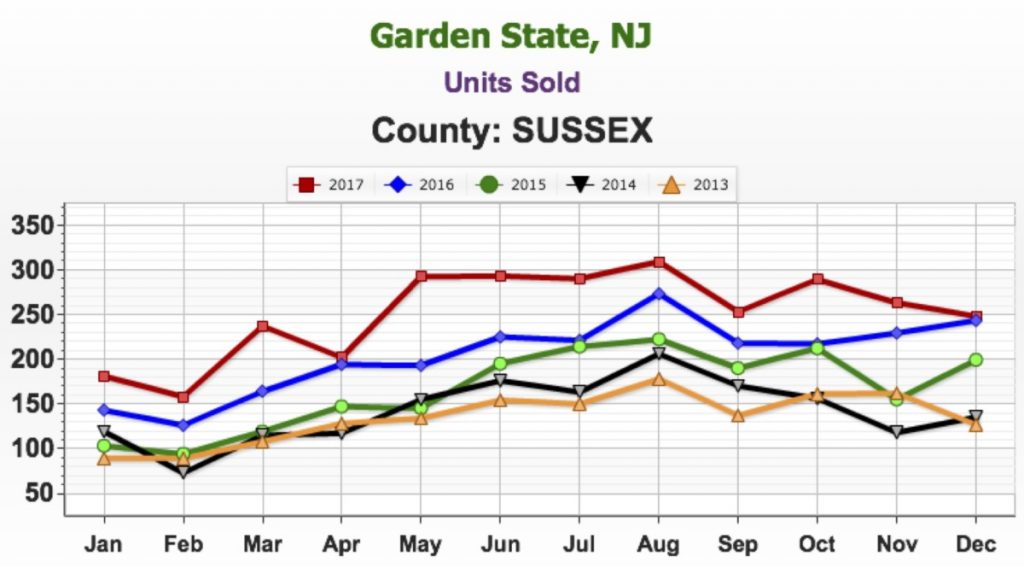
Units Sold
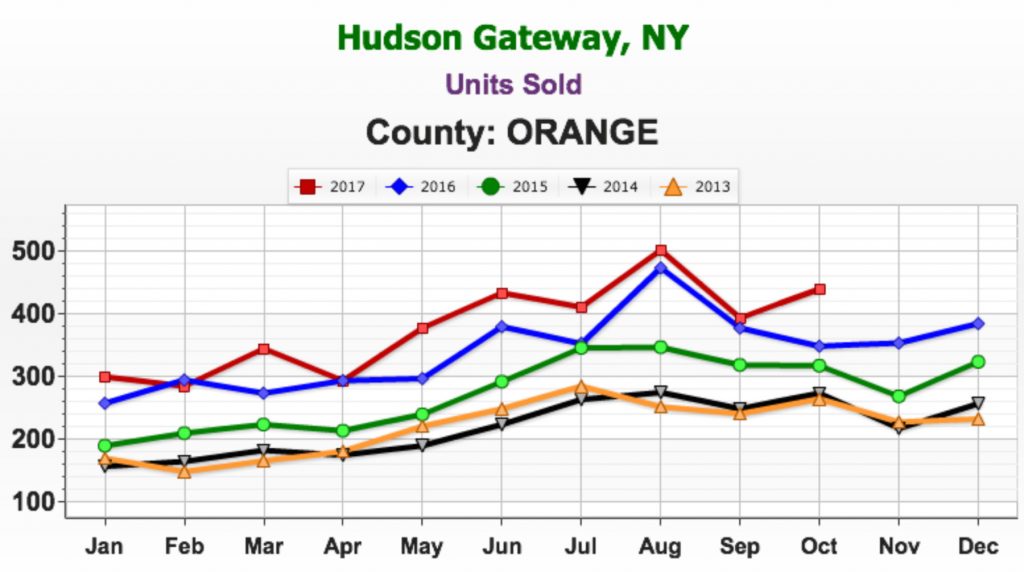
The term units here includes single family homes, condominiums, town house and multi-family homes with 1-4 units.
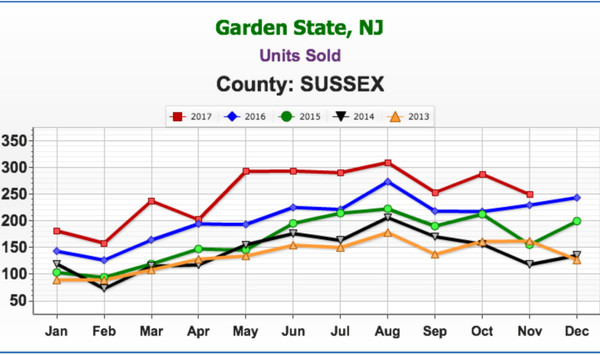
The market is still strong, higher than any of the years since 2013. 2017 has consistently had the highest number of units sold in each year since 2013.
October’s Market Review Meeting was held a little more than a week before Thanksgiving, and a little more than a month before we ring in a new year. It’s the perfect time to talk about goals that have been set, goals that have and have not been met, and goals that have been exceeded. The Green Team’s Warwick office is one of the top ten agencies in Orange County, with a goal of being one of the top five! And the Vernon office, which opened its doors just 18 months ago, is already in the top 25 of all Sussex County agencies! The Warwick office, as of October 31 it has already exceeded 2016’s year-end total. Green Team New Jersey Realty does not have a full year to compare 2017’s sales to, but its anticipated year-end sales will clearly demonstrate a successful accomplishment for a new agency.
Exceeding Goals and Expectations
2017 has seen exciting goals being set and met by agents in both offices. Mention Sales Leader Awards in Warwick, and there are two names that immediately come to mind: Jennifer DiCostanzo, 2016 Sales Leader and First Quarter Sales Leader Award winner for 2017, and Nancy Sardo, winner of the 2nd and 3rd Quarter Sales Leader Awards for 2017. Jen has already exceeded her goal for this year, and Nancy is close to reaching hers. Who will be the 4th Quarter Leader and who will be 2017 Sales Leader? We can’t wait to find out! And, while these two battle it out, Chris Kimiecik, while new to real estate, has blasted way past his goal of $1,000,000 in sales. Other agents have either reached or exceeded their goals, and others are still working towards meeting theirs. In Vernon, Keren Gonen is a shining star! Another agent new to the business, Keren set a very high first year goal of $3,000,000 – and she has already exceeded that! These agents are excellent examples of the opportunities and possibilities that exist in our industry, as well as demonstrating the hard work, dedication and drive that it takes to reach and then exceed goals. There are many other agents who are exceeding the goals they set for themselves for 2017. Green Team’s agents in both offices are working hard, constantly striving to improve their knowledge and skills, all while providing top notch service to their clients. 2018 looks to be an exciting year for all.
“How is the market?”
When a client asks this question, an agent’s answer is indicative of their level of professionalism and knowledge. This market review meeting focused on how to analyze local real estate stats to provide a clear and accurate portrait of market conditions to clients.
Local Market Reports – Sussex County, NJ
Average Sold to Asked Ratio
This is the percentage a house sold for under or over the last asking price (not the original price).
Sussex County:
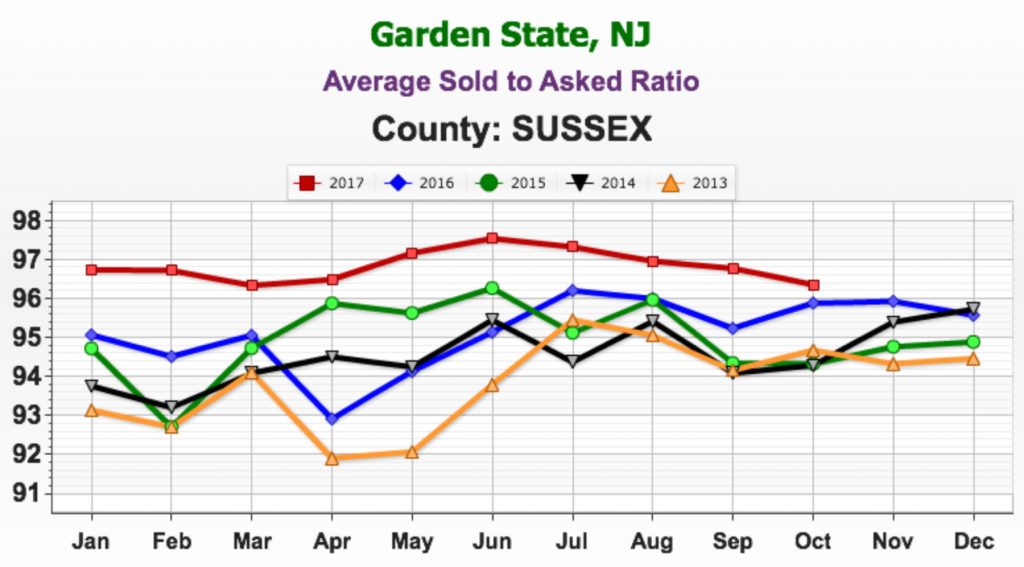
With an average of 96.8%, the Sold to Asked Ratio in Sussex County in 2017 has been higher than any of the previous four years. There has been a slight downward trend since July, but this can be attributed to a seasonal fluctuation. Besides, October’s average of 96.35% is still higher than any month during 2013 to 2016.
Units Sold
The term units here includes single family homes, condominiums, townhomes and multi-family homes with 1-4 units.
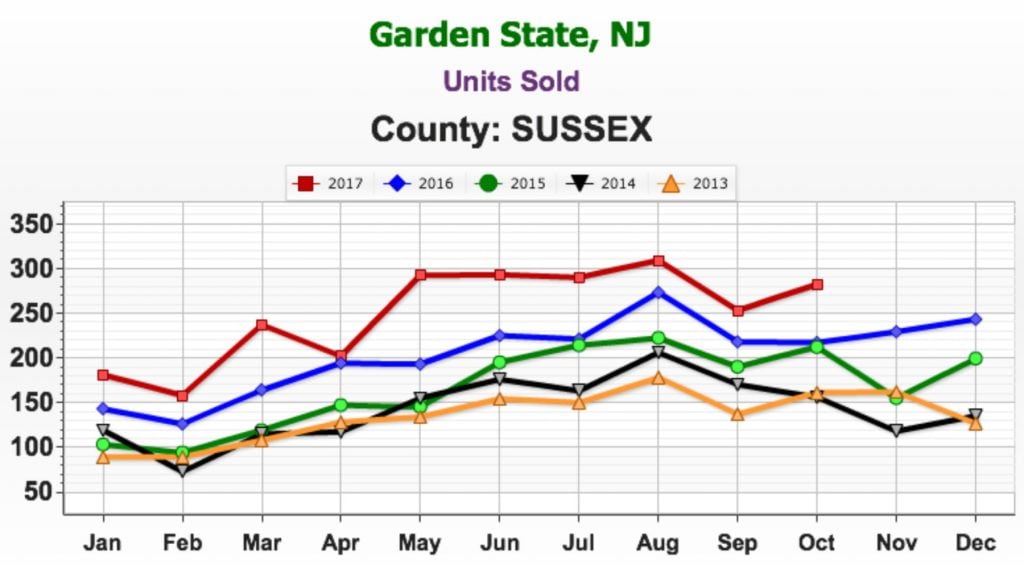
Sussex County: Here again, the stats show that the 2017 market is hot, with more units being sold this year than in any of the years from 2013 to 2016. There was a dip in September, but then a rise in October.
Average Days on Market
The faster things are selling, the hotter the market, so look for the lowest number on the graph as opposed to the highest. In New York State, the calculation was changed so that it is from the List Date to the Contract Date, rather than to the Binder Date, which was the standard 3 years ago.
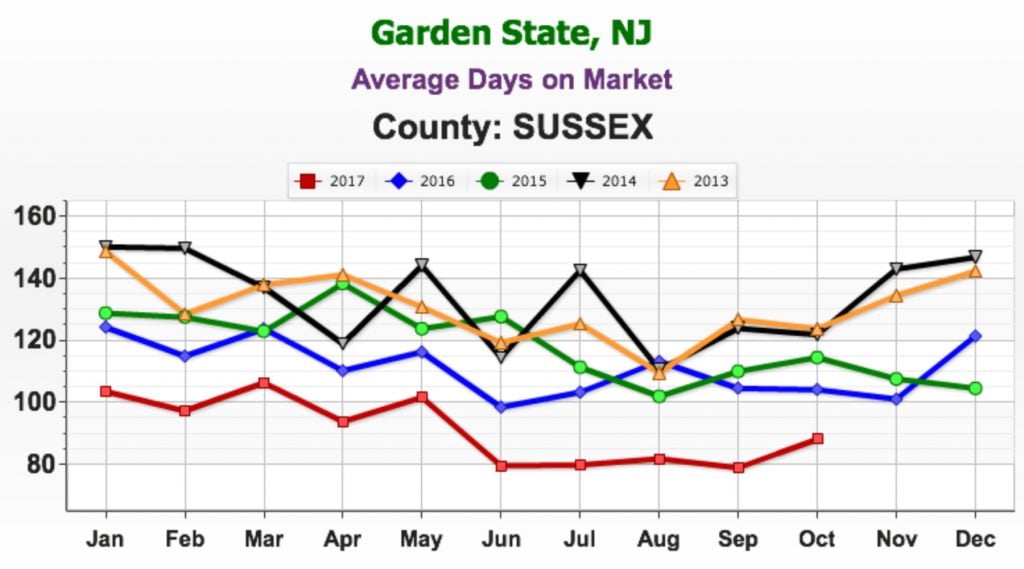
Sussex County: With an average of 91.03 days on the market, 2017 once again proves itself to be a hotter market than the previous four years.
Homes that sold at 100% or more of last asking price
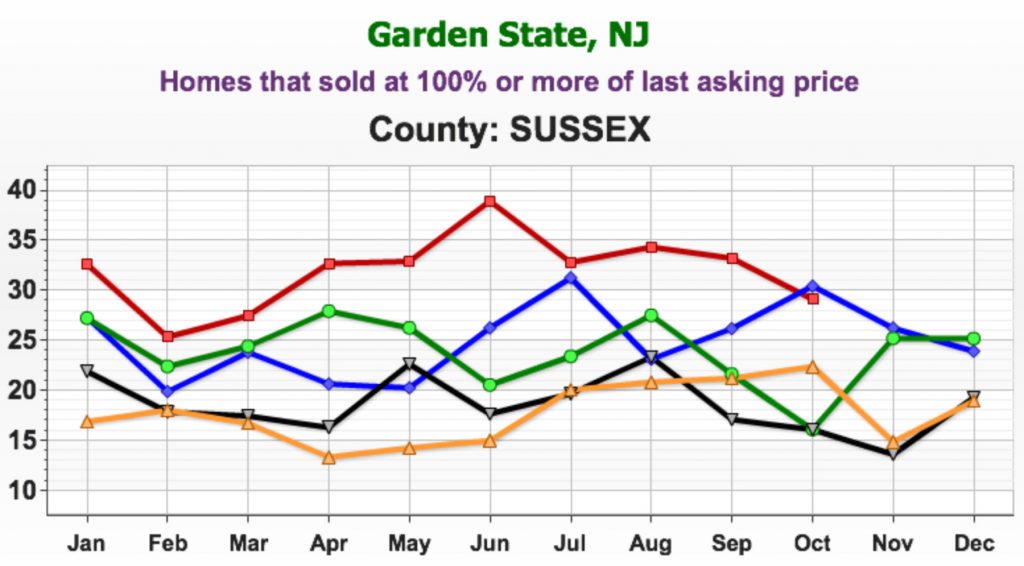
Sussex County: In October the number dipped slightly below last year’s October number, but still almost one-third of homes are selling at 100% of their asking price – or above it!
Average Price
Sussex County: Despite the market being hot, prices have gone down since 2013, when the average price was $243,909. In 2017, it’s $221,196. In fact, on average, prices are lower this year than the last four years. When pricing a home for a client It is essential to look at hyper-local comparables.
So, How is the Market?
After reviewing all of the data contained in the graphs for these categories for Sussex County and Orange County, the real estate market is Hot!!! If trends continue their upward climb we can anticipate another great year in 2018. Continue setting goals and let the market help you achieve the best possible deals for sellers, and find the best home, at the best price, for buyers.
Our Next Market Review Meeting
Our November Market Review Meeting is scheduled for Tuesday, December 12. As always, we look forward to keeping on top of our goals and discussing matters that are important to the success of your real estate transaction with our agents. We’ll then be posting information that we hope you’ll find interesting and helpful.
The last Real Estate Market Review Meeting of 2017 marks a year of growth and success on both company-wide and individual levels. In both the Warwick and Vernon offices, many sales associates have met or exceeded the goals they set at the beginning of the year. Many of the agents in Warwick doubled their sales from last year, including Nancy Sardo, Vikki Garby, Tammy Scotto, Angela Murphy, Chris Kimiecik, Julianna Green and Jane Reilly. As the Vernon office opened this year, there are no numbers from 2016 to compare to. However, the New Jersey sales associates are setting the bar high for next year. Eight agents had sales exceeding $1 million – and some exceeding $4 million! Keren Goren, Charles Nagy, Barbara Tesa, Ted Van Laar, Joyce Rogers, Heidi Hyland, Stacy Springerand Kimberly Lasalandra will have to set their goals high for 2018 to compare with their sales this year.
The Importance of setting goals
The numbers from December won’t be available until next month, but projections look very good and once the final numbers are in and tallied with the year to date numbers, award winners will be determined. The excitement builds! Will Jennifer DiCostanzo, winner of 2016’s Sale Leader Award take the prize again this year for the Warwick office? Will Keren Goren, a highly motivated newcomer to real estate, take the prize for the Vernon office? Stay tuned…
The Green Team Annual Award Ceremony will take place on January 26, and Fourth Quarter Sales Leader Awards and Sales Leader Award for 2017 will be announced. All of the agents who have become Quarter Sales Leaders and Sales Leaders for the Year have been goal setters. According to Geoff Green, the importance of the Personal Action & Engagement Plan for 2018 cannot be overstated and he encourages all Green Team agents to complete and submit theirs and start the New Year on the right note!
How is the market?
It is imperative that agents understand how to analyze local real estate stats and be able to provide a clear and accurate portrait of market conditions to their clients. Fluctuations from month to month may seem minor, but tracking them throughout the year gives a good indication of where the market stands. Trends towards a sellers or buyers market will affect advice to clients, whether they are buying or selling a home. The importance of this information is why a monthly meeting is held to go over the previous month’s statistics and overall trends for the year.
Local Market Reports – Sussex County, NJ
Average Sold to Asked Ratio
The percentage a house sold for under or over the last asking price (not the original price).
Sussex County:There was an increase in the Average Sold to Asked Ratio from October to November, from 96.38% to 96.76%, continuing the trend of 2017 being higher than any of the previous four years.
Units Sold
The term units here includes single family homes, condominiums, town homes and multi-family homes with 1-4 units.
Sussex County: The stats show that the market continues to be hot, with more units being sold this year than in any of the years from 2013 to 2016. While there was a rise in units sold from September to October, there was a slight dip in units sold in November. Even with that dip, the number of units sold this November is higher than the number of units sold in the same month in each of 2013, 2014, 2015 and 2016.
Average Days on Market
The faster things are selling, the hotter the market. Look for the lowest number on the graph as opposed to the highest. The calculation was changed in New York State. It’s now from the List Date to the Contract Date, rather than the Binder Date.
Sussex County: Consistently lower than the previous four years, November stats showed an average of 86.86 days on the market.
Homes that sold at 100% or more of last asking price
Sussex County: This number rose from October. 36.42% of homes sold at 100% or more of their last asking price – more than one-third!
Average Price
Sussex County: Despite the market being hot, prices have gone down since 2013, when the average price was $243,909. In 2017, it’s $221,994. November has seen a rise in average price to $229,779 from $214,056 in October. On average, prices are lower this year than the last four years. So it is essential to look at hyper-local comparables when pricing a home for a client.
What do these stats mean for buyers and sellers?
All the of above statistics show a market where sellers are in a strong position. A quarter to over a third of homes are selling at 100% or more of the seller’s last asking price. Homes are remaining on the market for shorter periods than any of the last five years. This is not a market where buyers have a strong upper hand when it comes to negotiating. Nor do they have the luxury of time. Thinking about selling? Now is a great time to find out what your home is worth.
The importance of a strong offer
With the shortage of inventory in today’s market combined with the above data, it has become increasingly important for buyers to come in quickly with a strong offer on the house they would like to call home! Buyers may not realize that increasing their offer by a few thousand dollars may only amount to an additional $20 or $30 in their monthly mortgage payment. Sellers may be receiving multiple offers. And other buyers may not be reticent about making a strong offer if they really want the house. It’s important to discuss your options with your real estate agent. Your agent will advise you on making that all important offer on the home that you want!
The prospect of staging their home for sale gives some clients “stage fright.” They don’t want to take down their family photos and collectibles. Moreover, they feel their home looks great the way it is and that will help the sale!
How Staging Can Help Sell Your Home
Home staging is a vital step that should not be overlooked or dismissed in the preliminary discussions of getting ready to sell. However, there are different “Stages” of Staging that will ultimately give your home “High Octane” power when entering the market. Showcasing targeted areas, giving attention to WOW factors, are key components. Your realtor will strategically guide you for your grand debut to the market.
A Picture is Worth a Thousand Words
Staging has become the new norm that will warrant interest and offers from buyers in short time. Remember, the goal in selling your home is to get the highest value the market will support in the least amount of time. Buyers expect to see their lifestyle fit in your home. It’s no longer just for high-end custom properties. Its purpose is to capture positive attention and leave an impression on the market. Buyers see first with their eyes. Then their heart, followed by an offer. You only get one chance at a first impression- make it worthwhile for you!
The Importance of De-Cluttering
Your home, once entered into the MLS, will be seen on the largest of online platforms. A “Show ready” home is well worth a few revisions. Enhance your home by painting to balance tones and freshen. Then put away any and all personal collections and the family photos. De-clutter, de-clutter, and de-clutter are the simplest things to do, yet among the most important, and will have a big impact when your home is professionally photographed.
Keep in mind, putting these items away is just temporary and also provides added privacy when opening your home to buyers and viewers, both online and in person. Focus all your attention on the house .. and NOT what’s in it! You want prospective buyers to leave your home excited and envisioning their needs and lifestyle, not wondering if they know you or your family from the photos displayed or distracted by the elaborate collection of vintage dolls or sports memorabilia.
So no need for stage fright. Put away those photos and priceless collectibles. If you follow these simple steps you’ll be looking forward to a great opening of your very own show-ing!
Disclaimer: This guide is not meant to be a resource for tax advice but instead a resource for basic information concerning only certain aspects of the new tax code and how they may impact the real estate market. You should get tax advice from your accountant or tax preparer who will explain how the entire tax code will affect your personal return.
This information comes immediately after the new tax code became law. Some of the information may be revised as the analysis of the new law evolves.
When the tax code was originally being overhauled by the House and the Senate, there were three major proposals being considered that would have substantially impacted the residential real estate market:
Changing the requirements for the exclusion of gain on the sale of a principal residence
The reduction on the limit of the Mortgage Interest Deduction (MID)
The elimination of the State and Local Tax deduction (SALT) which includes property taxes
Let’s look how the tax code has evolved from the original proposal, and decipher what impact experts believe it may have on the housing market.
1. Exclusion of gain on sale of a principal residence
Original Proposal: Owners would need to live in their house for at least 5 out of the last 8 years to claim this exemption. Under the former tax framework, a typical owner, who has lived in their house for at least 2 years out of the last 5 years, would pay nothing in capital gain taxes if they sell the house.
The New Tax Code: No change. The “at least 2 years out of the last 5 years” requirement is unchanged.
Impact on the Market: None.
2. Mortgage Interest Deduction
Original Proposal: Reduce the limit on the mortgage interest deduction (MID) amount from $1,000,000 to $500,000.
The New Tax Code: Reduces limit on deductible mortgage debt to $750,000 for new loans taken out after 12/14/17. Current loans up to $1 million are grandfathered.
Impact on the Market: Assuming a 20% down payment, this reduction in the MID will impact buyers that are purchasing a home between the prices of $938,000 and $1,250,000. Any home under the lower price is still covered and any home over the higher price was not covered under the former tax code either.
What does that mean to the market? Experts disagree. Calculated Risk’s Bill McBride:
“I think the impact of reducing the MID from a maximum of $1 million in mortgage debt to $750 thousand in mortgage debt will have very little impact on the housing market.”
On the other hand, Capital Economics claims:
“The impact on expensive homes could be detrimental, with a limit on the mortgage interest deduction raising taxes for those that itemize.”
3. State and Local Taxes (SALT)
Original Proposal: The elimination of the state and local tax deduction (which includes property taxes).
The New Tax Code: Allows an itemized deduction of up to $10,000 for the total of state and local property taxes and income or sales taxes.
Impact on the Market: Most experts agree that higher taxed regions will be impacted as homeowners in those communities now have a cap on these deductions.
Calculated Risk’s Bill McBride stated:
“SALT will have an impact on housing in some areas. Some people might choose to live in one state over another (if they have a choice), based on taxation. This could impact demand in certain states – especially for the middle and upper-middle class homeowners.”
Mark Zandi of Moody’s Analytics said:
“The impact on house prices is much greater for higher-priced homes, especially in parts of the country where incomes are higher and there are thus a disproportionate number of itemizers, and where homeowners have big mortgages and property tax bills.”
What will be the overall impact on the housing market?
For most of the country, the new tax code will not have a negative impact on the market. As Capital Economics reports:
“Given most households will see an overall tax cut, and potential buyers are likely to put that saving towards their home, we doubt it will have a significant detrimental impact on the housing market.”
There is also no doubt that some higher priced, higher taxed regions will be affected more than others. However, most experts agree that other portions of the tax code will favor the high-end buyer and seller, and this might mitigate many concerns. McBride explains:
“The corporate tax cuts (and other tax cuts) will mostly benefit the wealthy, and this will be a positive for high end real estate.”
What does this all mean to you?
To know for sure, you should sit with your accountant or financial planner and explore how all the aspects of the new code will impact your family.
Most families consider homeownership an essential part of the American Dream, and don’t purchase a home based solely on the tax advantages. The main reasons they buy a home are personal (they just got married, they are looking for a good place to raise children, they want to be near friends and family, they want to better enjoy their retirement, etc.). This will never change.
Looking at the new tax code, Mr. McBride’s opinion makes the most sense:
“There will be some negative impact based on SALT, but overall the impact of these policy changes on housing will be minimal.”
Still have some questions? The Green Team is ready to help. Give your local agent a call or contact us for assistance.
Local businesses and individuals have joined forces with the Green Team by becoming sponsors for our Second Annual Light Up the Holidays event. To date, Orange County sponsors have raised $3,400 for Warwick Playground Dreams, and Sussex County sponsors have raised $2,350 for the Vernon Senior Center. Sponsorship donations are made directly to the charity, and you’ll find these generous community and business members featured on the Green Team’s website, where they will have a permanent place of honor! It is not too late to join our sponsors in making a lot of dreams come true.
And now the fun begins! We are looking for photos of homes that reflect the beauty of the season to feature on our website and Facebook page! Enter your own home, nominate your neighbor, or a business whose decorations you admire! Also, don’t be surprised if a Green Team member has admired your light display and left you a placard asking you to register on our website! Visit https://www.greenteamhq.com/luh2017 to register, to see the community members who have donated so generously to these two charities, and to place or see your home in the competition!
Wishing all a joyous holiday season!
Click on the images below to view homes in your area that have been entered into the Light Up The Holidays 2017 contest so far. Continue to check back as homes will continue to be added through the new year.
So, you’ve been searching for that perfect house to call a ‘home,’ and you finally found it! The price is right, and in such a competitive market, you want to make sure that you make a good offer so that you can guarantee that your dream of making this house yours comes true!
Freddie Mac covered“4 Tips for Making an Offer” in their Executive Perspective. Here are the 4 tips they covered along with some additional information for your consideration:
“While it’s not nearly as fun as house hunting, fully understanding your finances is critical in making an offer.”
This ‘tip’ or ‘step’ should really take place before you start your home search process.
Getting pre-approved is one of many steps that will show home sellers that you are serious about buying, and will allow you to make your offer with the confidence of knowing that you have already been approved for a mortgage for that amount. You will also need to know if you are prepared to make any repairs that may need to be made to the house (ex: new roof, new furnace).
2. Act Fast
“Even though there are fewer investors, the inventory of homes for sale is also low and competition for housing continues to heat up in many parts of the country.”
The inventory of homes listed for sale has remained well below the 6-month supply that is needed for a ‘normal’ market. Buyer demand has continued to outpace the supply of homes for sale, causing buyers to compete with each other for their dream homes.
Make sure that as soon as you decide that you want to make an offer, you work with your agent to present it as soon as possible.
3. Make a Solid Offer
Freddie Mac offers this advice to help make your offer the strongest it can be:
“Your strongest offer will be comparable with other sales and listings in the neighborhood. A licensed real estate agent active in the neighborhoods you are considering will be instrumental in helping you put in a solid offer based on their experience and other key considerations such as recent sales of similar homes, the condition of the house and what you can afford.”
Talk with your agent to find out if there are any ways that you can make your offer stand out in this competitive market!
4. Be Prepared to Negotiate
“It’s likely that you’ll get at least one counteroffer from the sellers so be prepared. The two things most likely to be negotiated are the selling price and closing date. Given that, you’ll be glad you did your homework first to understand how much you can afford.
Your agent will also be key in the negotiation process, giving you guidance on the counteroffer and making sure that the agreed-to contract terms are met.”
If your offer is approved, Freddie Mac urges you to “always get an independent home inspection, so you know the true condition of the home.” If the inspector uncovers undisclosed problems or issues, you can discuss any repairs that may need to be made with the seller, or cancel the contract.
Bottom Line
Whether buying your first home or your fifth, having a local real estate professional who is an expert in their market on your side is your best bet to make sure the process goes smoothly. Let’s talk about how we can make your dreams of homeownership a reality!
The Green Team celebrates the holiday season by recognizing the joy and beauty of homes and businesses whose decorations Light Up the Holidays and our communities. It celebrates the ideals of giving and sharing that are at its core by raising money for local charities. And this year, what better way to celebrate the Holidays than by selecting a charity devoted to children!.
Warwick Playground Dreams
Parent volunteers from throughout the Town of Warwick make up this non-profit organization. Their goal, to raise the funds needed to replace aging equipment in Stanley Deming Park. Working with Play by Design of Ithaca, NY, the new playground will not only be whimsical and fun, but also inclusive, with ADA-accessible playground equipment. The playground will also be community built. It is hoped that local artists will decorate it to reflect the culture, history and beauty of Warwick.
Working together with the Village, schools,and Play by Design, volunteers are organized and ready, willing and able! Unfortunately, building a creative, fun and accessible playground is expensive. So being selected as the recipient of donations from Warwick’s Green Team Light up the Holidays event was good news. And on November 29 there was great news. The Light Up the Holidays team presented Warwick Playground Dreams with donations of $1,950. With the continued generosity of Warwick’s businesses, professionals and individuals, there will be more to come.
It Takes a Community to Build a Playground
“We were very excited and grateful when the Green Team reached out to us and offered to help us bring the community together in support of all of Warwick’s children,” said Hannelore Chambers, President of Warwick Playground Dreams. “It is so heartening to see other members of the community reaching out to help us raise awareness and get closer to our $300,000 goal.
As many other towns and cities before us have experienced, building a playground can also build a greater sense of community. How empowering for the children to see what a great thing can be created if everyone works together, and that this playground is being created out of love for them by their parents, grandparents and neighbors. Through our very close collaboration over the last year, many of our committee members have already experienced how strong bonds can be created all across the town between families who might not otherwise have crossed paths due to geography and different school districts.”
You Can Be Part of this Wonderful Project
Light Up the Holidays Sponsors are helping to purchase materials and equipment needed to build the playground. There will be challenging equipment for older kids, and equipment accessible and useful to children of different abilities. The organization will soon be entering their second phase of fundraising efforts. Local groups, businesses and families will be able to sponsor specific playground components. This will range from individual swings and slides to a proposed dual zip line and a wheelchair accessible merry-go-round.
The Green Team celebrates the holiday season by recognizing the joy and beauty of homes and businesses whose decorations Light Up the Holidays and our communities. And it celebrates the ideals of giving and sharing that are at its core by raising money for local charities.
Meet the Vernon Recipient of Light Up the Holidays 2017 Donations
Keren Gonen of Green Team New Jersey Realty shocked Jane Damstra, Director of the Vernon Township Senior Center, when she told Jane that her organization had been selected as its designated charity. Jane’s shock, however, soon turned to excitement as she started imagining what the sponsorship donations could mean to the approximately 200 seniors who come to the Center annually. On any given day you can find between 38 and 50 seniors ages 60 and over at the Center. First of all, some come for the lunch provided by the Senior Services Nutrition Program for a $2 donation. And many are there to enjoy the activities offered by the Center. Currently these include Zumba, shuffleboard, line dancing, Wii bowling and pool, cards, watching DVD’s. Almost all of these activities involve minimal cost, and don’t provide the challenge and creativity that many seniors crave.
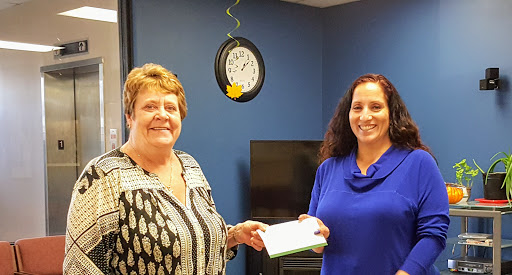
And now Keren has shocked Jane once again. On November 30 she presented Jane with $1,450 in donations. Furthermore, with the continued generosity of local businesses throughout Sussex County, there will be more to come.
Local Businesses Can Make a Difference
Aging does not bring an end to creativity, to curiosity, to learning, to enjoyment of life. Local businesses that sponsor the Green Team’s Second Annual Light Up the Holidays Contest can make a real difference in the lives of Vernon’s seniors. Because, now programs that Jane had only dreamed of can start to become reality.
One of her top priorities is the purchase of two laptop computers. They’ll be used as part of a training program with tech-savvy high school volunteers. The volunteers will teach the seniors to use the internet to talk to faraway family members, pay bills, and more. A group of talented knitters at the Center create items for donation to charitable causes. However, wool can be expensive. Thus, another priority is crafting supplies, including wool needed for these projects. Jane would also love to start a watercolor class. And she’d like to bring in guest speakers and instructors. Generally, fees exceed what the program budget will allow. Furthermore, there are other programs she wants to start – day trips for the many who are no longer able to drive themselves. Trips to the mall, to see local theatre productions… The list goes on.
Brighten your community through Light Up the Holidays!
Local professionals, businesses and individuals can work with the Green Team to bring exciting new programs to Vernon’s vibrant senior population. And if what comes around goes around, there will be light and joy enough for all of us! For more information about the Green Team and its Second Annual Light Up the Holidays Event, visit https://www.greenteamhq.com/luh2017/, and for more information about the Vernon Township Senior Center, visit http://www.vernontwp.com/services/senior_center/,
October’s Market Review Meeting was held a little more than a week before Thanksgiving, and a little more than a month before we ring in a new year. It’s the perfect time to talk about goals that have been set, goals that have and have not been met, and goals that have been exceeded. The Green Team’s Warwick office is one of the top ten agencies in Orange County, with a goal of being one of the top five! And the Vernon office, which opened its doors just 18 months ago, is already in the top 25 of all Sussex County agencies! The Warwick office, as of October 31 it has already exceeded 2016’s year-end total. Green Team New Jersey Realty does not have a full year to compare 2017’s sales to, but its anticipated year-end sales will clearly demonstrate a successful accomplishment for a new agency.
Exceeding Goals and Expectations
2017 has seen exciting goals being set and met by agents in both offices. Mention Sales Leader Awards in Warwick, and there are two names that immediately come to mind: Jennifer DiCostanzo, 2016 Sales Leader and First Quarter Sales Leader Award winner for 2017, and Nancy Sardo, winner of the 2nd and 3rd Quarter Sales Leader Awards for 2017. Jen has already exceeded her goal for this year, and Nancy is close to reaching hers. Who will be the 4th Quarter Leader and who will be 2017 Sales Leader? We can’t wait to find out! And, while these two battle it out, Chris Kimiecik, while new to real estate, has blasted way past his goal of $1,000,000 in sales. Other agents have either reached or exceeded their goals, and others are still working towards meeting theirs. In Vernon, Keren Gonen is a shining star! Another agent new to the business, Keren set a very high first year goal of $3,000,000 – and she has already exceeded that! These agents are excellent examples of the opportunities and possibilities that exist in our industry, as well as demonstrating the hard work, dedication and drive that it takes to reach and then exceed goals. There are many other agents who are exceeding the goals they set for themselves for 2017. Green Team’s agents in both offices are working hard, constantly striving to improve their knowledge and skills, all while providing top notch service to their clients. 2018 looks to be an exciting year for all.
“How is the market?”
When a client asks this question, an agent’s answer is indicative of their level of professionalism and knowledge. This market review meeting focused on how to analyze local real estate stats to provide a clear and accurate portrait of market conditions to clients.
Average Sold to Asked Ratio
This is the percentage a house sold for under or over the last asking price (not the original price).
Sussex County:
With an average of 96.8%, the Sold to Asked Ratio in Sussex County in 2017 has been higher than any of the previous four years. There has been a slight downward trend since July, but this can be attributed to a seasonal fluctuation. Besides, October’s average of 96.35% is still higher than any month during 2013 to 2016.
Orange County: In Orange County, the Sold to Asked Ratio is almost 98%, which means the market is Hot!!!
Units Sold
The term units here includes single family homes, condominiums, townhomes and multi-family homes with 1-4 units.
Sussex County: Here again, the stats show that the 2017 market is hot, with more units being sold this year than in any of the years from 2013 to 2016. There was a dip in September, but then a rise in October.
Orange County: Orange County seems to be trending the same as Sussex County, with a dip in September, then climbing back up in October. Green Team’s internal numbers track the market trend of the rise in the number of units sold in October. The number sold was greater than in July, which is unusual, and it was greater than October in each of the four years prior.
Average Days on Market
The faster things are selling, the hotter the market, so look for the lowest number on the graph as opposed to the highest. In New York State, the calculation was changed so that it is from the List Date to the Contract Date, rather than to the Binder Date, which was the standard 3 years ago.
Sussex County: With an average of 91.03 days on the market, 2017 once again proves itself to be a hotter market than the previous four years.
Orange County: A trend similar to Sussex.With an average of 110 days for the year to date, October listings are below that, with an average of 92.54. 2017 has been consistently lower than the prior four years.
Homes that sold at 100% or more of last asking price
Sussex County: In October the number dipped slightly below last year’s October number, but still almost one-third of homes are selling at 100% of their asking price – or above it!
Orange County: Orange County is at approximately 35%, and is higher than last year.
Average Price
Sussex County: Despite the market being hot, prices have gone down since 2013, when the average price was $243,909. In 2017, it’s $221,196. In fact, on average, prices are lower this year than the last four years. When pricing a home for a client It is essential to look at hyper-local comparables.
Orange County: The story is different in Orange County. The graph shows peaks and valleys, with some stabilization between September and October, and the average price of homes in 2017 is $238,220. That number was $235,213 in 2013, $235,868 in 2014, and $229,637 last year. Again, although the market is hot, prices have not risen as many might expect, so it is important to check local stats to see what houses in a given neighborhood are going for when pricing a home for the market. This does not appear to be a market trend where you can say prices are definitely coming up.
So, How is the Market?
After reviewing all of the data contained in the graphs for these categories for Sussex County and Orange County, the real estate market is Hot!!! If trends continue their upward climb we can anticipate another great year in 2018. Continue setting goals and let the market help you achieve the best possible deals for sellers, and find the best home, at the best price, for buyers.
Our Next Market Review Meeting
Our November Market Review Meeting is scheduled for Tuesday, December 12. As always, we look forward to keeping on top of our goals and discussing matters that are important to the success of your real estate transaction with our agents. We’ll then be posting information that we hope you’ll find interesting and helpful.


 Facebook
 X
X
 Pinterest
 Copy Link

 e prospect of









 reen Team celebrates the holiday season by recognizing the joy and beauty of homes and businesses whose decorations Light Up the Holidays and our communities. And it celebrates the ideals of giving and sharing that are at its core by raising money for local charities.
 October’s Market Review Meeting was held a little more than a week before Thanksgiving, and a little more than a month before we ring in a new year. It’s the perfect time to talk about goals that have been set, goals that have and have not been met, and goals that have been exceeded. The Green Team’s Warwick office is one of the top ten agencies in Orange County, with a goal of being one of the top five! And the Vernon office, which opened its doors just 18 months ago, is already in the top 25 of all Sussex County agencies! The Warwick office, as of October 31 it has already exceeded 2016’s year-end total. Green Team New Jersey Realty does not have a full year to compare 2017’s sales to, but its anticipated year-end sales will clearly demonstrate a successful accomplishment for a new agency.