Housing Market News May 6, 2020

Will this Economic Crisis Have a V, U, or L-Shaped Recovery?

[et_pb_section fb_built=”1″ _builder_version=”3.0.47″][et_pb_row _builder_version=”3.0.48″ background_size=”initial” background_position=”top_left” background_repeat=”repeat”][et_pb_column type=”4_4″ _builder_version=”3.0.47″ parallax=”off” parallax_method=”on”][et_pb_text _builder_version=”3.0.74″ background_size=”initial” background_position=”top_left” background_repeat=”repeat”]Many American businesses have been put on hold as the country deals with the worst pandemic in over one hundred years. As the states are deciding on the best strategy to slowly and safely reopen, the big question is: how long will it take the economy to fully recover? Let’s look at the possibilities. Here are the three types of recoveries that follow most economic slowdowns (the definitions are from the financial glossary at Market Business News):

  • V-shaped recovery: an economic period in which the economy experiences a sharp decline. However, it is also a brief period of decline. There is a clear bottom (called a trough by economists) which does not last long. Then there is a strong recovery.
  • U-shaped recovery: when the decline is more gradual, i.e., less severe. The recovery that follows starts off moderately and then picks up speed. The recovery could last 12-24 months.
  • L-shaped recovery: a steep economic decline followed by a long period with no growth. When an economy is in an L-shaped recovery, getting back to where it was before the decline will take years.

What type of recovery will we see this time?

No one can answer this question with one hundred percent certainty. However, most top financial services firms are calling for a V-shaped recovery. Goldman Sachs, Morgan Stanley, Wells Fargo Securities, and JP Morgan have all recently come out with projections that call for GDP to take a deep dive in the first half of the year but have a strong comeback in the second half.

Will This Economic Crisis Have a V, U, or L-Shaped Recovery? | MyKCM

Is there any research on recovery following a pandemic?

There have been two extensive studies done that look at how an economy has recovered from a pandemic in the past. Here are the conclusions they reached: 1. John Burns Consulting:

“Historical analysis showed us that pandemics are usually V-shaped (sharp recessions that recover quickly enough to provide little damage to home prices), and some very cutting-edge search engine analysis by our Information Management team showed the current slowdown is playing out similarly thus far.”

2. Harvard Business Review:

“It’s worth looking back at history to place the potential impact path of Covid-19 empirically. In fact, V-shapes monopolize the empirical landscape of prior shocks, including epidemics such as SARS, the 1968 H3N2 (“Hong Kong”) flu, 1958 H2N2 (“Asian”) flu, and 1918 Spanish flu.”

The research says we should experience a V-shaped recovery.

Does everyone agree it will be a ‘V’?

No. Some are concerned that, even when businesses are fully operational, the American public may be reluctant to jump right back in. As Market Business News explains:

“In a typical V-shaped recovery, there is a huge shift in economic activity after the downturn and the trough. Growing consumer demand and spending drive the massive shift in economic activity.”

If consumer demand and spending do not come back as quickly as most expect it will, we may be heading for a U-shaped recovery. In a message last Thursday, Chris Hyzy, Chief Investment Officer for Merrill and Bank of America Private Bank, agrees with other analysts who are expecting a resurgence in the economy later this year:

“We’re forecasting real economic growth of 30% for the U.S. in the 4th quarter of this year and 6.1% in 2021.”

His projection, however, calls for a U-shaped recovery based on concerns that consumers may not rush back in:

“After the steep plunge and bottoming out, a ‘U-shaped’ recovery should begin as consumer confidence slowly returns.”

Bottom Line

The research indicates the recovery will be V-shaped, and most analysts agree. However, no one knows for sure how quickly Americans will get back to “normal” life. We will have to wait and see as the situation unfolds.
[/et_pb_text][/et_pb_column][/et_pb_row][/et_pb_section][et_pb_section fb_built=”1″ _builder_version=”3.18.2″][et_pb_row _builder_version=”3.18.2″][et_pb_column type=”4_4″ _builder_version=”3.18.2″ parallax=”off” parallax_method=”on”][et_pb_post_nav in_same_term=”on” _builder_version=”3.18.2″ title_font=”|800|||||||” title_text_color=”#ffffff” title_font_size=”15px” background_color=”#007a42″ border_radii=”on|2px|2px|2px|2px” border_width_all=”2px” border_color_all=”#007a42″ custom_padding=”1px|4px|1px|4px”][/et_pb_post_nav][/et_pb_column][/et_pb_row][/et_pb_section]

Housing Market News April 27, 2020

April 2020 Housing Market Update

[et_pb_section fb_built=”1″ admin_label=”section” _builder_version=”3.0.47″][et_pb_row admin_label=”row” _builder_version=”3.0.48″ background_size=”initial” background_position=”top_left” background_repeat=”repeat”][et_pb_column type=”4_4″ _builder_version=”3.0.47″ parallax=”off” parallax_method=”on”][et_pb_text admin_label=”Text” _builder_version=”3.0.74″ background_size=”initial” background_position=”top_left” background_repeat=”repeat”]

Covid19 has caused economic turmoil, health crises and uncertainty. However, a historical perspective may help us manage emotions and enable us to see what is happening in the housing market and navigate it accordingly. Below is a recording of the Housing Market Update as well as a summary of the most important discussion points.


National – Historical Perspective


Will this be like 2008, the start of the great recession?


The Housing Market was greatly impacted at that time because it was the catalyst that caused the Great Recession. Home price changes during last 5 recessions indicate that recessions do not necessarily impact the housing market. In 3 of the last 5 recessions, housing markets actually increased.


Home Price Change during Last 5 Recessions


Housing and Mortgage Crash


In 2007, 2008 and 2009, the annual home price depreciation was significant. However, at the time we were dealing with sub-prime lending, etc.  However, looking further back, to the Dot.com crash and 9/11 market crash, there was a significant S&P 500 stock market correction. Yet prices in the housing market continued to increase. There were good fundamentals in place.April 2020 Green Team Realty Housing Market Update


Annual Home Price Appreciation


In any marketplace, you have to look at overall values. Are assets undervalued or overvalued? With the run-up to 2008, from 2000 to 2005, there were major price increases year over year. 6.5% was the lowest increase, with the highest being 12.5%. However, since 2014, 6.4% has been the highest increase. We haven’t gone back to those major subprime lending issues that happened before.


April 2020 Green Team Realty Housing Market Update


Mortgage Credit Availability and Affordability 


The Great Recession required mortgage industry restructuring. That, in turn, led to qualified buyers not being able to borrow. This time around, it’s a different landscape. We don’t have a subprime lending bubble in the residential housing market. Loans will be processed for good buyers with good credit. Mortgage requirements are tightening a bit, but not to an unreasonable level. Another analytic compares total home equity cashed out in the years 2005-2007 and 2017-2019. People were using their homes “like ATMs” during the former period.  The leverage people are putting on their homes has dropped from $824 Billion during 2005-2007 to $232 Billion during 2017-2019. 53.8% of all homes in America have at least 50% equity.


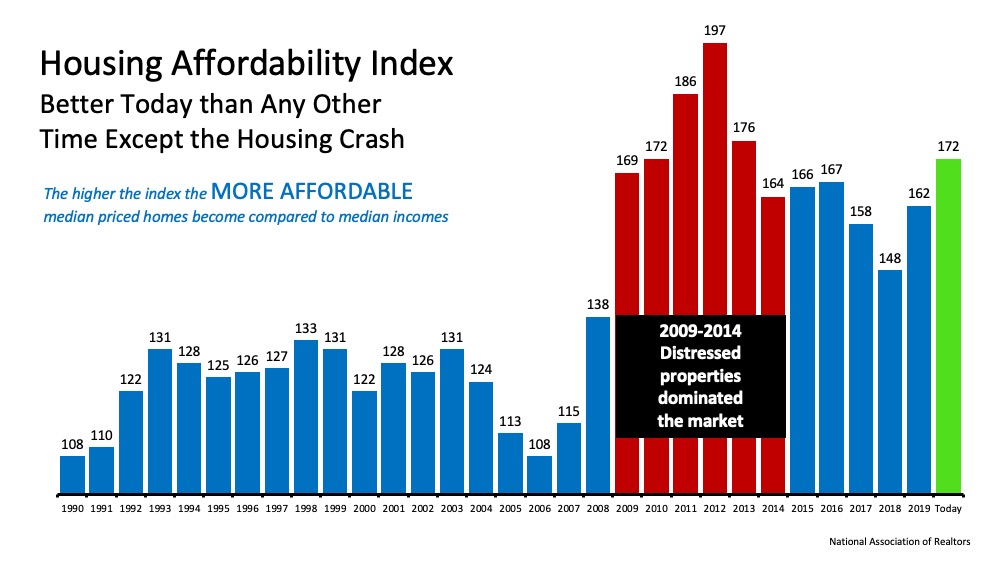
The percentage of median income needed to purchase a median-priced home has dropped from 25.4% in 2006 to 14.8% today. Affordability is in much better shape, largely due to mortgage rates being very low.


The Impact of Unemployment


Concerns about job losses are very real. A breakdown of the April 3 Unemployment Report shows the different sectors affected. 59.5% are from restaurant services and drinking places. The accommodation industry, retail trade, temporary help services, child daycare workers, health care office workers and construction workers make up most of the balance. In other words, these are jobs that should be coming back as soon as these businesses can operate again. It may take some time until people are confident and comfortable enough to get back out there. The next numbers come out on May 8, 2020 and will be discussed during the May HMU.


Unemployment rates and home sales do not seem to have a direct relationship. Current Unemployment Rates were compared to past financial crises. In 1933, during the Great Depression, unemployment rates were at a high of 24.9%. Goldman Sachs is predicting unemployment to be 15% in 2020. They are also predicting that number to go down to 6-8% in 2021, 5% in 2022 and 4% in 2023.


Based on data from the US Department of Labor accessed by Haver Analysis, the current employment situation is more like a natural disaster than a recession. The problem is how long this natural disaster, Covid19, is going to last. There are many unknowns, and no answers. We’ll be tracking what happens as parts of the economy reopen.


Historical look at Existing Home Sales Price


The market was hot the first two months of 2020, with average home sale price higher in January and February than those months in the preceding four years. It will be interesting to see what the numbers show over the next several months.


April 2020 Housing Market Update Green Team Realty


The above analytic shows Existing Home Sales Prices from January 1999 to January 2020. Even if you bought at the peak of 2007 or 2008, as Geoff did, just before the housing market plunged, it took 8 years for the market to recover. Historically speaking, people moved after an average of 6 years. That number is now inching up to 9 years. The average homeowner generally doesn’t buy or sell during a period of up or down. They want to wait and gain equity in their home. However, if you are not going to buy, what will you do? Rent?  If so, you’re not building equity, you’re not getting tax write-offs, and other benefits of home ownership.


Inventory


In 2007, there were 8.2 months of inventory.  Right now there are 3.1 months of inventory available. The market is much hotter now than in 2007 (leading into the Great Recession). Geoff believes that now is a very good time to buy, and not a bad time to sell, either, as inventory levels are so low. Historically, 6 months of supply is an average market. We are now down to 3 months of inventory. He does not see this number climbing anytime soon. Many sellers are not putting their homes on the market now, wanting to wait and see what will be happening. And, while people have to weigh their options, the low inventory can benefit those putting their home on the market.


April 2020 Local Stats


Orange & Sussex Counties


In Orange County, Units Sold were actually better in March than in February. Average Sales Price was way up. In Sussex County, Units Sold and Average Sales Price both coming out at a good solid pace. It will be interesting to see what the stats reflect when we take a look at our next Housing Market Update. At that time we’ll see the impact of Covid closures and stay-at-home regulations.


Housekeeping Items


Green Team Realty Housing Market Update


Panel Discussion


Geoff Green was joined by Ken Flood of Quest Financial Services and Ken Aulicino of Family First Funding LLC. Vikki Garby and Carol Buchanan of Green Team New York Realty and Keren Gonen of Green Team New Jersey Realty represented the real estate agents’  points of view. Discussion ranged from the current state of commercial and residential real estate markets. There was positive feedback on how agents are adapting to the Covid19 regulations and are still able to assist clients and close deals. All three agents spoke of strong, serious buyer interest. Ken Flood discussed the financial market and Ken Aucilino the mortgage industry. Because of the wealth of information and graphics as well as the fascinating panel discussion, it is highly recommended that you watch the webinar. Click here to view the April 2020 Housing Market Update.


Remember to sign up below for the next Housing Market Update 

[/et_pb_text][et_pb_agentfire_lead_form form=”contact” _builder_version=”3.18.2″][/et_pb_agentfire_lead_form][/et_pb_column][/et_pb_row][/et_pb_section]

Housing Market News April 27, 2020

What Impact Might COVID-19 Have on Home Values?


A big challenge facing the housing industry is determining what impact the current pandemic may have on home values. Some buyers are hoping for major price reductions because the health crisis is straining the economy.

The price of any item, however, is determined by supply and demand, which is how many items are available in relation to how many consumers want to buy that item.

In residential real estate, the measurement used to decipher that ratio is called months supply of inventory. A normal market would have 6-7 months of inventory. Anything over seven months would be considered a buyers’ market, with downward pressure on prices. Anything under six months would indicate a sellers’ market, which would put upward pressure on prices.

Going into March of this year, the supply stood at three months – a strong seller’s market. While buyer demand has decreased rather dramatically during the pandemic, the number of homes on the market has also decreased. The recently released Existing Home Sales Report from the National Association of Realtors (NAR) revealed we currently have 3.4 months of inventory. This means homes should maintain their value during the pandemic.

This information is consistent with the research completed by John Burns Real Estate Consulting, which recently reported:

“Historical analysis showed us that pandemics are usually V-shaped (sharp recessions that recover quickly enough to provide little damage to home prices).”

What are the experts saying?

Here’s a look at what some experts recently reported on the matter:

Ivy Zelman, President, Zelman & Associates

“Supported by our analysis of home price dynamics through cycles and other periods of economic and housing disruption, we expect home price appreciation to decelerate from current levels in 2020, though easily remain in positive territory year over year given the beneficial factors of record-low inventories & a historically-low interest rate environment.”

Freddie Mac

“The fiscal stimulus provided by the CARES Act will mute the impact that the economic shock has on house prices. Additionally, forbearance and foreclosure mitigation programs will limit the fire sale contagion effect on house prices. We forecast house prices to fall 0.5 percentage points over the next four quarters. Two forces prevent a collapse in house prices. First, as we indicated in our earlier research report, U.S. housing markets face a large supply deficit. Second, population growth and pent up household formations provide a tailwind to housing demand. Price growth accelerates back towards a long-run trend of between 2 and 3% per year.”

Mark Fleming, Chief Economist, First American

“The housing supply remains at historically low levels, so house price growth is likely to slow, but it’s unlikely to go negative.”

Bottom Line

Even though the economy has been placed on pause, it appears home prices will remain steady throughout the pandemic.

Housing Market News April 27, 2020

How Technology is Helping Buyers Navigate the Home Search Process [INFOGRAPHIC]

[et_pb_section fb_built=”1″ _builder_version=”3.0.47″][et_pb_row _builder_version=”3.0.48″ background_size=”initial” background_position=”top_left” background_repeat=”repeat”][et_pb_column type=”4_4″ _builder_version=”3.0.47″ parallax=”off” parallax_method=”on”][et_pb_text _builder_version=”3.0.74″ background_size=”initial” background_position=”top_left” background_repeat=”repeat”] 

How Technology is Helping Buyers Navigate the Home Search Process [INFOGRAPHIC] | MyKCM


Some Highlights:

  • A recent realtor.com survey revealed that buyers are still considering moving forward with the homebuying process, even if they can’t see the home in-person.
  • While they still prefer to physically see a home, virtual home tours and accurate listing information top the list of tech specs buyers find most helpful in today’s process.
  • Connect today with one of our agents to determine how technology can help power your home search.

[/et_pb_text][/et_pb_column][/et_pb_row][/et_pb_section][et_pb_section fb_built=”1″ _builder_version=”3.18.2″][et_pb_row _builder_version=”3.18.2″][et_pb_column type=”4_4″ _builder_version=”3.18.2″ parallax=”off” parallax_method=”on”][et_pb_post_nav title_font_size=”15px” border_radii=”on|2px|2px|2px|2px” _builder_version=”3.18.2″ title_font=”|800|||||||” border_color_all=”#007a42″ custom_padding=”1px|4px|1px|4px” title_text_color=”#ffffff” border_width_all=”2px” background_color=”#007a42″ in_same_term=”on”][/et_pb_post_nav][/et_pb_column][/et_pb_row][/et_pb_section]

Housing Market News April 24, 2020

Keys to Selling Your House Virtually


In a recent survey by realtor.com, people thinking about selling their homes indicated they’re generally willing to allow their agent and some potential buyers inside if done under the right conditions. They’re less comfortable, however, hosting an open house. This is understandable, given the health concerns associated with social contact these days. The question is, if you need to sell your house now, what virtual practices should you use to make sure you, your family, and potential buyers stay safe in the process?

In today’s rapidly changing market, it’s more important than ever to make sure you have a digital game plan and an effective online marketing strategy when selling your house. One of the ways your agent can help with this is to make sure your listing photos and virtual tours stand out from the crowd, truly giving buyers a detailed and thorough view of your home.

So, if you’re ready to move forward, virtual practices may help you win big when you’re ready to sell. While abiding by state and local regulations is a top priority, a real estate agent can help make your sale happen. Agents know exactly what today’s buyers need, and how to put the necessary digital steps in place. For example, according to the same survey, when asked to select what technology would be most helpful when deciding on a new home, here’s what today’s homebuyers said, in order of preference:

  • Virtual tour of the home
  • Accurate and detailed listing information
  • Detailed neighborhood information
  • High-quality listing photos
  • Agent-led video chat

After leveraging technology, if you have serious buyers who still want to see your house in person, keep in mind that according to the National Association of Realtors (NAR), there are ways to proceed safely. Here are a few of the guidelines, understanding that the top priority should always be to obey state and local restrictions first:

  • Limit in-person activity
  • Require guests to wash their hands or use an alcohol-based sanitizer
  • Remove shoes or cover with booties
  • Follow CDC guidance on social distancing and wearing face coverings

Getting comfortable with your agent – a true trusted advisor – taking these steps under the new safety standards might be your best plan. This is especially important if you’re in a position where you need to sell your house sooner rather than later.

Nate Johnson, CMO at realtor.com ® notes:

“As real estate agents and consumers seek out ways to safely complete these transactions, we believe that technology will become an even more imperative part of how we search for, buy and sell homes moving forward.”

It sounds like some of these new practices might be here to stay.

Bottom Line

In a new era of life, things are shifting quickly, and virtual strategies for sellers may be a great option. Opening your doors up to digital approaches may be game-changing when it comes to selling your house. Let’s connect so you have a trusted real estate professional to help you safely and effectively navigate through all that’s new when it comes to making your next move.

Community Support April 18, 2020

Resources for Covid-19 – for Family, Home and You

We are living in times that are unlike anything any of us have seen before. In the midst of a pandemic, home is now the place we shelter in. Whether we live alone or with family, our homes are where many of us spend most of our time. Schools are closed, as are non-essential businesses. Essential workers are putting themselves at risk just by doing their jobs, and we can’t thank them enough. Those of us sheltering in place are trying to do our part to keep the virus from spreading. Maintaining social distancing, we wave across the street to neighbors, FaceTime with relatives and friends. The health and well-being of those we love is our highest priority, even as we may struggle with stress, financial and emotional challenges. Here are some resources we’ve found to help get through these times.

Dealing with stress and anxiety

Photo by Photo by Ben White on UnsplashThe CDC has important information on coping with stress and anxiety in daily life due to Covid-19. And Realsimple.com has some great ideas on how to stress less. Even though this is called a two-week plan, there are ideas you can use any time. Of course, kids experience stress, too. So here’s info from pbs.org on how you and your kids can de-stress during coronavirus. Childmind.org provides tips for supporting teenagers and young adults during the coronavirus crisis.

Managing Financial Stress

There is no denying the stress that comes with loss of income. And with so much uncertainty as to when it will be safe to return to work, that stress is exacerbated. Goodtherapy.com shares a blog post about how to cope with income loss and financial stress during Covid 19Verywellmind.com shares advice on managing financial anxiety surrounding coronavirus.

Essential Employees

Strive Global shares strategies for anxiety and stress relief for essential workers.

Working from home

Photo by Photo by JESHOOTS.COM on Unsplash

Many of us are fortunate to be telecommuting these days. However, working from home comes with its own challenges.  Wirecutter offers advice on how to work from home with kids.   Real Simple gives you some tips on creating a makeshift home officeAnd Psychology Today provides productivity tips for working home under quarantine.

Take some time to boost your tech or other skills with free online classes. CIO provides a list of free online tech courses to take while you quarantineClass Central has a catalog of Free Online Learning Due to Coronavirus. And it’s updated continuously.

You can’t spend all your time working. Billboard shares links to Livestream and Virtual Concerts to Watch During the Coronavirus Crisis.


Spring Clean… and then redecorate with what you have

Photo by Photo by Francesca Tosolini on Unsplash

Of course no April blog post would be complete without a mention of the annual tradition called Spring Cleaning. However, buzzfeed.com changes things up a little, giving us tips for cleaning now that we’re home and may have more time. So, here are 29 Easy Ways to Keep your Space Clean and 65 Things in Your Home to Clean while Quarantined. While doing your spring cleaning, you might also want to try some of these surprising things to clean with vodka, from bhg.com.

Sheltering-in-place may find you wanted to change up your surroundings a little. A few websites we found provide some tips on decorating and redecorating – without leaving home. Housebeautiful.com suggests that you rearrange furniture as a way to redecorate for free. In addition, housebeautiful.com has ideas on making your bedroom more relaxing during these stressful times. Bhg.com has 23 totally free ways to decorate with what you have. And realsimple.com helps you to decorate your home without leaving your house.

Don’t forget to start taking care of the exterior of your home, too. Realsimple.com has some ideas on getting your yard ready for summer now.  And don’t forget your car! AAA Northeast has some good advice. If you can’t drive your car, clean it!  AAA also advises that you keep your car maintained during a driving hiatus.


Teaching and Having Fun with the Kids

Photo by Photo by Irina Murza on Unsplash

Housebeautiful.com has 23 creative ways to entertain your kids at home. And, if you’re in need of a little magic, wizardingworld.com introduces Harry Potter at HomeLivescience.com shares activities and online resources for homebound Kids: A coronavirus guideNew Jersey Family has Free Resources to Keep the Kids Learning and Entertained During Coronavirus Shutdown Forbes.com shares 101+ Ideas to Keep Your Kids Busy during Coronavirus Closures.

Harpercollins.com has an extensive At Home Resource for Kids and Family during Coronavirus 2020. And take your high school kids on some of the virtual college tours listed here by AAA Northeast.

Guide to Grocery Shopping and Cooking

Photo by Photo by Kelly Sikkema on Unsplash

Grocery shopping these days seems like an episode of the Twilight Zone. We’re all wearing Face Masks, whether employees or customers.  Here’s a Guide to Face Masks from the New York Times. BGH.com has advice on grocery shopping during coronavirus

Once you’ve navigated the grocery store and safely unpacked your groceries, here are some recipes to try. Southernliving.com has spring crock pot recipies. And bhg.com has some quick and easy dinners from pantry staples you can make.

And, if baking is a stress reliever for you, try these 56 Healthy Baking Recipes from popsugar.com.  


Stay safe, stay healthy, stay strong.


Housing Market News April 13, 2020

How to Find the Perfect Real Estate Agent


There’s a ton of real estate information available in the news today and on the Internet. It can be extremely confusing, especially in times of uncertainty like we’re facing right now.

If you’re thinking of buying or selling this year, you need an agent who can help you:

  • Make sense of this rapidly evolving housing market
  • Navigate everything from virtual showings to new online marketing strategies
  • Price your home correctly at the beginning of the selling process
  • Determine what to offer on your dream home without paying too much or offending the seller

Dave Ramsey, a financial guru, advises:

“When getting help with money, whether it’s insurance, real estate or investments, you should always look for someone with the heart of a teacher, not the heart of a salesman.”

Hiring an agent who has a finger on the pulse of the current market will make your buying or selling experience so much easier.

So, how do you identify who truly understands what’s happening right now? How do you know who will take the time to simply and effectively explain what today’s market conditions mean to you and your family?

Check out the agent on social media. What are they posting on Instagram, Facebook, Twitter, and more? Are they using their social media platforms to share relevant, helpful information, or are they just posting memes and recipes? The best agents are committed to educating the consumer so they can feel confident when buying or selling a home.

Bottom Line

What agents are posting online will help you determine who meets the criteria Dave Ramsey suggested you look for: someone with the heart of a teacher. Let’s connect today, so you can work with a true trusted real estate professional. To find a realtor with Green Team click here.


Housing Market News April 13, 2020

How Technology Is Enabling the Real Estate Process

Today’s everyday reality is pretty different than it looked just a few weeks ago. We’re learning how to do a lot of things in new ways, from how we work remotely to how we engage with our friends and neighbors. Almost everything right now is shifting to a virtual format. One of the big changes we’re adapting to is the revisions to the common real estate transaction, which all vary by state and locality. Technology, however, is making it possible for many of us to continue on the quest for homeownership, an essential need for all.

Here’s a look at some of the elements of the process that are changing (at least in the near-term), due to stay-at-home orders and social distancing, and what you may need to know about each one if you’re thinking of buying or selling a home sooner rather than later.

1. Virtual Consultations – Instead of heading into an office, you can meet with real estate and lending professionals through video chat. Whether it’s your first initial needs analysis as a buyer or your listing appointment as a seller, you can still get the process started remotely and create a plan together. Your trusted advisor is still on your side.

2. Home Searches & Virtual Showings – According to theNational Association of Realtors (NAR), the Internet is one of the three most popular information sources buyers use when searching for homes. Your real estate agent can send you listing information and help you request a virtual showing when you’re ready to start looking. This means you can virtually walk through the homes on your wish list while keeping your family safe. As a seller, you can still have virtual open houses and virtual tours too, so as not to miss those buyers looking to find a home right now.

3. Document Signing – Although this is another area that varies by state, today more portions of the transaction are being done digitally. In many areas, your agent or loan officer can set up an account where you can upload all of the required documents and sign electronically right from your computer.

4. Sending Money – Whether you need to pay for an appraisal or submit closing costs, there are options available. Depending on the transaction and local regulations, you may be able to pay by credit card, and most banks will also allow you to wire funds from your account. Sometimes you can send a check by mail, and in some states, a mobile escrow agent will pick up a check from your home.

5. Closing Process – Again, depending on your area, a mobile notary may be able to bring the required documents to your home before the closing. If your state requires an attorney to be present, check with your legal counsel to see what options are available. Also, depending on the title company, some are allowing drive-thru closings, which is similar to doing a transaction at a bank window.

Although these virtual processes are starting to become more widely accepted, it does not mean that this is the way things are going to get done from now on. Under the current circumstances, however, technology is making it possible to continue much of the real estate transaction today.

Bottom Line

If you need to move today, technology can help make it happen; there are options available. Let’s touch base today to discuss your situation and our local regulations, so you don’t have to put your real estate plans on hold.

Housing Market News April 13, 2020

Recession? Yes. Housing Crash? No.

With over 90% of Americans now under a shelter-in-place order, many experts are warning that the American economy is heading toward a recession, if it’s not in one already. What does that mean to the residential real estate market?

What is a recession?

According to the National Bureau of Economic Research:

“A recession is a significant decline in economic activity spread across the economy, lasting more than a few months, normally visible in real GDP, real income, employment, industrial production, and wholesale-retail sales.”

COVID-19 hit the pause button on the American economy in the middle of March. Goldman Sachs, JP Morgan, and Morgan Stanley are all calling for a deep dive in the economy in the second quarter of this year. Though we may not yet be in a recession by the technical definition of the word today, most believe history will show we were in one from April to June.

Does that mean we’re headed for another housing crash?

Many fear a recession will mean a repeat of the housing crash that occurred during the Great Recession of 2006-2008. The past, however, shows us that most recessions do not adversely impact home values. Doug Brien, CEO of Mynd Property Management, explains:

“With the exception of two recessions, the Great Recession from 2007-2009, & the Gulf War recession from 1990-1991, no other recessions have impacted the U.S. housing market, according to Freddie Mac Home Price Index data collected from 1975 to 2018.”

CoreLogic, in a second study of the last five recessions, found the same. Here’s a graph of their findings:Recession? Yes. Housing Crash? No. | MyKCM

What are the experts saying this time?

This is what three economic leaders are saying about the housing connection to this recession:

Robert Dietz, Chief Economist with NAHB

“The housing sector enters this recession underbuilt rather than overbuilt…That means as the economy rebounds – which it will at some stage – housing is set to help lead the way out.”

Ali Wolf, Chief Economist with Meyers Research

“Last time housing led the recession…This time it’s poised to bring us out. This is the Great Recession for leisure, hospitality, trade and transportation in that this recession will feel as bad as the Great Recession did to housing.”

John Burns, founder of John Burns Consulting, also revealed that his firm’s research concluded that recessions caused by a pandemic usually do not significantly impact home values:

“Historical analysis showed us that pandemics are usually V-shaped (sharp recessions that recover quickly enough to provide little damage to home prices).”

Bottom Line

If we’re not in a recession yet, we’re about to be in one. This time, however, housing will be the sector that leads the economic recovery.

Agency News and Awards April 6, 2020

Meet Cara Dumond

For Cara Dumond, education was the starting point

Meet Cara Dumond, an accomplished MBA Graduate. She comes to Green Team New York Realty with a proven record of success. Cara is a motivated, dynamic and innovative business professional. And she is equipped with articulate communication and presentation skills. She loves being around people. Furthermore, her ability to spark a conversation is a definite assets to her real estate business.

Cara graduated from Monroe-Woodbury High School. She went on to major in Business Administration at Marist Business School at Marist College. With a minor in Fashion Merchandising, Cara achieved her Bachelor of Science Degree. She then went on to receive her Masters of  Business Administration with a concentration in Marketing, with high honors.

From Masters degree to project support manager to management/retail positions

For over 10 years Cara was a project support manager for a manufacturing consulting company. They deployed tailored training, implantation and consulting services that helped customers create an organizational culture of continuous sustainable improvement.

For the last 5 years she worked in management/retail positions for Ann Taylor (Loft), Levis Strauss and Company, and Lafayette 148. While at Lafayette 148, she became a top achiever in commission sales in the first 5 months. Through email, personal outreach and social media, Cara developed hundreds of personal relationships with clientele. Her networking and sales abilities are additional assets for a real estate professional.

The transition to real estate and family time

When Cara and her husband Eric built their home in Greenville, New York 15 years ago, she was involved in every step of the process and loved it. She was selling her town home at the same time. While it was extremely stressful and overwhelming, she loved the excitement and challenges.  And, she began to see the potential for a career as a real estate professional.

Cara loves working with people. And she wanted a more flexible schedule to fit her family’s lifestyle. Further, she wanted to get away from the hustle and bustle of the corporate world. As a people person who enjoys being out in the world, Cara delights in meeting new people and helping them find their dream home. Born and raised in Orange County, she loves the area and shares her local knowledge with her clients. For Cara, the entire business is exciting and fascinating. From helping a client navigate the purchase of their first home, to finding a distressed property and seeing its potential to be brought back to life or high-end luxury, she loves it all. But beyond that, she is all about putting her clients needs, wants and desires first and forefront

Real Estate, family and community   

Cara and Eric have twins, a boy and a girl, and a Yorkie named Gucci. The twins attend Minisink High School and are active in sports. They play basketball, football, wrestling, lacrosse and snowboarding. Naturally, Cara enjoys watching them play. And she volunteers when needed.

Cara enjoys home decorating and has a passion for home staging, She also enjoys yoga, reading and trying out different restaurants in the Hudson Valley. Cara also volunteers at Mini Wellness Retreats. The company is based in the local community. It offers events that help attendees feel a renewed sense of prioritization for their health and wellness. Additionally, Cara loves being able to support a cause that has such a positive impact on her community.

Cara’s unique skill set and experience combine to make her a wonderful addition to the Green Team family.