Facebook
 X
X
 Pinterest
 Copy Link
Today’s Buyers Are Serious about Purchasing a Home
Today’s homebuyers are not just talking about their plans, they’re actively engaged in the buying process – and they’re serious about it. A recent report by the National Association of Home Builders (NAHB) indicates:
“…. Of American adults considering a future home purchase in the second quarter of 2020, about half (49%) are not simply planning it, they are actively engaged in the process to find a home. That is a significantly higher share than the comparable figure a year ago (41%), which suggests that the COVID-19 crisis and its accompanying record-low mortgage rates have converted some prospective buyers into active buyers.”
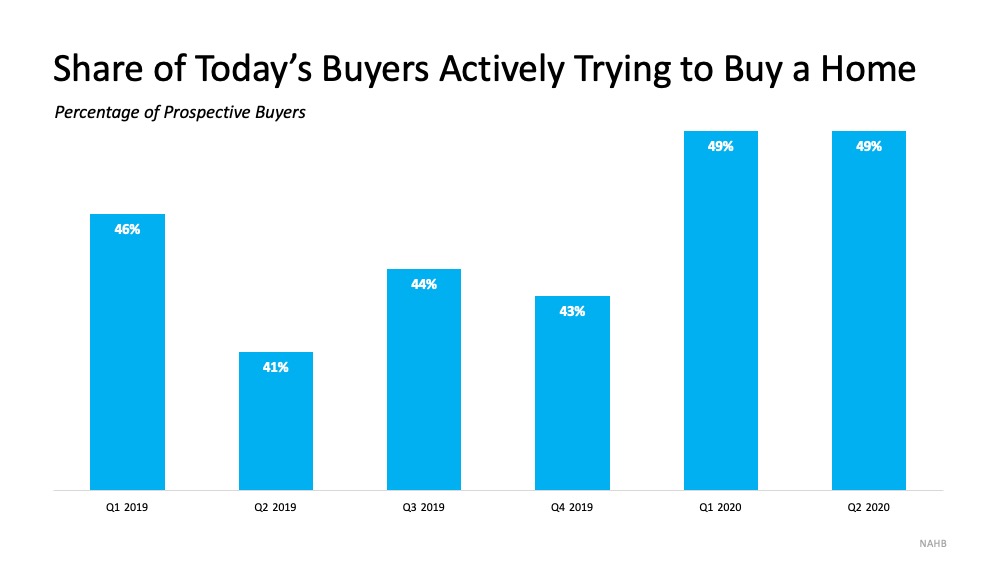 It’s no surprise that buyers are out in full force today. Many Americans now need more space to work from home, and the current low mortgage rates are providing an extra boost of motivation to enter the housing market.
If you’re considering selling your house, know that today’s buyers are serious about making a move. Your opportunity to sell your house in a market with high demand is growing, especially as more millennials enter the housing market too. The same report also notes:
“Of Millennials planning a home purchase in the next year, 57% are already actively searching for a home.”
Odeta Kushi, Deputy Chief Economist at First American, explains:
“When breaking down house-buying power by educational attainment for millennials in 2019, we find that the higher the education, the higher the household income, and the higher the house-buying power. In 2019, median house-buying power for millennials increased 16 percent relative to 2018.”
As demand for homes to buy grows and more millennials enter the market with growing buying power, the opportunity to sell your house grows too.
Bottom Line
Today’s buyers are serious ones and more millennials are helping to fuel that charge. So, if you’re considering selling your home, let’s connect you with one of our Real Estate Sales Associates today to determine your next steps in the process while buyers are actively looking.
How to Find the Perfect Real Estate Agent

There’s a ton of real estate information available in the news today and on the Internet. It can be extremely confusing, especially in times of uncertainty like we’re facing right now.
If you’re thinking of buying or selling this year, you need an agent who can help you:
- Make sense of this rapidly evolving housing market
- Navigate everything from virtual showings to new online marketing strategies
- Price your home correctly at the beginning of the selling process
- Determine what to offer on your dream home without paying too much or offending the seller
Dave Ramsey, a financial guru, advises:
“When getting help with money, whether it’s insurance, real estate or investments, you should always look for someone with the heart of a teacher, not the heart of a salesman.”
Hiring an agent who has a finger on the pulse of the current market will make your buying or selling experience so much easier.
So, how do you identify who truly understands what’s happening right now? How do you know who will take the time to simply and effectively explain what today’s market conditions mean to you and your family?
Check out the agent on social media. What are they posting on Instagram, Facebook, Twitter, and more? Are they using their social media platforms to share relevant, helpful information, or are they just posting memes and recipes? The best agents are committed to educating the consumer so they can feel confident when buying or selling a home.
Bottom Line
What agents are posting online will help you determine who meets the criteria Dave Ramsey suggested you look for: someone with the heart of a teacher. Let’s connect today, so you can work with a true trusted real estate professional. To find a realtor with Green Team click here.
For Sale By Owner – Do or Don’t?

Study: FSBOs Don’t Save Real Estate Commission
One of the main reasons why For Sale By Owners (FSBOs) don’t use a real estate agent is because they believe they will save the commission an agent charges for getting their house on the market and selling it. A new study by Collateral Analytics, however, reveals that FSBOs don’t actually save anything, and in some cases may be costing themselves more, by not listing with an agent.
In the study, they analyzed home sales in a variety of markets in 2016 and the first half of 2017. The data showed that:
“FSBOs tend to sell for lower prices than comparable home sales, and in many cases below the average differential represented by the prevailing commission rate.” (emphasis added)
Why would FSBOs net less money than if they used an agent?
The study makes several suggestions:
- “There could be systematic bias on the buyer side as well. FSBO sales might attract more strategic buyers than MLS sales, particularly buyers who rationalize lower-priced bids on with the logic that the seller is “saving” a traditional commission. Such buyers might specifically search for and target sellers who are not getting representational assistance from agents.” In other words, ‘bargain lookers’ might shop FSBOs more often.
- “Experienced agents are experts at ‘staging’ homes for sale” which could bring more money for the home.
- “Properties listed with a broker that is a member of the local MLS will be listed online with all other participating broker websites, marketing the home to a much larger buyer population. And those MLS properties generally offer compensation to agents who represent buyers, incentivizing them to show and sell the property and again potentially enlarging the buyer pool.” If more buyers see a home, the greater the chances are that there could be a bidding war for the property.
Three conclusions from the study:
- FSBOs achieve prices significantly lower than those from similar properties sold by Realtors using the MLS.
- The differential in selling prices for FSBOs when compared to MLS sales of similar properties is about 5.5%.
- The sales in 2017 suggest the average price was near 6% lower for FSBO sales of similar properties.
Bottom Line
If you are thinking of selling, FSBOing may end up costing you money instead of saving you money.